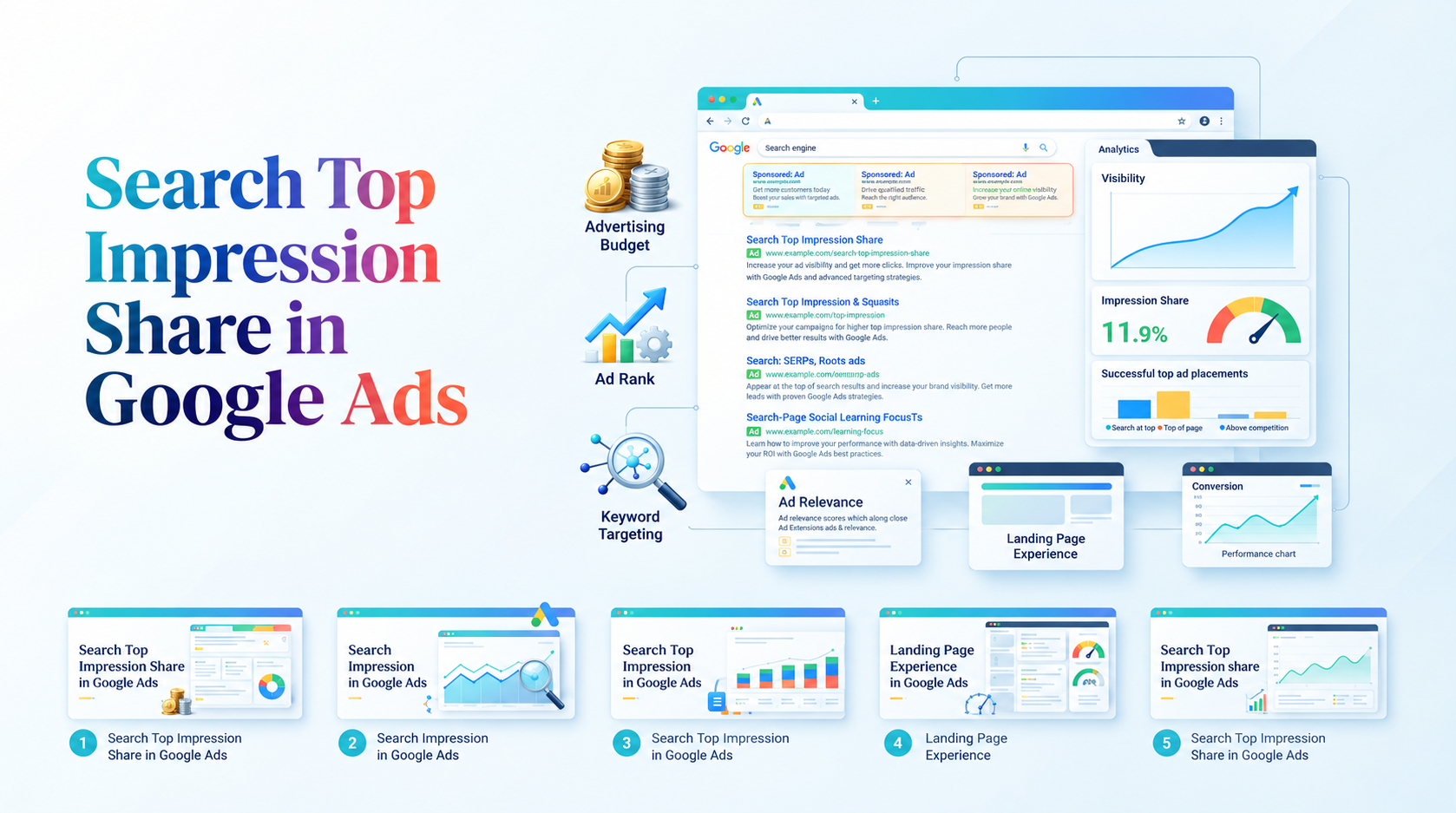
To improve Search Top Impression Share in Google Ads, first identify why your ads miss eligible top-of-page impressions. Check Search Lost Top Impression Share (Budget) and Search Lost Top Impression Share (Rank) to determine whether budget limitations or low Ad Rank are reducing visibility. Then improve ad relevance, refine keyword targeting, optimize landing pages, and adjust bids where appropriate. Increase budgets only for campaigns with profitable growth potential, and track conversions, conversion rate, and cost per conversion to measure results.
Search Top Impression Share in Google Ads is an important metric for understanding how often your ads appear among the top search ads compared with the estimated number of eligible top-ad impressions. A low share may mean your ads are missing valuable opportunities because of budget limits, low Ad Rank, or strong competition. However, a low percentage does not always indicate poor campaign performance.
To improve Search Top Impression Share, you need to identify what prevents your ads from appearing in top positions and fix the underlying issue. This involves reviewing your budget, bidding strategy, keyword targeting, ad relevance, and landing page experience. Furthermore, measuring clicks, conversions, and cost per conversion helps you determine whether better ad visibility delivers meaningful business results. In this guide, you will learn how to diagnose lost impression share, apply seven practical optimization strategies, and improve ad visibility without wasting your advertising budget.
Table of Contents
- What Is Search Top Impression Share in Google Ads?
- What Causes Low Search Top Impression Share?
- How to Check Search Top Impression Share in Google Ads
- How to Improve Search Top Impression Share: 7 Practical Strategies
- Increase Your Budget for High-Performing Campaigns
- Improve Google Ads Ad Rank
- Refine Keyword Targeting
- Improve Ad Copy and Relevance
- Optimize Landing Page Experience
- Adjust Your Bidding Strategy
- Improve Campaign Structure and Targeting
- How to Use Target Impression Share Bidding
- How to Diagnose and Fix Low Search Top Impression Share
- Common Mistakes to Avoid When Improving Search Top Impression Share
- Frequently Asked Questions
- What Is a Good Search Top Impression Share?
- How Is Search Top Impression Share Calculated?
- What Is the Difference Between Top and Absolute Top Impression Share?
- How Can I Increase Search Top Impression Share?
- Does a Higher Search Top Impression Share Improve Conversions?
- Should I Use Target Impression Share Bidding?
- What Causes Search Lost Top Impression Share?
- Improve Search Top Impression Share Without Wasting Ad Spend.
1. What Is Search Top Impression Share in Google Ads?
Search Top Impression Share in Google Ads measures the percentage of eligible top-of-page ad impressions your campaign received compared with the estimated number of top-of-page impressions it could have received.
It helps advertisers understand how often their Search ads appear above organic search results when they are eligible for top ad placements. A low Search Top Impression Share may indicate that the campaign is losing opportunities because of budget limitations, ad rank, or other auction factors.
Google Ads provides related metrics to help you investigate the cause. You can use them to decide whether to adjust your budget, improve Ad Rank, or refine your targeting.
Search Top Impression Share Explained
The formula is:
Search Top Impression Share = Top ad impressions received ÷ Estimated eligible top-ad impressions × 100
For example, suppose your ad receives 300 top impressions out of an estimated 600 eligible top impressions. Your search top impression share would be 50%.
This means your ad captured half of its estimated eligible top-ad opportunities during the selected reporting period.
A lower share does not always mean that your campaign is performing poorly. You may have deliberately limited your budget, targeted a narrow audience, or chosen a bidding strategy that prioritizes conversions over top placement.
Therefore, compare this metric with clicks, conversions, cost per conversion, and your campaign objectives before making changes.
Search Top Impression Share vs. Search Absolute Top Impression Share
These Google Ads metrics measure different levels of ad visibility.
| Metric | What it measures | When to use it |
| Search Top Impression Share | The share of eligible top-ad impressions your ad receives | To evaluate visibility among top ads |
| Search Absolute Top Impression Share | The share of eligible top-ad impressions your ad receives in the very first ad position | To evaluate first-position visibility |
| Search Top Impression Rate | The percentage of your ad impressions that appear among top ads | To understand how often served ads appear near the top |
| Search Absolute Top Impression Rate | The percentage of your ad impressions that appear in the first ad position | To understand how often served ads appear first |
The key difference is the denominator. Impression share compares received impressions with estimated eligible opportunities. Impression rate measures placement among impressions your ad actually received.
For example, a campaign can have a high Search Top Impression Rate but a low Search Top Impression Share. Its ads may appear near the top frequently when they show, yet miss many other eligible opportunities.
Why Search Top Impression Share Matters
Search Top Impression Share helps you understand how often your ads appear in prominent positions. It can also reveal opportunities to improve campaign delivery.
Here is why the metric matters:
- Understand ad visibility: Find out whether your ads frequently appear among top search ads.
- Identify missed opportunities: Discover whether budget limits or Ad Rank prevent your ads from appearing at the top.
- Improve bidding decisions: Use performance data to decide when a bid adjustment may help.
- Evaluate campaign efficiency: Compare visibility with clicks, leads, sales, and cost per conversion.
- Protect advertising spend: Avoid paying more for prominent positions when those positions do not improve business results.
However, a higher Search Top Impression Share does not guarantee more sales. Your results also depend on search intent, your offer, competition, and the landing page experience.
2. What Causes Low Search Top Impression Share?
Low Search Top Impression Share usually points to missed opportunities in the ad auction. The main causes include limited budget, low Ad Rank, weak relevance, and inefficient targeting.
Before changing your campaign, identify which factor is most likely responsible. This will help you avoid unnecessary spending.
Limited Campaign Budget
Google Ads uses your available budget to determine how often your campaign can participate in eligible auctions. When the budget is too low, your ads may miss opportunities to appear among top ads.
For example, a local repair company may receive valuable leads from its search campaign but run out of budget before the day ends. As a result, it may miss later searches from potential customers.
In this situation, check Search Lost Top Impression Share (Budget). A high value suggests that the budget is restricting top-ad visibility.
However, do not increase spending automatically. First, check whether the campaign generates qualified leads or profitable sales.
Low Ad Rank
Ad Rank helps determine whether your ad can appear and where it may appear in search results. It depends on several factors, including your bid, ad and landing page quality, auction competition, and the expected impact of ad assets and other formats.
A low Ad Rank can reduce your chances of appearing among top ads, even when your budget is sufficient.
To investigate this issue, review Search Lost Top Impression Share (Rank). Then assess your bids, ad relevance, landing page experience, and overall campaign setup.
Raising bids may help in some auctions. However, it does not guarantee a top position or a profitable result.
Weak Ad Relevance and Landing Page Experience
Your ads should match what people are searching for. A person searching for emergency plumbing services should see an ad that clearly addresses that need, rather than a general advertisement about home maintenance.
The landing page should continue the same message. It should explain the service, provide useful information, and make it easy to contact the business.
When your ad and landing page do not match the search intent, visitors may leave without taking action. Weak relevance can also affect ad quality and your ability to compete effectively.
Broad or Inefficient Keyword Targeting
Broad keyword targeting can bring useful traffic, but it can also attract searches that do not match your offer.
For instance, a company selling paid accounting software may attract people searching for free accounting templates. Those visitors may have little interest in purchasing the product.
Review your search terms report to identify irrelevant queries. Add suitable negative keywords and organize related keywords into focused ad groups.
As a result, your campaign can use its budget more effectively and focus on searches that are more likely to produce useful outcomes.
Strong Competition in Search Auctions
Your ad competes with other eligible ads whenever a relevant search occurs. Competitors may change their bids, improve their ads, or enter the same market.
Search demand can also change throughout the day, across locations, and between devices. Therefore, your Search Top Impression Share may rise or fall even when you have not changed your campaign.
Review performance over a meaningful period instead of reacting to a single day’s results. Compare similar dates and check whether changes in competition, budget, or search demand may explain the difference.
3. How to Check Search Top Impression Share in Google Ads
You can use Google Ads reporting columns to find your Search Top Impression Share and understand why your ads may be missing top placements.
To check Search Top Impression Share in Google Ads:
- Sign in to your Google Ads account.
- Open the relevant Search campaign or ad group.
- Go to the campaign reporting table.
- Select Columns and open the competitive metrics options.
- Add Search Top Impression Share, Search Absolute Top Impression Share, Search Lost Top Impression Share (Budget), and Search Lost Top Impression Share (Rank), where available.
- Compare these metrics across campaigns and review conversion performance before making changes.
Use Search Lost Top Impression Share (Budget) to investigate budget-related losses and Search Lost Top Impression Share (Rank) to investigate losses related to Ad Rank. Metric availability may vary by campaign type and reporting context.
You can also review impression share metrics at the ad group and keyword levels where they are available. This helps you find the campaigns or keywords that need attention.
For additional guidance on campaign setup, keyword selection, and bidding, read How Google Search Campaigns Work: The Ultimate Guide.
Review Search Lost Top Impression Share (Budget)
Search Lost Top Impression Share (Budget) estimates how often your ad missed eligible top placements because its budget was too low.
A high value indicates that budget constraints may be an important reason for lost visibility.
For example, a campaign that consistently generates qualified leads at an acceptable cost may benefit from a carefully planned budget increase. On the other hand, a campaign that spends heavily without generating useful leads may need targeting or conversion improvements first.
Use this metric alongside cost per conversion, conversion rate, and sales quality. This will help you decide whether additional spending is justified.
Review Search Lost Top Impression Share (Rank)
Search Lost Top Impression Share (Rank) estimates how often your ad missed eligible top placements because of Ad Rank.
When this metric is high, investigate your bidding strategy, ad relevance, landing page quality, and auction conditions.
Do not assume that the bid is always the problem. Better keyword targeting and more relevant ads may help your campaign compete more effectively. However, the appropriate fix depends on the auction and your campaign’s performance.
Compare Campaigns, Ad Groups, and Keywords
Comparing performance at different levels helps you identify where to focus your effort.
For example, one campaign may lose top impressions because of budget limits, while another may lose them because of Ad Rank. A specific ad group may also attract irrelevant searches that consume budget without generating leads.
Prioritize campaigns that have clear business value. Avoid making account-wide changes based on the results of a single campaign.
4. How to Improve Search Top Impression Share: 7 Practical Strategies
Once you identify the cause of low Search Top Impression Share, apply the strategy that matches the problem. The following steps can help you improve visibility while keeping costs under control.
1. Increase Your Budget Where It Matters
A budget increase may help when your campaign loses valuable top-ad opportunities because of limited spending capacity.
Start by reviewing Search Lost Top Impression Share (Budget). Then check whether the campaign generates conversions at an acceptable cost.
Use this process:
- Identify campaigns with meaningful budget-related losses.
- Review qualified leads, sales, and cost per conversion.
- Check whether additional spending could support your business goals.
- Increase the budget gradually where the evidence supports it.
- Monitor costs and conversions after the change.
For example, a service company may have two campaigns. One generates qualified leads at a sustainable cost, while the other attracts many clicks but few enquiries. Increasing the first campaign’s budget may make more sense than funding both equally.
The goal is not to spend more simply to increase visibility. It is to capture additional valuable opportunities.
2. Improve Ad Rank
Ad Rank plays an important role in determining whether your ads appear and where they appear. If your Search Lost Top Impression Share (Rank) is high, review the factors that influence your ability to compete.
Start with these actions:
- Check whether your bids are appropriate for your goals.
- Make ad copy more relevant to the search terms you target.
- Improve the usefulness and clarity of your landing pages.
- Add relevant ad assets where appropriate.
- Review campaign settings that may restrict eligible traffic.
Google does not use a single fixed formula that guarantees a particular position. Therefore, avoid assuming that a bid increase alone will solve the problem.
Instead, improve the overall quality and relevance of your campaign, then evaluate the results.
3. Improve Keyword and Search Term Relevance
Your keywords should reflect the searches that matter to your business. When targeting is too broad, your campaign may spend money on people who are unlikely to convert.
Review your search terms report regularly. Look for queries that are unrelated to your products, services, or customer needs.
Next, add negative keywords where appropriate. Group similar keywords and search intent into relevant ad groups. Also, check match types and adjust them based on the traffic you receive.
For example, a paid digital marketing agency may want to reach businesses looking for professional Google Ads management. Searches for free courses or jobs may not fit its sales goal.
Removing irrelevant traffic can free up budget for more valuable searches. It does not guarantee a higher impression share, but it can improve campaign efficiency.
4. Write More Relevant Search Ads
Your search ads should give people a clear reason to click. Match the headline to the user’s intent and explain what makes your offer useful.
Use these practices:
- Include relevant search terms naturally in headlines.
- Explain your service or product clearly.
- Highlight a genuine benefit or point of difference.
- Use a call to action that fits the next step.
- Add relevant sitelinks, callouts, or other suitable assets.
- Test different messages and review their performance.
For instance, an ad for emergency plumbing could highlight same-day service if the business genuinely offers it. A vague headline about quality services may not address the user’s immediate need.
Relevant ads can support better user experiences and help your campaign compete. However, no headline or asset guarantees a top position.
5. Optimize Landing Pages
Your landing page should match the promise made in your ad. Visitors should quickly understand what you offer and what to do next.
To improve your landing page:
- Match the page heading to the ad’s main message.
- Explain the service or product in clear language.
- Make contact details and calls to action easy to find.
- Improve page speed and mobile usability.
- Remove unnecessary form fields and confusing steps.
- Check that forms, phone links, and conversion tracking work correctly.
For example, someone who clicks an ad for a specific accounting service should reach a page about that service, not a generic homepage that requires more searching.
A relevant landing page can improve the visitor experience and support conversions. It can also contribute to landing page quality, which is one factor in Ad Rank.
For more tips on improving landing pages and tracking conversions, read 10 Tips For Preparing Your Website For Google Ads.
6. Refine Your Bidding Strategy
Your bidding strategy should match your campaign goal. A strategy designed to increase visibility may behave differently from one designed to generate conversions.
Review the strategy currently used by your campaign. Consider whether it supports your target outcomes, available conversion data, and budget.
If visibility is the main objective, Target Impression Share bidding may be appropriate. If your priority is sales or leads, a conversion-focused strategy may be a better fit.
Before changing your strategy:
- Review recent campaign performance.
- Confirm that conversion tracking works correctly.
- Set a realistic goal for your campaign.
- Check whether bid limits restrict delivery.
- Allow enough time and data to evaluate the change.
Do not switch bidding strategies solely because Search Top Impression Share is low. First, decide whether gaining more top impressions is likely to improve your business results.
7. Review Targeting and Campaign Structure
Your targeting settings determine which searches and users can trigger your ads. Unnecessary restrictions may limit your eligible opportunities.
Review locations, ad schedules, devices, keyword coverage, and campaign structure. Make changes only when the data supports them.
For example, a local service business may find that most qualified enquiries come from a specific service area. It can prioritize that area rather than spreading its budget too widely.
However, avoid narrowing targeting without a clear reason. Overly restrictive settings can reduce reach and prevent your ads from appearing for valuable searches.
Keep campaigns organized by meaningful goals, services, or locations. This makes performance easier to compare and budget decisions easier to explain.
5. How to Use Target Impression Share Bidding
Target Impression Share is an automated bidding strategy that aims to show ads at a selected location on Google Search, subject to campaign eligibility and the strategy’s settings. Search Top Impression Share is a reporting metric that measures the top impressions received against estimated eligible top impressions.
Although Target Impression Share bidding can help pursue a visibility goal, it does not guarantee a specific impression share or a profitable result. Monitor conversions, cost per conversion, and other business outcomes alongside impression share.
What Is the Target Impression Share Strategy?
With Target Impression Share bidding, you select the percentage of eligible impressions you want to target and the placement where you want your ads to appear.
Google then adjusts bids to work toward that goal, subject to auction conditions, eligibility, and your settings.
For example, a business may want its ads to appear among the top results for important branded searches. Target Impression Share can help support that visibility goal.
Still, a higher target can require more competitive bids and may increase costs. Choose a goal based on your campaign needs rather than aiming for 100% by default.
Choose the Right Placement Goal
Google Ads offers three placement options for this strategy.
| Placement goal | What it means | Suitable use |
| Top of results | Show among the top ads | Businesses seeking prominent visibility |
| Absolute top | Aim for the first ad position among top ads | Campaigns where first-position visibility is especially important |
| Anywhere on results | Show anywhere among eligible search results | Campaigns seeking broader visibility without requiring a top position |
The best option depends on your goal, competition, and budget. First-position visibility is not always worth the additional cost.
Set a Realistic Target and Maximum CPC Bid Limit
Your impression share target should reflect the opportunities that matter most. An aggressive target may require higher bids, especially in competitive auctions.
A maximum CPC bid limit caps the bids used by the strategy. If you set it too low, it may restrict the strategy’s ability to reach your target.
Start with a realistic target and review actual CPC, impression share, and conversions. Adjust the settings only after you understand how they affect performance.
When Should You Use Target Impression Share?
Target Impression Share may suit campaigns where visibility is the main goal, such as protecting brand visibility or promoting awareness for important search terms.
However, it may not be the best choice when your main goal is to maximize profitable leads or sales. In that case, a conversion-focused bidding strategy may better match your objective, provided you have reliable conversion tracking and suitable data.
Choose the strategy that supports the result you want, not just the metric that is easiest to increase.
6. A Practical Diagnostic Framework for Low Search Top Impression Share
A structured diagnosis helps you find the reason for low Search Top Impression Share before spending more. Use the following framework to connect each problem with an appropriate action.
Step 1: Check Lost Impression Share Due to Budget
Review Search Lost Top Impression Share (Budget). Determine whether your campaign misses valuable top-ad opportunities because it lacks budget.
Next, compare the campaign’s leads, sales, and cost per conversion. Increase the budget only when the likely value of additional traffic justifies the cost.
Step 2: Check Lost Impression Share Due to Rank
Review Search Lost Top Impression Share (Rank). If the value is high, assess bids, ad relevance, landing pages, keyword targeting, and auction competition.
Avoid treating a low Search Top Impression Share as proof that your bids are too low. The cause may be related to other factors.
Step 3: Review Conversion and Cost Data
Compare Search Top Impression Share with:
- Clicks and click-through rate (CTR).
- Average cost per click (CPC).
- Conversions and conversion rate.
- Cost per conversion.
- Revenue or return on ad spend (ROAS), where applicable.
These metrics help you understand whether additional visibility is likely to support your business goals.
Step 4: Apply the Right Fix
Use your findings to select a targeted action.
| Problem | What to check | Recommended action |
| High Search Lost Top Impression Share (Budget) | Campaign profitability and budget limits | Increase budget selectively when justified |
| High Search Lost Top Impression Share (Rank) | Bids, ad relevance, landing page quality, and competition | Improve Ad Rank and review bidding |
| Irrelevant search traffic | Search terms and keyword match types | Add suitable negative keywords and refine targeting |
| Low conversion rate | Landing page relevance, user experience, and conversion tracking | Improve the page and validate tracking |
| High CPC with weak results | Auction costs, keyword intent, and conversion value | Review bidding and focus on valuable traffic |
Step 5: Measure the Results
Record your starting performance before making changes. Then compare the results over a suitable period.
Track Search Top Impression Share, Search Lost Top Impression Share (Budget), Search Lost Top Impression Share (Rank), CPC, conversions, and cost per conversion.
Where possible, change one major factor at a time. This makes it easier to understand what helped. Also, account for changes in demand, competition, and seasonality when comparing periods.
Example: Improving Search Top Impression Share for a Service Business
Consider a fictional plumbing company that runs Google Search campaigns to generate service enquiries.
The company notices that its Search Top Impression Share is low. Rather than immediately raising bids, it reviews its campaign data.
Its initial audit finds three issues:
- The campaign loses some top-ad opportunities because of budget limits.
- Several search terms relate to plumbing jobs rather than plumbing services.
- The landing page does not clearly explain the company’s emergency service.
The company takes three steps. First, it adds relevant negative keywords to reduce unrelated traffic. Next, it improves the ad and landing page to focus on emergency plumbing services. Finally, it reviews the remaining budget-related losses and increases the budget only if the campaign can support additional qualified leads.
After the changes, the company compares impression share, clicks, qualified enquiries, and cost per lead against its starting results.
The outcome should be judged by the actual data. A higher impression share would show improved visibility, but the company should also check whether it gained more qualified leads at an acceptable cost. This example illustrates the process; it does not promise a specific performance increase.
7. Common Mistakes to Avoid
Improving Search Top Impression Share requires careful decisions. Avoid these common mistakes when optimizing Google Ads campaigns.
Increasing the budget without reviewing profitability.
Higher bids may help your ad compete in some auctions, but they can also raise costs. Check budget-related and rank-related losses before changing bids.
Raising bids without considering the cost per conversion.
More budget can create more opportunities, but it can also increase spending without improving sales. Prioritize campaigns with evidence of valuable results.
Focusing on impression share instead of conversions.
These metrics measure different placements. Use Search Top Impression Share to assess visibility among top ads and Search Absolute Top Impression Share to assess visibility in the first ad position.
Ignoring irrelevant search terms.
An ad that appears more often is not necessarily an ad that generates more business. Track qualified leads, sales, cost per conversion, and revenue where possible.
Treating a higher impression share as proof of better campaign performance.
A very high target can make bidding more expensive. Set a realistic target based on competition, budget, and the importance of the placement.
Ignoring Negative Keywords and Search Intent
Irrelevant search terms can consume budget and attract visitors who are unlikely to convert. Review search terms regularly and refine targeting.
Making Too Many Changes at Once
Changing bids, budgets, ads, and targeting together makes it difficult to identify the cause of a performance change. Test major adjustments in a controlled way where practical.
8. Frequently Asked Questions
What Is a Good Search Top Impression Share?
There is no universal ideal Search Top Impression Share for every campaign. The appropriate target depends on competition, campaign objectives, available budget, conversion performance, and profitability.
How Can I Increase Search Top Impression Share Quickly?
Start by checking Search Lost Top Impression Share (Budget) and Search Lost Top Impression Share (Rank). If budget is the main issue, consider a selective increase. If Ad Rank is the issue, review bids, ad relevance, landing pages, and targeting. Measure conversions and costs after making changes.
Should I Increase My Budget to Improve Search Top Impression Share?
Increase the budget only when budget limitations are restricting valuable traffic and the campaign supports your business goals. If losses are mainly related to Ad Rank, review the factors affecting rank before allocating more budget.
What Is the Difference Between Search Top and Absolute Top Impression Share?
Search Top Impression Share measures the share of eligible top-ad impressions your ad receives. Search Absolute Top Impression Share measures the share of eligible top-ad impressions your ad receives in the first ad position. The first measures visibility among top ads; the second focuses on first-position visibility.
Does Quality Score Affect Search Top Impression Share?
Quality Score is a diagnostic tool that estimates the quality of your ads and landing pages compared with other advertisers. Ad quality is one factor that can influence Ad Rank, which affects placement opportunities. However, Quality Score is not the sole factor in the ad auction, and improving its number alone does not guarantee a higher impression share.
Should I Use Target Impression Share Bidding?
Use Target Impression Share when prominent ad visibility is an important goal, such as for selected brand searches. When your priority is profitable sales or leads, consider whether a conversion-focused strategy is more suitable. Always account for your budget, competition, and actual campaign results.
How Do I Reduce Search Lost Top Impression Share Due to Budget?
Review the campaign’s budget-related losses alongside conversions, cost per conversion, and business value. Reduce wasted spend by refining keywords and excluding irrelevant searches. Then allocate more budget to campaigns that can use additional spending effectively. Increasing the budget alone is not always the best solution.
Conclusion: Improve Search Top Impression Share Without Wasting Ad Spend
Improving Search Top Impression Share in Google Ads starts with understanding why your ads miss top placements. Check budget-related losses and Ad Rank-related losses before making changes. Then refine keywords, improve ad relevance, optimize landing pages, and choose a bidding strategy that fits your campaign goals.
Most importantly, do not chase the highest possible impression share without considering cost and conversion quality. Compare visibility with clicks, qualified leads, sales, and cost per conversion. This approach helps you make better decisions, improve campaign efficiency, and invest in the search opportunities that matter most to your business.