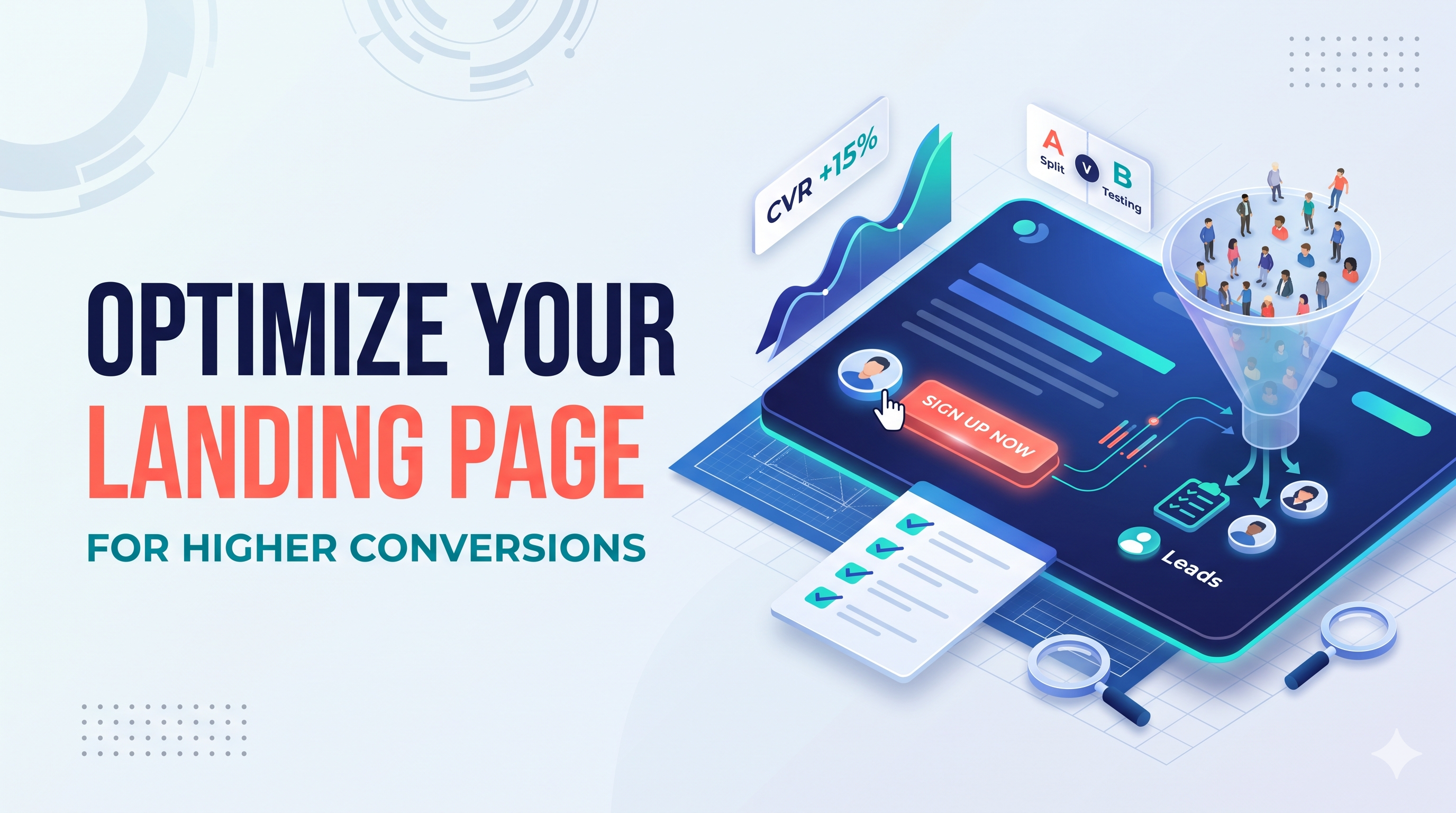
To improve landing page conversion rate, match the page content to visitor intent and the message that brought visitors there. Write a clear headline, communicate your value, use a strong call to action, simplify forms, add genuine trust signals, improve mobile speed, and test changes. Track completed leads and other meaningful conversions rather than clicks alone to identify which improvements deliver better results.
Your landing page may attract visitors but still fail to generate enough leads. People might click your ads, read your offer, and leave without filling out a form or contacting your business. As a result, you spend time and money bringing visitors to a page that does not deliver the results you expect.
Learning how to improve landing page conversion rate starts with understanding what stops visitors from taking action. A weak headline, unclear offer, slow loading speed, or complicated form can reduce conversions. Fortunately, small, focused changes can make your landing page more useful and encourage more visitors to become leads.
Table of Contents
1. Why Is Your Landing Page Not Converting?
2. 10 Ways to Improve Landing Page Conversion Rate
- 2.1 Match Your Landing Page to Visitor Intent
- 2.2 Write a Clear and Compelling Headline
- 2.3 Explain Your Value Proposition Clearly
- 2.4 Use One Clear Primary Call to Action
- 2.5 Simplify Your Landing Page Form
- 2.6 Add Genuine Trust Signals
- 2.7 Improve Landing Page Speed and Mobile Experience
- 2.8 Align Your Landing Page Copy With Your Offer
- 2.9 Run A/B Tests to Find What Works
- 2.10 Set Up Conversion Tracking and Improve Based on Data
3. How to Diagnose Landing Page Conversion Problems
- 3.1 A Step-by-Step Landing Page Audit
- Step 1: Check Traffic Quality
- Step 2: Review the First Screen
- Step 3: Test the Conversion Path
- Step 4: Review the Data
- Step 5: Prioritize the Main Issue
- Step 6: Test and Measure
4. Landing Page Conversion Optimization Checklist
5. Frequently Asked Questions
- 5.1 How Can I Improve My Landing Page Conversion Rate?
- 5.2 What Is a Good Landing Page Conversion Rate?
- 5.3 Why Is My Landing Page Getting Traffic but No Leads?
- 5.4 How Many CTAs Should a Landing Page Have?
- 5.5 Does Landing Page Speed Affect Conversions?
- 5.6 How Do I Measure Landing Page Conversion Rate?
Why Is Your Landing Page Not Converting?
A landing page may fail to convert when visitors cannot quickly understand the offer, see its value, trust the business, or complete the next step. Other problems include irrelevant traffic, slow loading speed, weak calls to action, and forms that ask for too much information.
For example, imagine a digital marketing agency runs an ad offering a free website audit. However, the landing page opens with a general description of all its services and hides the audit form near the bottom. Visitors may leave because the page does not immediately deliver what the ad promised.
In this case, the problem is not necessarily the ad itself. The landing page creates a gap between the visitor’s expectation and the experience after the click.
Therefore, review the entire journey before changing the design. Check where visitors arrive, what they see first, what action they need to take, and what might stop them from completing it.
10 Ways to Improve Landing Page Conversion Rate
1. Match Your Landing Page to Visitor Intent
Visitors arrive with different needs. Some want to compare services, while others are ready to request a quote or sign up. Your landing page should match the reason they clicked.
This is especially important when you use paid advertising. A visitor who clicks an ad for a specific service should land on a page that explains that service, not a generic homepage with several unrelated offers.
How to improve it:
- Match the headline to the message in your ad or campaign.
- Use the same offer, product, or service that attracted the visitor.
- Keep the page focused on one main audience and goal.
- Remove information that does not support the visitor’s decision.
- Make the next step clear from the beginning.
For example, if a Google Ads campaign promotes website design for small businesses, the landing page should explain the website design service, its benefits, and how to request a quote. Sending visitors to a general services page forces them to search for the information themselves.
Similarly, an email campaign promoting a free consultation should lead to a page where visitors can learn about and book that consultation.
Why it works: A clear connection between the original message and the landing page reduces confusion. It also helps visitors decide whether the offer meets their needs. Google’s landing page guidance emphasizes relevance, useful content, and easy navigation for people who click ads.
2. Write a Clear and Compelling Headline
Your headline is one of the first things visitors notice. It should explain what you offer and why it matters. If the message is vague, people may struggle to understand whether they are in the right place.
A headline such as “Transform Your Business Today” sounds positive but does not explain what the company actually provides. A specific headline gives visitors a stronger reason to continue.
How to improve it:
- State the main benefit in simple language.
- Include the product or service when it helps clarify the offer.
- Keep the headline easy to scan.
- Support the headline with a short subheading.
- Avoid exaggerated promises that you cannot prove.
For example:
Weak headline: Take Your Business to the Next Level
Stronger headline: Get a Website Designed to Generate More Qualified Leads
The second headline tells visitors what the service is intended to help them achieve. A supporting sentence could explain the process, target audience, or key benefit.
Furthermore, make sure the headline reflects the actual offer on the page. A catchy headline may attract attention, but a misleading one can reduce trust and lead to poor-quality enquiries.
3. Explain Your Value Proposition Clearly
A value proposition tells visitors why your offer is useful and why they should consider it. It should explain the main benefit without making people read several paragraphs to understand what they will receive.
Visitors often compare multiple businesses before making a decision. Therefore, your landing page should help them understand what makes your offer relevant to their needs.
How to improve it:
- Explain the problem your product or service solves.
- Describe the main benefit to the customer.
- Highlight meaningful differences from other options.
- Use specific details instead of broad claims.
- Address the questions that matter before someone takes action.
For example, a software company could write, “Manage customer enquiries, organize sales follow-ups, and view your team’s progress from one dashboard.” This is more useful than saying, “We offer an innovative business solution.”
In addition, support your value proposition with short benefit statements or a simple list of features. Keep the focus on what the visitor gains rather than listing every feature your business offers.
4. Use One Clear Primary Call to Action
A call to action (CTA) tells visitors what to do next. It might invite them to request a quote, book a consultation, download a guide, or start a trial.
When a landing page contains several competing buttons, visitors may not know which action matters most. A clear primary CTA makes the next step easier to understand.
How to improve it:
- Choose one main conversion goal for the page.
- Use action-oriented button text.
- Place the primary CTA where visitors can find it easily.
- Make the button visually distinct from surrounding content.
- Repeat the CTA lower on a long page when appropriate.
- Ensure the button works on desktop and mobile.
For example, a business seeking qualified leads could use “Request a Free Consultation” instead of the vague phrase “Submit.” The more specific wording explains what happens when the visitor clicks.
However, the CTA must match the actual next step. Do not promise a free consultation if the form only requests a general sales callback.
You can test different CTA messages, placements, and designs to see which version produces more completed actions. Change one major element at a time when possible so you can better understand the result.
5. Simplify Your Landing Page Form
A form is often the final step between a visitor and a new lead. Unfortunately, a long or confusing form can discourage people from completing it.
Every extra field should serve a clear purpose. Requesting information that your team does not need at this stage may add friction without improving lead quality.
How to improve it:
- Ask only for essential information.
- Use clear labels and simple instructions.
- Explain why you need sensitive or less familiar details.
- Mark required fields clearly.
- Show helpful error messages.
- Confirm when the form has been submitted successfully.
- Test the full process on mobile devices.
For example, a consultation request may only need a name, work email, and a short description of the project. A detailed qualification form may be useful for a high-value service, but it should ask questions that help your team assess the inquiry.
There is no universal ideal number of form fields. The right length depends on the offer, the value of the conversion, and the information your team needs.
As a result, compare form completion rates and lead quality before removing fields. A shorter form may generate more submissions, but those leads still need to be relevant to your business.
6. Add Genuine Trust Signals
Visitors may hesitate to share their details when they are unfamiliar with your business. Trust signals can help answer their concerns and give them reasons to feel more confident.
Useful signals include real customer testimonials, relevant case studies, clear contact information, transparent policies, and accurate company details.
How to improve it:
- Add genuine testimonials with permission.
- Show relevant case studies or examples of completed work.
- Include accurate contact information.
- Explain what happens after a visitor submits a form.
- Display relevant certifications or partnerships only when they are genuine.
- Make privacy information easy to find.
For example, a website development agency could feature a case study explaining the client’s original challenge, the work completed, and the outcome. Specific evidence is often more useful than a vague claim such as “We are the best agency.”
Likewise, a short note beside the form explaining how the team will use the submitted information may help visitors feel more comfortable.
Avoid fake reviews, unsupported statistics, and invented client logos. These tactics can damage trust instead of improving conversions.
7. Improve Landing Page Speed and Mobile Experience
Visitors expect a landing page to load quickly and work well on their devices. Slow pages, shifting layouts, tiny text, and difficult buttons can make it harder to understand an offer or complete a form.
Mobile usability is especially important when your campaigns receive traffic from phones. A page that looks good on a desktop may still be frustrating on a smaller screen.
How to improve it:
- Compress large images.
- Remove unnecessary scripts and plugins.
- Use readable text and sufficient spacing.
- Make buttons easy to tap.
- Keep forms simple on mobile devices.
- Avoid pop-ups that block important content.
- Test page performance and Core Web Vitals.
For technical checks, use a website speed testing tool to review loading performance, responsiveness, and layout stability. Core Web Vitals include Largest Contentful Paint (LCP), Interaction to Next Paint (INP), and Cumulative Layout Shift (CLS).
For example, a visitor may click an ad while using a phone. If the page takes too long to display the offer or the form is difficult to complete, that visitor may leave before becoming a lead.
Therefore, test the landing page on real mobile devices as well as desktop screens. Prioritize the issues that prevent visitors from seeing the offer or taking action.
8. Align Your Landing Page Copy With Your Offer
Your landing page copy should answer the questions visitors need to resolve before they convert. These may include what the offer includes, who it is for, how it works, how much it costs, and what happens next.
If the page leaves these questions unanswered, visitors may hesitate or contact your team for basic information that should already be available.
How to improve it:
- Explain the offer in the opening section.
- Use short paragraphs and descriptive subheadings.
- Highlight the most important benefits.
- Address common concerns and objections.
- Include relevant details about pricing or the quote process.
- Avoid unnecessary jargon and repeated claims.
For example, a landing page promoting an SEO audit could explain which areas the audit covers, what the customer receives, and how the findings can be used. This gives visitors a clearer picture of the service before they submit their details.
Furthermore, remove content that distracts from the main conversion goal. A landing page does not need to include every company update or service description. It needs enough information to help the right visitor make an informed decision.
9. Run A/B Tests to Find What Works
A/B testing compares two versions of a landing page or one of its elements. It can help you understand whether a particular change improves conversions.
Instead of relying only on personal preference, use actual visitor behavior to evaluate your ideas.
How to improve it:
- Start with a specific problem or hypothesis.
- Choose one important element to test.
- Define the main conversion metric before the test begins.
- Send comparable traffic to each version.
- Run the test long enough to collect useful data.
- Review lead quality as well as conversion rate.
For example, you might test a headline that focuses on saving time against one that focuses on generating more leads. Keep the rest of the page as consistent as possible so the comparison is meaningful.
You can also test CTA wording, form length, trust signals, or the placement of key information.
However, do not declare a winner after only a few conversions. Small samples can produce misleading results. Consider traffic volume, differences between visitor groups, and whether the observed improvement is large and reliable enough to act on.
Once you have a useful result, apply the winning version and identify the next improvement to test.
10. Set Up Conversion Tracking and Improve Based on Data
You cannot reliably improve landing page performance if you do not know what happens after visitors arrive. Conversion tracking helps you measure important actions, such as completed forms, consultation bookings, purchases, or qualified inquiries.
Clicks and page views show activity, but they do not necessarily show whether your landing page is generating business results.
How to improve it:
- Define the main conversion action for each landing page.
- Track successful form submissions rather than button clicks alone.
- Check that conversion events fire correctly.
- Use analytics to compare landing pages and traffic sources.
- Review lead quality and sales outcomes when available.
- Record major changes so you can compare performance over time.
For example, a landing page might receive 1,000 visits and generate 30 completed forms. Its conversion rate is 3%.
If a later version generates 40 completed forms from 1,000 comparable visits, its conversion rate is 4%. That is an increase of one percentage point, or about 33.3% relative to the original rate.
However, the second version is only a better business result if the extra inquiries are relevant and the tracking is accurate. A page that generates many low-quality leads may be less valuable than one that generates fewer but more qualified inquiries.
Use your analytics platform and advertising reports to check the full path from click to completed action. This helps you decide which landing page changes deserve further testing.
How to Diagnose Landing Page Conversion Problems
When landing page conversions are low, avoid changing every element at once. First, identify where visitors struggle. Then use evidence to choose the most useful improvement.
The table below provides a practical diagnostic framework.
| Warning sign | Possible cause | What to check | Recommended action |
| Many clicks but few page visits | Slow loading or tracking problems | Page load time, landing page errors, analytics | Test the destination and verify tracking |
| Many visits but few form starts | Weak headline or unclear offer | Above-the-fold content, offer, CTA | Clarify the value and make the next step visible |
| Many form starts but few completions | Long form or usability issue | Required fields, errors, mobile experience | Remove unnecessary friction and test the form |
| Many leads but poor lead quality | Broad targeting or unclear qualification | Traffic sources, form questions, lead outcomes | Improve targeting and explain who the offer suits |
| Strong desktop results but weak mobile results | Mobile design or performance issues | Mobile speed, button size, form usability | Fix the mobile experience first |
| Visitors click the CTA but do not convert | Broken flow or unclear next step | Button destination, form errors, confirmation page | Test the complete conversion journey |
| Conversion rate falls after a redesign | Unintended changes or technical errors | Before-and-after data, forms, page layout | Identify the change and fix the most likely cause |
A step-by-step landing page audit
Step 1: Check traffic quality. Review where visitors come from and whether the message that attracted them matches the landing page. Different audiences may have different needs.
Step 2: Review the first screen. Confirm that the headline, offer, and primary CTA are easy to find. Visitors should understand the page without having to search through unrelated content.
Step 3: Test the conversion path. Complete the form or purchase process on desktop and mobile. Check buttons, validation messages, confirmation pages, and any follow-up steps.
Step 4: Review the data. Compare visits, CTA interactions, form starts, completed submissions, and qualified leads. Use these figures to identify the stage where the biggest drop occurs.
Step 5: Prioritize the main issue. Fix broken functionality, misleading copy, or serious usability problems before spending time on small design changes.
Step 6: Test and measure. Make a focused change, compare the results with a suitable baseline, and check whether lead quality improves. Continue testing based on what the data shows.
This process helps you improve landing page conversion rate without relying on guesswork or redesigning the entire page.
Landing Page Conversion Optimization Checklist
Before publishing or updating a landing page, use this checklist:
- The headline clearly explains the offer.
- The page matches the visitor’s intent and traffic source.
- The main value proposition is easy to understand.
- One primary CTA stands out.
- The form requests only necessary information.
- Trust signals are genuine and relevant.
- The page loads well on desktop and mobile.
- The copy answers common questions and objections.
- The full conversion journey works correctly.
- Conversion tracking records successful actions.
- Lead quality is reviewed alongside conversion rate.
- A testing plan identifies what to improve next.
Start with the problems most likely to stop visitors from converting. Then use data and testing to guide further improvements.
Frequently Asked Questions
1. How can I improve my landing page conversion rate?
Start by matching the page to visitor intent, writing a clear headline, explaining the value of your offer, and using a strong call to action. Next, simplify forms, add genuine trust signals, improve mobile performance, and track completed conversions. Test changes to learn which improvements work best for your audience.
2. What is a good landing page conversion rate?
There is no single conversion rate that is ideal for every landing page. Results depend on the industry, offer, traffic source, audience, and conversion goal. Compare your page with its past performance and relevant industry data, while also checking lead quality and business outcomes.
3. Why is my landing page getting traffic but no leads?
Your landing page may not clearly explain the offer, match the visitor’s expectations, or provide a convincing reason to act. Other causes include slow loading, poor mobile usability, weak CTAs, complicated forms, and irrelevant traffic. Review the full journey to identify where visitors leave.
4. How many CTAs should a landing page have?
A landing page should usually have one primary conversion goal. You can repeat the same CTA in several places on a long page, but avoid presenting multiple competing actions that distract visitors from the main offer.
5. Does landing page speed affect conversions?
Page speed can affect how easily visitors access your content and complete an action. Slow pages and frustrating mobile experiences can create barriers. Test important pages, fix major performance issues, and compare conversion results after making changes.
6. How do I measure landing page conversion rate?
Divide the number of conversions by the number of visits or visitors used in your chosen measurement method, then multiply by 100. For example, 40 conversions from 1,000 visits equals a 4% conversion rate. Keep the measurement method consistent when comparing results.
Turn More Landing Page Visitors Into Leads
Improving landing page conversion rate requires more than changing button colors or adding new design elements. You need to understand what visitors expect, communicate the value of your offer, remove barriers, and make the next step clear.
Start with the headline, value proposition, CTA, form, and mobile experience. Then check conversion tracking and use a diagnostic framework to identify the biggest problem. By testing focused changes and reviewing lead quality, you can make better decisions and improve the chances of turning more visitors into valuable leads.