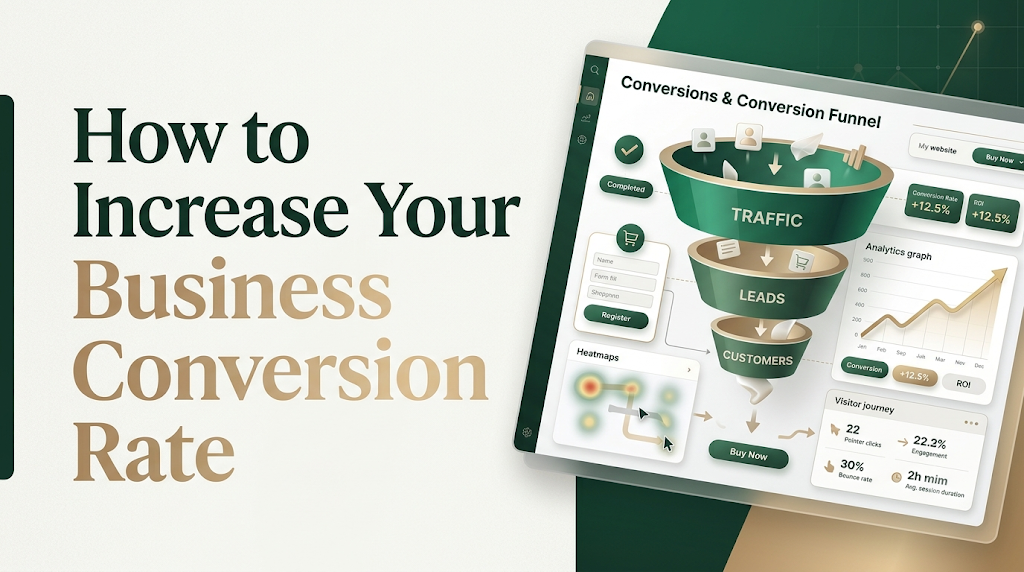
To increase your business conversion rate, make your website easier to use, create clear calls to action, improve landing pages, understand customer behavior, and simplify the conversion process. Track important actions such as purchases, form submissions, and enquiries. Then, use the results to test improvements and remove barriers that stop visitors from taking action. Learn how to calculate and optimize your conversion rate to make better decisions about your website and marketing performance.
Getting visitors to your website is only the first step toward business growth. The real challenge is turning those visitors into paying customers, qualified leads, subscribers, or enquiries. Even a website with strong traffic may struggle to generate results when visitors cannot find what they need or do not understand what to do next. That is why learning how to increase your business conversion rate is important for long-term growth. A clear website design and development strategy and digital marketing strategy help connect your marketing efforts with the actions that matter to your business.
A low conversion rate does not always mean that your product or service is unattractive. Visitors may leave because your pages load slowly, your offer is unclear, your forms ask for too much information, or your website does not build enough trust. Therefore, businesses should look beyond traffic numbers and study the complete customer journey. A focused conversion rate optimization (CRO) strategy can help identify these problems and turn more website visits into meaningful results. You can also explore website problems that cost businesses sales to identify common conversion barriers.
In this guide, you will learn five practical strategies to improve website conversion rates, generate more qualified leads, and increase sales. You will also find examples, measurement tips, and a campaign diagnostic framework to help you decide what to fix first.
What Is a Business Conversion Rate?
A business conversion rate is the percentage of visitors or potential customers who complete a desired action. This action depends on your business goals. For an online store, it may be a completed purchase. For a service company, it may be a contact form submission, phone call, consultation booking, or quote request. Understanding these actions helps businesses measure the performance of their online marketing campaigns, website development, and digital services.
The basic conversion rate formula is:
Conversion Rate = (Number of Conversions ÷ Total Visitors) × 100
For example, suppose your website receives 2,000 visitors in one month and 80 of them submit an enquiry form. Your conversion rate is:
(80 ÷ 2,000) × 100 = 4%
This means that 4% of your website visitors completed the selected action. You can use the same calculation for purchases, registrations, downloads, or other goals. However, keep the measurement method consistent when comparing results. For a deeper explanation, read this guide on how to calculate and optimize conversion rate.
Why Is Conversion Rate Optimization Important?
Conversion rate optimization (CRO), also known as CRO, is the process of improving a website or marketing journey so that more visitors complete a desired action. Instead of focusing only on attracting more traffic, CRO helps businesses get more value from the visitors they already have. It also supports better decisions across website development, digital marketing, and business growth.
Here are some important reasons to improve your business conversion rate:
- Generate more leads: A clear website journey can encourage more visitors to submit enquiries, request quotes, or book consultations. Explore lead generation and digital marketing solutions to understand how businesses can attract and convert potential customers.
- Increase sales opportunities: Better product information and a simpler buying process can help more interested visitors complete purchases. Learn about website problems that cost businesses sales and how to address them.
- Make better use of marketing budgets: More conversions from existing traffic can improve the value of your SEO, Google Ads campaigns, and social media efforts.
- Improve customer experience: Clear navigation, helpful content, and simple forms make it easier for visitors to find what they need. Follow these best practices for small business websites.
- Understand customer behavior: Conversion data can show where visitors lose interest and which website elements need attention. Learn how to use website analytics to understand visitor behavior.
For example, a business that receives 5,000 monthly visitors may not need more traffic as its first solution. It may need a better landing page, a clearer offer, or a shorter enquiry form. Reviewing landing page conversion improvements can help identify opportunities before increasing advertising spend.
5 Powerful Strategies to Increase Your Business Conversion Rate
Improving conversions requires more than changing a button color or adding promotional messages. You need to understand what visitors expect, remove unnecessary barriers, and guide them toward a useful next step. Start with these five strategies and measure their impact over time. You can also explore practical ways to improve website performance and sales.
1. Improve Website User Experience
Your website creates an important first impression. Visitors should be able to understand your offer, find useful information, and move between pages without confusion. A cluttered layout, broken links, confusing navigation, or slow-loading pages can make people leave before they convert. A well-structured business website gives visitors a clearer path toward taking action.
Focus on these website improvements:
- Create simple navigation: Use clear menu labels and organize pages into logical sections. Follow these small business website design best practices.
- Improve page speed: Compress large images, reduce unnecessary scripts, and review website loading performance.
- Use responsive design: Make sure buttons, text, images, and forms work well on mobile devices. Learn more about mobile SEO and mobile-first indexing.
- Make information easy to scan: Use descriptive headings, short paragraphs, and clear product or service details.
- Remove distractions: Avoid unnecessary pop-ups, competing messages, and elements that interrupt the visitor’s journey.
For example, imagine a visitor wants to request a service quote. They arrive on your website but cannot find the service details or contact button. They may leave and choose another business. A clear service page with visible contact options can make the next step easier. You can also review best practices for small business websites to identify ways to improve the visitor experience.
2. Create Clear and Compelling Calls to Action
A call to action (CTA) tells visitors what to do next. It may encourage them to buy a product, request a quote, book a consultation, download a guide, or contact your team. When a CTA is vague or difficult to find, visitors may not know how to continue. Strong landing page design and content can make these actions easier to understand.
Use these practices to improve your calls to action:
- Choose action-focused words: Use phrases such as “Get a Quote,” “Book a Consultation,” “Start Now,” or “Shop Now.”
- Explain the benefit: Tell visitors what they will receive after clicking the button.
- Make buttons easy to notice: Use sufficient contrast and place the CTA near relevant information.
- Keep the message specific: Match the CTA to the page goal instead of using generic phrases everywhere.
- Avoid too many competing actions: Give each page one main conversion goal and use secondary links only when needed.
Consider a software company offering a free product consultation. A button that says “Learn More” may not explain the next step. Changing it to “Book a Free Consultation” makes the action more specific. However, the page must also explain what the consultation includes. This approach supports a stronger landing page conversion strategy and follows the CTA best practices for business websites.
3. Optimize Your Landing Pages
A landing page should match the visitor’s intent and make the value of your offer clear. When someone clicks an advertisement, search result, or promotional link, the destination page should provide the information they expect. A mismatch between the message and the page can reduce trust and lead to lost opportunities. Follow relevant website landing page best practices to create a more focused experience.
Use these landing page optimization techniques:
- Write a benefit-focused headline: Explain what the visitor can gain from your product, service, or offer.
- Present your value proposition: Show why your solution is useful and how it addresses a customer problem.
- Use relevant visuals: Add product images, service illustrations, or screenshots that support the page message.
- Include trust signals: Display genuine testimonials, reviews, certifications, or case studies where appropriate.
- Simplify the lead form: Ask only for information you need at that stage of the customer journey.
- Match ads with landing page content: Keep the offer, headline, and message consistent across the campaign. Review Google Ads optimization practices to improve campaign and landing page alignment.
For example, a digital marketing agency running an advertisement for SEO services should send visitors to a page that explains its SEO services. Sending them to a general homepage may force them to search for the information themselves. A focused page with service details, proof of experience, and a clear enquiry form creates a more direct journey. You can explore more ideas in this guide to improving landing page conversion rates.
4. Use Customer Feedback and Behavior Analysis
Website analytics can show what visitors do, but customer feedback can help explain why they do it. For example, analytics may reveal that visitors leave a pricing page without submitting an enquiry. A short survey, customer interview, or support conversation may show that the pricing details are unclear. Combining these insights helps businesses make more informed customer engagement decisions and better understand their target audience.
Use a mix of research methods to understand visitor behavior:
- Heatmaps: See where visitors click, move, or scroll on a page, depending on the tool and tracking setup.
- Session recordings: Review sample user sessions to identify confusing interactions or navigation problems.
- Customer surveys: Ask visitors what information they could not find or what stopped them from taking action.
- Live chat and support queries: Review common questions to find gaps in your website content.
- Form analytics: Check where users abandon forms or encounter validation errors.
For example, a service business may notice that many visitors start its enquiry form but do not submit it. A review may reveal that the form asks for unnecessary details or contains unclear field labels. Removing optional questions and explaining required fields may reduce friction. These findings can also inform your wider customer engagement and digital marketing strategy.
5. Simplify the Conversion Process and Build Trust
Even interested visitors may abandon a purchase or enquiry when the final steps feel difficult. Long forms, unexpected costs, unclear policies, limited payment options, and missing contact information can create hesitation. Therefore, make the conversion process as clear and direct as possible. A strong website landing page experience should answer important questions before asking visitors to take action.
Try these improvements:
- Reduce unnecessary form fields: Ask only for details required to respond to the enquiry or complete the purchase.
- Explain the next step: Tell visitors what happens after they submit a form or place an order.
- Display clear pricing: Show relevant costs, fees, and conditions before the final step.
- Provide visible contact details: Make it easy to find your business email, phone number, or support options.
- Use genuine trust signals: Add authentic reviews, customer stories, secure payment information, and clear policies.
- Offer helpful support: Give visitors a way to ask questions when they need more information.
For an e-commerce business, an unexpected delivery charge at checkout may cause a customer to abandon the order. Showing delivery costs earlier can help set the right expectations. Review your own checkout or enquiry journey and focus on the barriers your customers actually face. You can also examine website problems that cost businesses sales to identify potential issues.
Campaign Diagnostic Framework: Find Out Why Your Conversions Are Low
A low conversion rate is a symptom, not a complete diagnosis. Before redesigning your website or increasing your advertising budget, identify where visitors are dropping out. Use the following framework to connect campaign data with possible website problems. This is especially useful when reviewing landing page performance and paid campaign results.
| What you notice | Possible problem | What to check |
| High ad clicks but few conversions | Ad and landing page message do not match | Compare the ad promise with the landing page headline and offer |
| High landing page visits but few CTA clicks | Unclear value or weak CTA | Review the headline, offer, button wording, and placement |
| Many CTA clicks but few form submissions | Form friction or technical issues | Test required fields, validation, mobile layout, and form errors |
| Many carts but few purchases | Checkout friction or unexpected costs | Review shipping fees, payment options, and checkout steps |
| Good traffic but poor lead quality | Targeting or offer mismatch | Review search terms, audience intent, and lead qualification |
| Conversions fall after a website update | A technical or design change may have caused a problem | Test forms, links, tracking, page speed, and mobile usability |
A Simple Process to Diagnose and Fix Conversion Problems
Step 1: Identify the weak stage. Review the journey from ad impression or search visit to landing page, CTA click, form submission, and final sale. Find the stage where the largest drop occurs.
Step 2: Check the visitor experience. Open the page on desktop and mobile. Test the main buttons, forms, links, and checkout steps. Look for errors or confusing content. Review mobile website optimization practices to identify device-related issues.
Step 3: Review the data. Compare conversion rates by landing page, traffic source, device, and campaign. Use a consistent date range and measurement method. You can also follow Google Ads conversion tracking and optimization guidance.
Step 4: Make one focused change. For example, simplify a form or rewrite a headline. Avoid changing several major elements at once because it becomes harder to understand what affected the result.
Step 5: Measure the outcome. Compare the results with the original performance. Keep changes that improve meaningful conversions without reducing lead or customer quality. Learn more about calculating and optimizing conversion rates.
This process helps you make decisions based on evidence instead of assumptions. For additional guidance, explore Google Ads optimization practices and review how your landing pages support the campaign promise.
How to Measure and Track Your Business Conversion Rate
You cannot improve what you do not measure. Conversion tracking helps you understand which pages, campaigns, and customer journeys produce valuable actions. Start by defining what counts as a conversion for your business. For example, an online store may track completed purchases, while a service company may track qualified enquiries and consultation bookings. A clear conversion rate measurement process makes performance easier to evaluate.
Use these metrics to understand your results:
- Conversion rate: The percentage of visitors or sessions that complete your selected action.
- Lead generation rate: The percentage of visitors who submit a lead form or make an enquiry.
- Cost per conversion: The amount spent to generate one measured conversion.
- Bounce and engagement data: Signals that can help you investigate whether visitors find the page useful. Interpret them in the context of the page and business goal.
- Cart abandonment rate: The percentage of shopping carts that do not result in a completed purchase.
- Revenue per visitor: The revenue generated divided by the number of visitors, using a consistent reporting method.
Analytics tools can help businesses measure important user actions through events and key events. For example, a completed lead form can be recorded as a key event, helping you understand which traffic sources and journeys contribute to enquiries. You can also use website analytics to understand visitor behavior and identify which pages generate meaningful interactions.
For paid campaigns, conversion tracking can also help connect advertising activity with business outcomes. Make sure the tracking setup records the action you actually value, such as a completed purchase or qualified lead, rather than counting every button click as a successful conversion. You can learn more about Google Ads optimization and conversion tracking and use the data to review campaign performance.
Common Conversion Rate Optimization Mistakes to Avoid
Businesses sometimes make website changes without understanding what is stopping visitors from converting. This can waste time and make performance harder to evaluate. Avoid these common mistakes when improving your website conversion strategy.
- Focusing only on traffic: More visitors do not always mean more sales. Review traffic quality and conversion performance together. Read why more website traffic does not always mean more customers.
- Using vague CTAs: Generic buttons may not tell visitors what will happen next. Use clear, action-focused language and follow website CTA best practices.
- Ignoring mobile visitors: Test your forms, menus, and buttons on smaller screens as well as desktops. Review mobile SEO and mobile-first indexing.
- Making forms too long: Unnecessary questions can discourage visitors from completing an enquiry.
- Changing too many elements at once: Test focused changes so you can understand what influenced the outcome.
- Ignoring customer feedback: Analytics show patterns, while customer comments can explain the reasons behind them. Understand your target audience and customer behavior.
- Tracking the wrong actions: Measure completed purchases and qualified leads instead of relying only on clicks or page views. Follow Google Ads conversion tracking practices.
A better approach is to review your website regularly, identify one important problem, and test a practical improvement. This keeps your digital marketing strategy focused on measurable business goals.
Frequently Asked Questions About Increasing Business Conversion Rate
1. What is a good business conversion rate?
There is no single conversion rate that is good for every business. Results vary by industry, offer, traffic source, device, and conversion goal. Compare your performance with your own historical data and relevant industry benchmarks. Then focus on improving the quality and consistency of your conversions. Learn how to calculate and optimize your business conversion rate.
2. How can I increase my website conversion rate quickly?
Start by fixing obvious barriers. Make your main offer clear, improve the visibility of your CTA, test your enquiry forms, and check that your website works well on mobile devices. These changes can address common usability problems, although results depend on your audience and website. Explore ways to improve landing page conversion rates for additional ideas.
3. Does website design affect conversion rates?
Yes. Website design can influence how easily visitors understand your offer and complete an action. Clear navigation, readable content, responsive layouts, and visible CTAs can make the experience easier. A well-organized business website supports a clearer customer journey. You can also review website problems that cost businesses sales.
4. What is conversion rate optimization (CRO)?
Conversion rate optimization is the process of improving a website or marketing journey to increase the percentage of visitors who complete a desired action. It involves analyzing user behavior, identifying barriers, testing changes, and measuring results. Learn more about conversion rate calculation and optimization.
5. How does landing page optimization improve conversions?
Landing page optimization makes the page more relevant to visitor intent. It improves headlines, offers, content, CTAs, forms, and trust signals so visitors can understand the value and take the next step. Explore these website landing page best practices and landing page conversion optimization techniques for practical improvements.
6. How do I track website conversions?
Use an analytics platform to measure meaningful actions. Set up events for actions such as purchases, form submissions, and bookings, then mark the relevant events as key events. For advertising performance, configure the appropriate conversion actions and verify that they record correctly. Read more about Google Ads conversion tracking and campaign optimization.
7. How often should I review my conversion rate?
Review conversion performance regularly, such as weekly or monthly, depending on your traffic volume and business cycle. Avoid making decisions from very small data samples. Compare similar periods and investigate major changes in traffic, campaigns, website design, or tracking. Use conversion rate optimization techniques to guide ongoing improvements.
Turn More Website Visitors Into Customers
Increasing your business conversion rate is not about pushing every visitor to buy. It is about making your website more useful, building trust, and helping people take the next step with confidence. Start by improving the website user experience, creating clear CTAs, optimizing landing pages, understanding customer behavior, and simplifying the conversion process. These improvements can support stronger customer engagement and better business results.
However, conversion optimization is an ongoing process. Track meaningful actions, review where visitors leave, and test focused improvements. Use the results to decide what to change next. With a clear strategy and consistent measurement, your business can make better use of its existing traffic and create more opportunities for leads and sales. If you need help improving your website or digital marketing performance, explore Ecsion’s digital solutions.