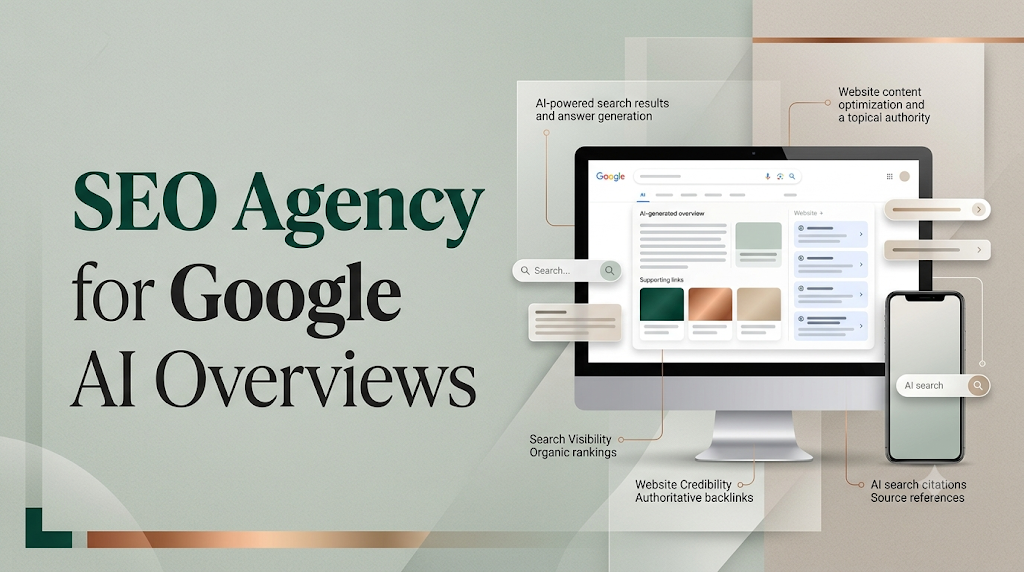
An SEO agency for Google AI Overviews helps businesses improve their website’s visibility in Google Search, including AI-generated answers and the links that support them. Effective strategies focus on technical SEO, helpful content, search intent, topical expertise, and website authority. Although no agency can guarantee placement in Google AI Overviews, the right SEO approach can improve your site’s eligibility and overall search visibility.
Google’s guidance confirms that established SEO best practices remain relevant to AI Overviews and AI Mode. Businesses should prioritize crawlable pages, useful original content, clear website structure, and reliable information rather than relying on shortcuts or AI-specific ranking tricks. Google Search Central
What Does an SEO Agency for Google AI Overviews Do?
An SEO agency specializing in Google AI Overviews combines traditional search engine optimization with content and measurement strategies designed to improve visibility in AI-powered search experiences.
Its work may include:
- Technical SEO: Ensuring important pages can be crawled, indexed, and understood by Google.
- AI search content optimization: Answering users’ questions clearly and providing useful, original information.
- Search intent analysis: Identifying the questions and related searches that matter to potential customers.
- Topical authority development: Building comprehensive coverage of relevant subjects.
- Entity and brand optimization: Maintaining consistent, verifiable information about the business and its expertise.
- Performance measurement: Monitoring search visibility, organic traffic, qualified leads, and conversions.
The objective is not simply to appear in an AI-generated answer. It is to help relevant users discover the business and take meaningful action.
7 Ways to Choose the Right SEO Agency for Google AI Overviews
1. Look for Strong Technical SEO Expertise
Your website needs a solid technical foundation before content optimization can deliver its full potential.
An experienced agency should evaluate whether Google can access, crawl, index, and display your important pages in Search.
Ask the agency to review:
- Robots.txt and indexing directives.
- XML sitemaps and canonical tags.
- Internal linking and website architecture.
- JavaScript rendering and page accessibility.
- Duplicate content and crawl issues.
- Mobile usability and page experience.
- Search Console indexing and performance data.
Pages generally need to be indexed and eligible to appear with a search snippet to be considered for AI search features. Meeting the requirements does not guarantee inclusion.
2. Evaluate Its Content Optimization Strategy
AI search visibility depends on content that genuinely helps users. Rewriting existing articles with generic AI-generated text is not a substitute for expertise or original value.
A capable SEO agency should develop content that answers relevant questions, explains complex topics, and offers information that readers cannot easily find elsewhere.
Look for a strategy that includes:
- Direct answers to important questions.
- Clear headings and logical content structure.
- Original examples, research, and practical insights.
- Accurate facts supported by trustworthy sources.
- Relevant comparisons and step-by-step explanations.
- Regular updates when information changes.
For example, a software company could publish a detailed comparison of solutions, explain common implementation challenges, and include original findings from its own customers.
3. Check Its Experience With AEO and GEO
You may see agencies offer Answer Engine Optimization (AEO) and Generative Engine Optimization (GEO) alongside traditional SEO.
These terms generally describe efforts to improve visibility in answer-based and generative AI search experiences. However, Google emphasizes that its existing SEO principles remain foundational for AI Overviews and AI Mode.
Ask prospective agencies:
- How do you identify questions relevant to our customers?
- How do you measure visibility in AI search results?
- How do you improve content quality and topical coverage?
- How do you distinguish measurable outcomes from estimates?
- How do you adapt recommendations to Google’s published guidance?
Avoid agencies that promise guaranteed AI Overview placements or claim to have access to Google’s internal AI ranking systems.
4. Review Its Approach to E-E-A-T and Brand Credibility
Experience, Expertise, Authoritativeness, and Trustworthiness (E-E-A-T) describe qualities emphasized in Google’s search quality guidance. E-E-A-T is not a single ranking factor that an agency can directly optimize.
A useful strategy is to make your expertise and business information easy for people to verify.
An agency can help by:
- Publishing content reviewed by qualified subject-matter experts.
- Providing accurate author biographies and credentials.
- Citing reliable sources for factual claims.
- Showcasing genuine case studies and customer experiences.
- Maintaining consistent business information across relevant platforms.
- Earning relevant, editorially justified mentions and links.
The goal is to build credibility through real expertise and useful information, not manufactured authority signals.
5. Ask How It Measures AI Search Visibility
Traditional keyword rankings alone may not tell the full story of how customers discover your business.
Your agency should explain how it monitors search performance and separates measurable results from estimates.
Useful metrics include:
- Organic clicks and impressions.
- Search queries and landing-page performance.
- Relevant AI search appearances or citations, where measurable.
- Qualified leads and conversion rates.
- Revenue or pipeline generated by organic search.
- Changes in branded and non-branded search demand.
Use Google Search Console and Google Analytics to assess organic performance. Google has also introduced reporting for generative AI search features, so verify which reports and capabilities are available in your account.
Third-party AI visibility tools can help monitor selected prompts and responses, but their results are samples rather than a complete view of Google’s internal systems.
6. Make Sure It Uses Ethical, Sustainable SEO Practices
An agency should focus on long-term improvements instead of tactics that attempt to manipulate AI answers.
Be cautious if an agency promises guaranteed citations, recommends publishing large quantities of nearly identical pages, or sells artificial brand mentions as a shortcut to AI visibility.
Instead, look for practices such as:
- Creating original, useful content.
- Following Google’s spam policies.
- Improving website structure and crawlability.
- Maintaining accurate business and product information.
- Earning relevant links through legitimate outreach and useful resources.
- Reviewing AI-assisted content for accuracy and originality.
Google does not require special AI files or dedicated schema markup to qualify for AI Overviews. Structured data can still support eligible search features when implemented correctly, but it does not guarantee AI inclusion.
7. Compare Reporting, Pricing, and Business Outcomes
The right agency should explain what it will deliver, how progress will be measured, and how its work connects to your business objectives.
Before signing a contract, ask for:
- A documented SEO audit and prioritized action plan.
- A clear content and technical SEO roadmap.
- Defined deliverables and reporting frequency.
- Transparent pricing and contract terms.
- Baseline performance measurements.
- Realistic expectations and success criteria.
- Relevant case studies with clearly explained results.
Evaluate agencies on the quality of their recommendations, transparency, and ability to connect SEO work with business outcomes—not on promises of guaranteed rankings.
How to Improve Your Website’s Chances of Appearing in Google AI Overviews
Choosing an agency is only part of the process. Your business should also maintain a practical optimization plan.
Step 1: Identify valuable search questions. Research the questions customers ask before buying, comparing, or using your products and services.
Step 2: Improve existing pages. Update outdated information, answer important questions, and add original insights where they provide real value.
Step 3: Fix technical SEO issues. Check indexing, crawlability, internal links, canonical tags, and page accessibility.
Step 4: Demonstrate expertise. Include relevant examples, evidence, expert contributions, and trustworthy sources.
Step 5: Strengthen related content. Link relevant articles and service pages so users and search engines can discover related information.
Step 6: Monitor performance. Review Search Console data, organic engagement, conversions, and AI search visibility where measurable.
Step 7: Refine your strategy. Use actual performance data to prioritize improvements rather than making changes based on speculation about AI ranking factors.
Frequently Asked Questions
1. What is an SEO agency for Google AI Overviews?
It is an SEO agency that helps businesses improve their visibility in Google Search, including AI Overviews. Its services typically include technical SEO, content optimization, search intent research, authority development, and performance measurement.
2. Can an SEO agency guarantee placement in Google AI Overviews?
No. Google does not guarantee that a page will be indexed, ranked, or included in an AI Overview. A reputable agency should explain its strategy and measurable goals without promising guaranteed placement.
3. How much does Google AI Overviews SEO cost?
Pricing varies by agency, website complexity, competition, content requirements, and the amount of technical work involved. Request a customized proposal that specifies deliverables, reporting, and performance objectives.
4. Is traditional SEO still important for Google AI Overviews?
Yes. Google’s published guidance states that established SEO best practices remain relevant to AI Overviews and AI Mode. Technical accessibility, useful content, and reliable information continue to matter.
5. Does schema markup help a website appear in AI Overviews?
Schema markup can help search engines interpret eligible structured information and support certain search features. However, Google does not require special AI Overview schema, and adding structured data does not guarantee inclusion.
6. How long does it take to improve AI search visibility?
There is no guaranteed timeline. Results depend on the site’s existing technical health, content quality, competition, indexing, and other factors. An agency should establish a baseline and report progress over time.
7. How can I measure whether an SEO agency is delivering results?
Track organic clicks, impressions, relevant queries, qualified leads, conversions, and revenue where attribution is available. Supplement these metrics with carefully documented AI search visibility monitoring, while recognizing that individual AI answers can vary.
Conclusion
An SEO agency for Google AI Overviews should combine technical SEO, original content, topical expertise, credible brand information, and transparent performance measurement. These fundamentals can improve your website’s search readiness and help potential customers discover your business across traditional and AI-powered search experiences.
Choose an agency that follows Google’s published guidance, demonstrates its work, and connects SEO improvements to measurable business outcomes. Focus on sustainable visibility rather than guaranteed AI citations or shortcuts.