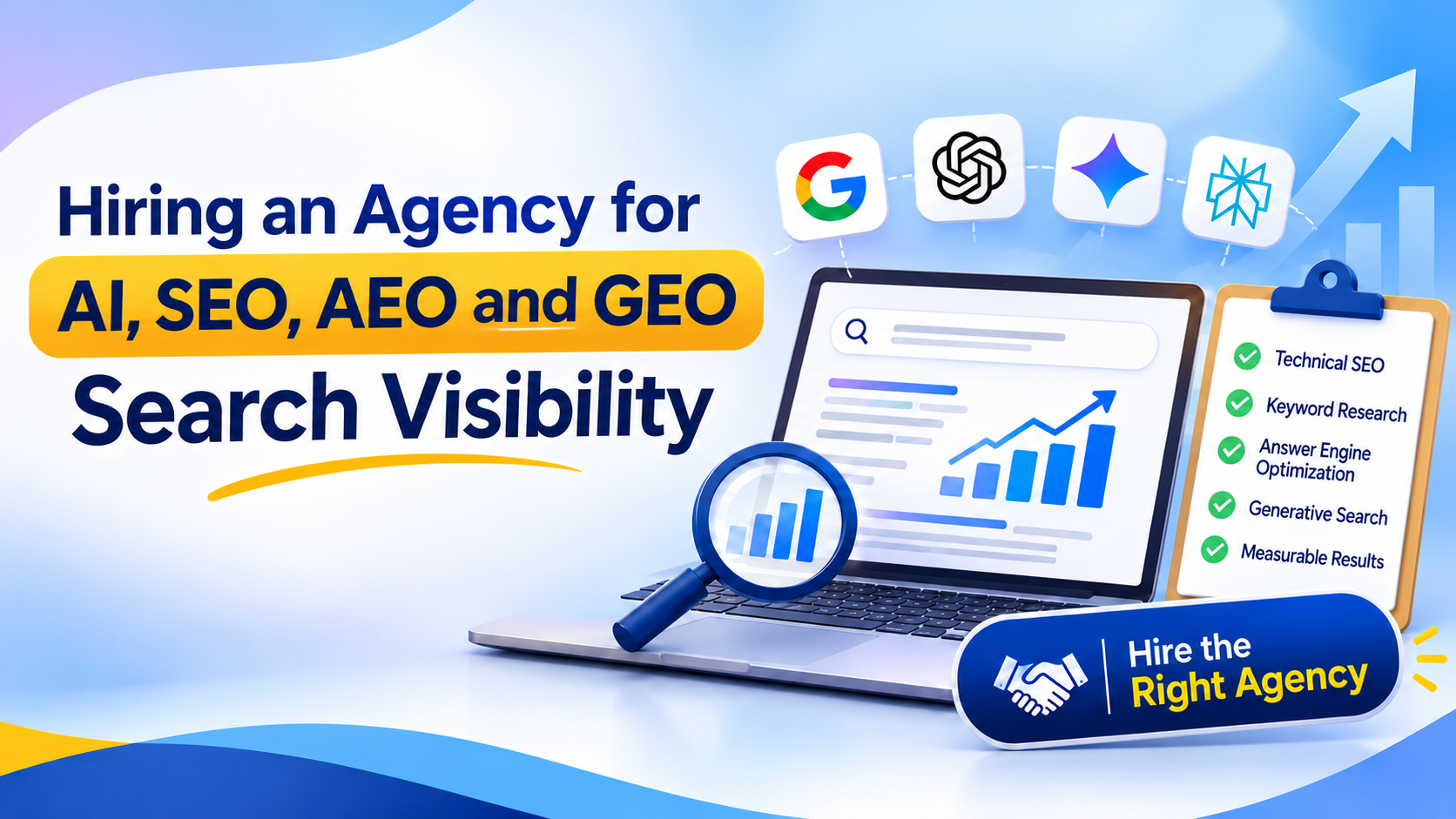
When hiring an agency for AI, SEO, AEO and GEO search visibility, look for expertise in technical SEO, keyword research, search intent, content optimization, answer engine optimization, and generative search. The right agency should understand how Google, ChatGPT, Gemini, and Perplexity discover and present information. It should also provide a clear strategy, relevant case studies, transparent reporting, and measurable business goals. Most importantly, choose an agency that combines traditional SEO with AI search visibility instead of relying on short-term ranking tricks or guaranteed AI citations.
Connect With Our Experts
Request a CallbackIntroduction
Search is changing how customers discover businesses, compare services, and make buying decisions. People no longer depend only on traditional Google search results. They also use AI-powered platforms such as ChatGPT, Google AI Overviews, Gemini, and Perplexity to research products, find service providers, and get direct answers to their questions.
As a result, businesses need more than traditional search engine optimization (SEO) to build a strong online presence. They must also understand answer engine optimization (AEO), generative engine optimization (GEO), and AI search optimization.
However, finding an agency that understands all these areas can be difficult. Many agencies offer SEO services, but not every agency has a clear strategy for answer engines and generative AI platforms. Some focus only on keyword rankings, while others promise AI visibility without explaining how they plan to achieve it.
Therefore, choosing the right AI search visibility agency requires a closer look at its technical knowledge, content strategy, optimization methods, industry experience, and reporting process.
A reliable agency should understand how traditional search engines and AI-powered platforms discover, interpret, and present website information. It should also know how to connect search visibility with business outcomes such as qualified traffic, enquiries, leads, and conversions.
In this guide, we will explain what to look for when hiring an agency for AI, SEO, AEO and GEO search visibility, how these optimization methods differ, which services matter most, and how businesses can evaluate an agency before making a decision.
1. Understand the Difference Between SEO, AEO, GEO and AI Search Visibility
Before hiring a search visibility agency, understand what each optimization method does. Although SEO, AEO, GEO, and AI search optimization are closely related, they serve different purposes.
A professional agency should explain these differences and show how they work together in one search strategy.
What Is Search Engine Optimization (SEO)?
Search engine optimization (SEO) is the process of improving a website so that search engines can discover, understand, and rank its pages for relevant searches.
Traditional SEO focuses on improving organic search visibility through technical improvements, keyword research, helpful content, website structure, internal links, and relevant backlinks.
For example, imagine a company that provides custom software development services. It wants its website to appear when potential customers search for terms such as “custom software development company” or “business software development services.”
An SEO strategy would begin by researching relevant keywords and understanding what potential customers expect to find. Next, the agency would optimize service pages, improve website structure, create useful supporting content, and resolve technical issues that affect crawling and indexing.
Furthermore, SEO helps businesses attract people who are already searching for their products, services, or solutions. Businesses can also explore how to rank a website fast on Google to understand the importance of keyword relevance, technical improvements, and search intent.
Important SEO components include:
Keyword Research and Search Intent: Identifying relevant search terms and understanding why people use them. The agency should consider informational, commercial, transactional, and navigational search intent.
On-Page SEO: Improving page titles, meta descriptions, headings, content, image alt text, and internal links so that each page communicates its topic clearly.
Technical SEO: Improving website crawling, indexing, page speed, mobile usability, URL structure, canonical tags, and website performance. An agency should also understand website sitemap optimization and how it supports search engine discovery.
Off-Page SEO: Building website authority through relevant backlinks, genuine brand mentions, digital PR, and trusted industry references.
Content SEO: Creating useful landing pages, service pages, guides, and blog articles that answer customer questions and cover relevant topics in depth.
A strong SEO agency should understand how these elements work together. Publishing more content alone will not solve problems caused by poor technical structure, weak search intent, or a lack of useful information.
What Is Answer Engine Optimization (AEO)?
Answer engine optimization (AEO) focuses on making website information clear, useful, and easy for answer engines to understand and retrieve.
Unlike traditional search results, which often present a list of links, answer engines can provide direct responses to user questions. These answers may include information from multiple sources.
For example, a business owner may ask an AI-powered search platform, “What should I look for when choosing a custom software development company?”
An AEO-focused content strategy helps a business explain its expertise through clear answers, useful definitions, detailed explanations, and relevant supporting information.
The aim is to make the business’s content a useful source for answer-based search experiences. Businesses looking to understand the wider optimization approach can also explore Ecsion’s SEO vs AEO vs GEO complete guide.
AEO includes several important practices.
Question-Based Content: Create content around the actual questions customers ask. Examples include “What is custom software development?”, “How much does business software cost?”, and “Which software is right for a growing company?”
Direct and Clear Answers: Answer important questions near the beginning of the relevant section. Use simple language before adding deeper explanations.
Structured Content: Organize information with descriptive headings, short paragraphs, comparison tables, and relevant lists. This makes the content easier for people and search systems to understand.
Accurate Information: Include reliable facts, practical examples, expert explanations, and relevant sources. Avoid vague claims and unsupported statements.
Relevant Structured Data: Use suitable schema markup when it accurately describes the visible content and meets search engine guidelines.
AEO is particularly useful for businesses that want to build visibility around informational searches, frequently asked questions, product comparisons, and service-related queries.
What Is Generative Engine Optimization (GEO)?
Generative engine optimization (GEO) focuses on improving how a brand’s information can be discovered, understood, and potentially referenced in AI-generated answers.
Generative search platforms can combine information from different sources to create responses. Therefore, businesses need content that clearly explains their expertise, products, services, and industry knowledge.
For example, someone may ask Perplexity or ChatGPT, “Which companies offer reliable ecommerce development services?”
An effective GEO strategy aims to make a business’s website and supporting information relevant to such questions. It focuses on original content, topical relevance, clear brand information, trusted references, and accessible website content.
Businesses can explore Ecsion’s Complete AI SEO Playbook for additional insights into AI search optimization, entity recognition, and generative search strategies.
Important GEO activities include:
Topical Authority: Publish useful content that covers important subjects related to your products and services. A software development company, for example, can cover software architecture, integrations, security, development costs, and implementation.
Entity Optimization: Make your business information consistent across your website and relevant online sources. Clearly explain your brand, services, location, expertise, and relationships with relevant industry topics.
Original Research and Insights: Provide information that adds value beyond commonly available explanations. Include practical examples, industry observations, original data, and expert opinions when available.
Brand Mentions and Digital Authority: Build genuine visibility through relevant publications, industry websites, business profiles, and credible references.
AI Platform Accessibility: Check whether relevant AI search crawlers can access your public website content. Review crawler permissions and technical restrictions where applicable.
GEO should not be treated as a collection of shortcuts. A business cannot guarantee that an AI platform will cite a particular page simply by adding keywords or schema markup.
What Is AI Search Visibility?
AI search visibility is the broader goal of making a business discoverable across AI-powered search experiences and traditional search platforms.
It includes how a brand appears in Google AI Overviews, AI Mode, ChatGPT Search, Gemini, Perplexity, and other search experiences as they evolve.
AI search visibility brings together several areas of digital optimization. These include SEO, AEO, GEO, content quality, brand authority, technical accessibility, and entity understanding.
For example, a company may rank on Google for “website development services” but may not appear when someone asks an AI platform to recommend website development companies.
This difference shows why businesses should examine their visibility across more than one search experience. Ecsion’s guide to ranking in ChatGPT, Gemini and Perplexity provides further insights into AI-powered discovery.
SEO vs AEO vs GEO vs AI Search Visibility: Key Differences
| Component | Main focus | Primary objective | Example |
| SEO | Search engines | Improve organic rankings and traffic | Ranking for “SEO agency” |
| AEO | Answer engines | Provide clear answers to user questions | Answering “What does an SEO agency do?” |
| GEO | Generative search engines | Improve the chances of being discovered and referenced in generated answers | Being referenced in an AI-generated agency comparison |
| AI Search Visibility | Overall AI-powered discovery | Improve brand discoverability across AI search experiences | Appearing in relevant ChatGPT or Gemini search responses |
These approaches are connected rather than competing strategies. SEO provides an important foundation, while AEO and GEO help businesses address the changing ways people search for and consume information.
Therefore, when hiring an agency, look for a team that understands all four areas and can explain how they fit your business goals.
2. Why Your Business Needs an AEO and GEO Search Visibility Strategy
Customer search behaviour is becoming more conversational. Instead of entering only short keywords, people now ask detailed questions, compare options, and request recommendations from AI-powered platforms.
This shift creates new opportunities for businesses, but it also changes how they need to approach online visibility.
A company that depends only on traditional keyword rankings may miss opportunities to reach people who use AI-generated answers during their research and buying journey.
Reach Customers Beyond Traditional Google Rankings
Traditional SEO remains important. However, customers can now discover brands through AI-generated summaries, conversational search, and answer-based recommendations.
For example, someone looking for a digital marketing company may search Google for “best digital marketing agency.” Another person may ask ChatGPT, “What should a startup consider when choosing a digital marketing agency?”
Both searches have a similar business purpose, but they require different types of information.
A combined SEO, AEO, and GEO strategy helps businesses address these search behaviours through relevant service pages, informative articles, comparisons, and clear answers. A broader understanding of the future of search and AI-powered discovery can also help businesses prepare for these changes.
Build Brand Authority and Trust
People want reliable information before choosing a company. Therefore, a business should demonstrate its experience through useful content, consistent brand information, and credible industry references.
For example, a software development company can publish detailed guides about custom software costs, development processes, security practices, and application integrations.
Furthermore, it can support these resources with case studies, project examples, and clear explanations of its services.
This gives potential customers more reasons to trust the business. It also creates a stronger foundation for search engines and AI platforms to understand what the company offers.
Improve Visibility Across Multiple Search Platforms
Customers use different platforms for different research needs. Some prefer Google Search, while others use ChatGPT, Gemini, or Perplexity to explore complex topics.
Consequently, businesses should not measure their entire online presence through traditional keyword rankings alone.
An AEO and GEO strategy helps expand the areas a business monitors. It can examine relevant search queries, brand mentions, AI-generated answers, source citations, referral traffic, and organic performance.
However, visibility varies across platforms, prompts, locations, and time. Therefore, businesses should measure trends rather than expect a fixed position in every AI response.
Attract More Relevant Website Visitors
Visibility is valuable when it reaches the right audience. A business does not need traffic from every possible search. It needs visitors who are interested in its products, services, and expertise.
For example, a company offering enterprise software solutions should focus on searches related to business automation, system integrations, enterprise applications, and custom development.
Therefore, a strong search strategy should connect informational content with relevant commercial pages. This creates a clear path from discovering a business to understanding its services and making an enquiry.
Stay Competitive as Search Technology Evolves
Search experiences continue to change. Businesses that understand these developments can make better decisions about their websites, content, and digital marketing strategies.
An agency with SEO, AEO, and GEO expertise can help identify gaps in traditional search visibility and opportunities in AI-powered discovery.
The goal is not to abandon traditional SEO. Instead, businesses should strengthen their existing search foundations while preparing for new ways of finding information.
3. Check the Agency’s Expertise in AI Search Optimization
An agency may claim to offer AI SEO, GEO, and AEO services. However, these terms alone do not prove that it understands how AI-powered search works.
Before hiring an agency, ask how it approaches AI search optimization and what activities it includes in its strategy.
Understanding AI-Powered Search Platforms
The agency should understand the different search experiences available through Google AI Overviews, Google AI Mode, ChatGPT Search, Gemini, and Perplexity.
Each platform may use different retrieval methods, sources, and presentation formats. Therefore, an agency should not assume that one optimization technique guarantees visibility everywhere.
Ask how the agency studies your industry’s presence across these platforms. It should be able to explain how it identifies relevant questions, evaluates brand mentions, checks source references, and tracks changes in visibility.
Google AI Mode vs ChatGPT Search: Key Differences
Google AI Mode and ChatGPT Search both use artificial intelligence to help users find information, explore topics, and discover relevant sources. However, they differ in their search ecosystems, information discovery methods, user experiences, and connections with traditional search.
Google AI Mode is an AI-powered search experience integrated into Google Search. It can break complex questions into related subtopics, explore multiple searches, and combine information into conversational responses with links to relevant web sources.
ChatGPT Search brings web search capabilities into ChatGPT, allowing users to ask conversational questions and receive responses supported by relevant web sources. Users can explore cited sources and ask follow-up questions within the same conversation.
For businesses hiring an SEO, AEO, and GEO agency, understanding these differences is important because visibility strategies should account for how each platform discovers and presents information.
| Comparison Criteria | Google AI Mode | ChatGPT Search |
| Platform | Integrated into Google Search | Integrated into ChatGPT |
| Primary Purpose | Provides AI-powered search experiences with conversational exploration | Combines conversational AI with web search |
| Search Experience | Allows users to explore complex questions through conversational follow-ups within Google Search | Allows users to ask questions, refine queries, and explore topics through ChatGPT conversations |
| Information Discovery | Uses Google’s Search infrastructure and AI systems to discover and organize relevant web information | Uses web search and retrieval capabilities to find relevant information for responses |
| Query Processing | Can divide a question into related subtopics and search for information across multiple sources | Can rewrite or expand queries and retrieve relevant web information to support a response |
| Answer Presentation | Generates synthesized answers with links to supporting web sources | Generates conversational answers with source citations and links when web search is used |
| Follow-Up Questions | Supports follow-up exploration within the AI search experience | Supports contextual follow-up questions within an ongoing conversation |
| Search Ecosystem | Connected to Google’s search ecosystem | Connected to ChatGPT’s conversational and web search ecosystem |
| Business Visibility | Businesses may gain visibility through relevant web sources surfaced in AI-generated search responses | Businesses may gain visibility when their content is discovered and referenced in ChatGPT Search responses |
| SEO Considerations | Website accessibility, relevant content, search indexing, and topical relevance remain important | Relevant, accessible, trustworthy, and well-structured web content can support discovery and referencing |
| Performance Measurement | Monitor Google Search Console data, organic performance, and relevant AI search visibility | Monitor brand mentions, source citations, referral traffic, and repeated query-based visibility tests |
What Does This Mean for Businesses?
Businesses should not assume that appearing in Google AI Mode automatically means appearing in ChatGPT Search, or vice versa. Each platform has its own search experience and information retrieval systems.
For example, a software development company may appear as a relevant source when someone asks Google AI Mode about custom software development companies. However, the same business may not appear when someone asks ChatGPT Search for software development recommendations.
Therefore, an experienced SEO, AEO, and GEO agency should evaluate visibility across both platforms instead of relying exclusively on Google rankings or isolated AI-generated responses.
The objective should be to build strong website content, technical accessibility, topical authority, and consistent brand information that support discoverability across different search experiences.
Understanding AI Content Retrieval and Context
AI search systems need useful information to produce relevant responses. The agency should understand concepts such as semantic relevance, entities, context, retrieval, and content relationships.
For example, a page about ecommerce development should explain the service clearly. It should also cover relevant subjects such as payment integrations, inventory systems, website security, scalability, and maintenance.
These connections help communicate the subject more completely.
Furthermore, an experienced agency should understand that simply repeating related keywords does not establish expertise. The information must be accurate, relevant, and useful.
Understanding AI Search Crawlers and Website Accessibility
Technical accessibility is another important part of AI search optimization.
An agency should know how to review robots.txt rules, website access restrictions, page indexing, server responses, and content availability.
For businesses that want their content to be discoverable in ChatGPT Search, the agency should also understand OpenAI’s published crawler guidance.
For example, OAI-SearchBot is used to discover websites for ChatGPT Search features. Website owners can manage crawler access through their robots.txt configuration.
However, allowing a crawler does not guarantee that a website will be selected or cited in an AI answer.
A reliable agency should explain these technical limits rather than promise guaranteed AI placement.
Using AI Tools With Human Expertise
AI tools can support keyword research, content analysis, competitor research, and topic discovery. However, they should not replace subject knowledge, fact-checking, and editorial judgment.
For instance, an agency may use AI to identify common customer questions about website development. Its content team should then develop accurate explanations, include real examples, and review technical details.
Google also advises website owners to focus on original, useful content rather than publishing large volumes of low-value material generated through automation.
Therefore, evaluate how an agency uses AI in its workflow and how it maintains content accuracy and quality.
4. Evaluate the Agency’s Technical SEO Capabilities
Technical SEO is one of the most important services to examine before hiring an agency.
Even useful content can struggle to appear in search results when a website has crawling, indexing, rendering, or performance problems.
A good agency should conduct a detailed website SEO audit before recommending major changes. It should also explain which issues affect search visibility and which improvements should receive priority.
Website Crawling and Indexing
Search engines need to access and process website pages before they can appear in organic search results.
The agency should review robots.txt rules, XML sitemaps, canonical tags, noindex directives, redirect chains, broken links, and server errors.
For example, a business may publish several valuable service pages, but incorrect noindex tags could prevent those pages from appearing in search results.
Therefore, the agency should use tools such as Google Search Console and website crawling software to identify and resolve indexing problems. A detailed understanding of website sitemap optimization for SEO can also help identify issues with website discovery.
Website Speed and Core Web Vitals
Website performance affects how visitors experience your pages. Slow loading, delayed interactions, and unexpected layout changes can make a website difficult to use.
Ask whether the agency reviews Core Web Vitals, including:
| Metric | What it measures | Good target |
| Largest Contentful Paint (LCP) | Loading performance | 2.5 seconds or less |
| Interaction to Next Paint (INP) | Interaction responsiveness | 200 milliseconds or less |
| Cumulative Layout Shift (CLS) | Visual stability | 0.1 or less |
These are Google’s recommended good thresholds when measured at the 75th percentile of page loads.
A technical SEO team should be able to identify the causes of poor performance and recommend practical fixes. These may include image compression, better caching, script optimization, server improvements, and layout adjustments.
Mobile SEO and Website Usability
A website must work well on smartphones and tablets, not just desktop screens.
The agency should check responsive layouts, mobile navigation, readable text, clickable elements, image sizing, and the availability of important content on mobile devices.
This matters because Google primarily uses the mobile version of website content for indexing.
Furthermore, a mobile-friendly website helps potential customers explore services, read articles, and contact your business more easily. Review the mobile SEO and mobile-first indexing guide for more information.
Structured Data and Schema Markup
Structured data helps search engines understand certain types of information on a webpage.
An agency should know when schema markup is useful and how to implement it correctly.
Depending on the website, relevant schema types may include Organization, LocalBusiness, Article, Product, BreadcrumbList, and other supported schema types.
However, schema markup should accurately reflect visible page content. Adding structured data does not guarantee better rankings, AI citations, or rich search results.
The agency should also validate its implementation and check for errors.
Website Architecture and Internal Linking
A well-organized website makes it easier for visitors and search engines to find important information.
The agency should examine navigation, URL structure, content hierarchy, related pages, and internal links.
For example, a website offering digital marketing services can connect its SEO service page with relevant articles about keyword research, technical SEO, content marketing, and website performance.
This creates meaningful relationships between pages and helps visitors explore related subjects.
An effective internal linking strategy should use descriptive anchor text and link only where the destination adds value.
5. Review the Agency’s Keyword Research and Search Intent Strategy
Keyword research is not simply about finding popular search terms and adding them to website pages.
A good agency should understand what people want when they search, how competitive a query is, and which pages can best answer their needs.
Does the Agency Understand Search Intent?
Search intent explains the reason behind a search query. It helps an agency decide what type of content to create and how to present it.
For example, consider these searches:
| Search query | Search intent | Suitable content |
| What is SEO? | Informational | Educational guide |
| Best SEO agency for startups | Commercial | Comparison or service page |
| Hire an SEO agency | Transactional | Service or enquiry page |
| Ecsion SEO services | Navigational | Brand or service page |
The agency should identify these differences before building a keyword strategy.
Otherwise, a business may receive traffic from searches that do not match its services or commercial goals. Understanding how to match search intent with relevant keywords and content is an important part of building an effective SEO strategy.
Does It Research Long-Tail and Conversational Keywords?
Customers increasingly use detailed searches and natural-language questions.
Instead of searching only for “SEO services”, a potential customer may search for “Which SEO services can help a small business improve its Google rankings?”
Therefore, an agency should include long-tail keywords, question-based keywords, related search terms, and conversational queries in its research.
These phrases can support blog content, service pages, FAQs, and AEO-focused resources. Businesses can also explore how to find long-tail keywords to understand how specific search phrases can attract relevant audiences.
Does It Build Topic Clusters?
A topic cluster connects a central subject with several related supporting pages.
For example, a business focusing on SEO services could create a main resource about search engine optimization. Supporting articles could cover technical SEO, keyword research, on-page SEO, backlinks, content optimization, and website indexing.
The agency should connect these pages through relevant internal links.
This approach helps create a useful content structure instead of publishing unrelated blog posts.
Does It Analyze Competitor Search Visibility?
Competitor research helps identify content gaps, keyword opportunities, and areas where other businesses have established authority.
The agency should examine competing websites, their service pages, content quality, keyword coverage, backlink profiles, and visibility across relevant search platforms.
However, copying competitor content is not a strong strategy.
Instead, the agency should identify what competitors explain poorly or overlook and create more useful resources for your audience.
6. Examine the Agency’s Content Strategy for SEO, AEO and GEO
Content plays a major role in search visibility. However, publishing more articles does not automatically create better results.
A strong agency should develop content that answers customer questions, demonstrates expertise, supports service pages, and provides useful information across different stages of the buying journey.
Does It Create Helpful, People-First Content?
Every page should have a clear purpose. It should answer a question, explain a service, solve a problem, or help a customer make a decision.
For example, a company offering custom application development can publish resources about development costs, application features, integration requirements, security, and project timelines.
Furthermore, the content should include practical explanations rather than repeating general information available across hundreds of websites.
Ask whether the agency has a process for research, writing, technical review, editing, and fact-checking.
Does It Optimize Content for Answer-Based Searches?
AEO-friendly content should make important information easy to find.
The agency should use descriptive headings, direct answers, relevant definitions, concise explanations, and useful examples.
For example, a section titled “How Much Does Custom Software Development Cost?” should begin with a direct explanation of the factors that affect pricing.
The page can then discuss project complexity, integrations, features, maintenance, and development time.
This structure helps readers understand the answer before exploring the details.
Does It Create Original Content for Generative Search?
GEO requires more than reorganizing existing articles.
Businesses should publish information that demonstrates genuine knowledge and provides something useful to readers.
An agency should encourage content such as original case studies, expert insights, research-backed explanations, industry comparisons, implementation guides, and practical examples.
For instance, rather than publishing another generic article about website development, a company could explain how a specific website architecture supports performance, scalability, and business requirements.
This creates more distinctive content and gives readers a stronger reason to trust the source.
Does It Use Content Refreshing and Optimization?
A good content strategy does not end when an article is published.
The agency should review existing pages to identify outdated facts, missing information, keyword gaps, broken links, weak explanations, and opportunities to improve relevance.
For example, an older article about SEO may not explain current AI search experiences. Updating it with accurate information about AEO, GEO, and AI-powered search can make it more useful.
However, updates should add genuine value rather than change dates without improving the content.
7. Check Brand Authority, Entity SEO and Digital PR Expertise
Search visibility is not limited to what a business publishes on its own website. Its identity, expertise, and reputation across the wider web can also matter.
Therefore, ask whether the agency understands brand authority, entity SEO, digital PR, and reputation management.
What Is Entity SEO?
Entity SEO focuses on helping search systems understand a business as a distinct entity and identify its relationships with people, services, locations, products, and industry topics.
For example, a technology company should have consistent information about its business name, services, website, contact details, and areas of expertise.
An agency can improve this foundation through clear Organization information, suitable structured data, consistent business profiles, descriptive service pages, and relevant references.
The aim is to reduce confusion about what the business does and which topics it is associated with.
Why Are Brand Mentions Important?
Brand mentions occur when other websites, publications, or online sources refer to a business.
Relevant mentions can help people discover a brand and learn about its expertise.
For example, a software development company may be mentioned in an industry article about application development or a business publication discussing technology solutions.
However, the quality and relevance of these references matter more than simply collecting a large number of mentions.
A good agency should focus on genuine industry relationships, relevant digital PR, and useful contributions.
Does the Agency Have a Digital PR Strategy?
Digital PR helps businesses build awareness and earn relevant coverage through industry publications, expert commentary, research, and useful resources.
An agency should explain how it identifies suitable publications and develops stories that provide value to their audiences.
Avoid agencies that promise hundreds of links or rely on unrelated websites. Such approaches do not demonstrate a sustainable authority-building strategy.
8. Ask for Case Studies, Industry Experience and Proven Results
An agency’s claims should be supported by evidence.
Before signing an agreement, review its previous projects, case studies, client experience, and the results it can demonstrate.
However, do not evaluate an agency only by impressive ranking screenshots.
Review Relevant SEO Case Studies
Ask for examples of projects involving businesses similar to yours.
A useful case study should explain the original challenge, the strategy implemented, the time period, and the measurable results.
For example, an agency may show how it improved organic visibility for a service business by fixing indexing issues, improving service pages, and building supporting content.
Look for evidence such as changes in organic clicks, impressions, qualified enquiries, conversions, and relevant keyword visibility.
Ask About AEO and GEO Experience
AI search optimization is still developing, and reporting methods differ across platforms.
Therefore, ask the agency how it measures AI visibility.
It may use a consistent set of relevant prompts to monitor brand mentions, source citations, and appearances across supported AI search experiences.
However, the agency should explain that results can vary by query, platform, location, and time.
A single AI response or screenshot is not enough to prove long-term visibility.
Check Its Experience Across Different Industries
An agency that understands your industry may identify customer questions, buying concerns, and relevant search opportunities more quickly.
For example, an ecommerce business may need product page optimization, category SEO, and shopping-related content. In contrast, a B2B software company may need detailed service pages, technical content, comparison guides, and lead-focused search strategies.
The agency should adapt its approach to your audience rather than use the same content plan for every business.
9. Understand How the Agency Measures SEO, AEO and GEO Performance
A professional agency should explain how it measures success and which metrics it uses to evaluate performance.
Traditional SEO, AEO, and GEO do not rely on exactly the same measurements. Therefore, reporting should include both established search metrics and suitable AI visibility indicators.
| Performance area | Important metrics | What they help measure |
| Traditional SEO | Organic clicks, impressions, rankings, CTR | Search performance and organic discovery |
| Technical SEO | Indexing status, crawl errors, Core Web Vitals | Website accessibility and technical health |
| AEO | Answer visibility, featured snippets where applicable, relevant answer appearances | Visibility in answer-focused search experiences |
| GEO | AI mentions, source citations, referral visits | Brand discovery and references in generative search |
| Content performance | Organic traffic, engagement, conversions | Content usefulness and business value |
| Business results | Qualified leads, enquiries, conversion rate | Contribution to business growth |
Google Search Console and Google Analytics
Google Search Console helps businesses understand how their websites perform in Google Search.
It provides information about clicks, impressions, click-through rates, average positions, indexing, and other search-related issues.
Google Analytics can help evaluate website visits, traffic sources, user activity, and conversions.
The agency should explain how it uses these tools to identify performance changes and make decisions.
AI Search Visibility Tracking
AI visibility tracking should examine how a brand appears in relevant questions across supported AI platforms.
For example, a business could monitor questions such as:
“Which companies provide custom ecommerce development?”
“What should I consider before hiring a software development agency?”
“Which features should a growing business look for in a CRM?”
The agency can record whether the brand appears, whether its website is referenced, which competing brands appear, and how these results change over time.
However, AI responses are not fixed search rankings. A good agency should use consistent testing methods and explain the limits of the data. Resources such as Ecsion’s guide to AI search visibility across ChatGPT, Gemini and Perplexity can help businesses understand this changing discovery landscape.
Focus on Qualified Leads, Not Just Traffic
Higher traffic does not always mean better business performance.
For example, a website may receive thousands of visits from general informational searches but generate very few enquiries.
Meanwhile, a smaller number of visitors from relevant commercial searches may produce more qualified leads.
Therefore, an agency should connect search performance with business objectives. These may include contact form submissions, calls, demo requests, product enquiries, and sales opportunities.
10. Evaluate the Agency’s Strategy, Communication and Transparency
Technical expertise matters, but a successful working relationship also depends on clear communication and realistic expectations.
Before hiring an agency, understand how it manages projects, shares updates, prioritizes work, and handles changes.
Does It Provide a Clear SEO and AI Visibility Roadmap?
The agency should provide a strategy based on your current website, industry, competition, and business objectives.
A useful roadmap may include an initial technical audit, keyword and competitor research, content planning, on-page optimization, AEO improvements, GEO activities, and performance reviews.
It should also explain which activities need immediate attention and which require longer-term work.
For example, fixing blocked service pages may be more urgent than publishing several new blog posts.
Does It Explain Its Work Clearly?
You should understand what the agency is doing and why.
Ask how often you will receive reports, who will manage your project, how technical issues will be communicated, and how you can review completed work.
Furthermore, make sure you retain appropriate access to your website, analytics, Search Console, and other business accounts.
Does It Set Realistic Expectations?
No professional agency can guarantee the number-one Google position or a fixed number of AI citations.
Search performance depends on competition, content quality, website condition, search engine systems, and many other factors.
A reliable agency should explain expected activities, possible outcomes, risks, and measurement methods without making unrealistic promises.
Is the Pricing and Scope of Work Clear?
Before signing a contract, review what is included in the service.
The proposal should explain the scope of technical SEO, content production, keyword research, optimization, reporting, and AI search visibility work.
It should also clarify content volumes, revision limits, implementation responsibilities, timelines, and additional costs.
A lower price is not always better. Compare the quality and depth of services rather than choosing an agency based on monthly fees alone.
11. How Businesses Can Choose an Agency for AI Search Visibility
Choosing an agency for AI search visibility requires a broader evaluation than hiring a traditional SEO provider.
Businesses should look for an agency that understands how search technology is changing while maintaining a strong foundation in technical SEO, content strategy, and organic growth.
The following process can help you make a more informed decision.
Connect With Our Experts
Request a CallbackStep 1: Define Your Business and Search Visibility Goals
Start by identifying what you want to achieve.
Your goal may be to improve Google rankings, attract more organic traffic, increase brand mentions in AI search, generate qualified leads, or strengthen visibility across multiple platforms.
For example, a B2B company may want to appear for service-related searches and become a useful source for AI-generated answers about its industry.
Clear objectives help the agency create a strategy that supports actual business needs.
Step 2: Review the Agency’s SEO, AEO and GEO Services
Examine the agency’s service offerings carefully.
Check whether it provides technical SEO, keyword research, content optimization, entity SEO, AEO, GEO, digital PR, and AI visibility tracking.
The agency should explain how these services connect rather than present them as unrelated activities.
Step 3: Evaluate Its Website and Content Expertise
Review the agency’s own website, blog articles, service pages, and content structure.
Look for clear explanations, relevant industry knowledge, useful internal links, and evidence of subject expertise.
Although an agency’s own rankings cannot tell you everything about its capabilities, its website can provide useful insight into how it approaches digital visibility.
Step 4: Request a Website Audit and Strategy
Ask the agency to review your website and identify its most important opportunities.
A useful audit should examine technical health, organic search performance, keyword gaps, content quality, website architecture, and relevant AI visibility opportunities.
The agency should provide recommendations based on actual findings instead of sending a generic proposal.
Step 5: Compare Case Studies and Reporting Methods
Review its previous projects and ask how it measures SEO and AI search results.
Pay attention to the quality of the evidence, the relevance of the projects, and the clarity of the reporting.
Moreover, ask how the agency distinguishes between increased brand mentions, actual website citations, referral visits, and qualified leads.
Step 6: Compare Communication, Pricing and Long-Term Support
Finally, compare the proposed services, pricing, reporting schedule, and communication process.
Choose an agency that explains its strategy clearly, understands your business, and is willing to adapt its approach as search behaviour changes.
The right agency should work as a long-term search visibility partner rather than focus only on short-term keyword improvements.
12. Questions to Ask Before Hiring an AI, SEO, AEO and GEO Agency
Before making your final decision, ask direct questions that reveal the agency’s actual knowledge and working methods.
| Question | What a good answer should explain |
| How will you improve our organic search visibility? | Keyword research, technical SEO, content optimization, and search intent |
| What is your approach to AEO? | Question-based content, clear answers, and answer-focused optimization |
| How do you approach GEO? | Original content, topical relevance, brand authority, and AI discovery |
| Which AI platforms do you monitor? | Relevant platforms and a consistent testing process |
| How do you measure AI visibility? | Brand mentions, citations, source references, and referral traffic |
| How do you conduct technical SEO audits? | Crawling, indexing, website performance, and site architecture |
| Can you share relevant case studies? | Project details, starting challenges, activities, and measurable outcomes |
| How often will you provide reports? | Reporting frequency, metrics, and recommendations |
| Can you guarantee first-page rankings or AI citations? | An honest explanation of why no such guarantee is possible |
| What will our team need to provide? | Website access, business information, subject expertise, and approvals |
The quality of an agency’s answers can tell you a lot about its experience. Look for clear explanations supported by practical examples rather than complicated terminology or unrealistic promises.
13. Red Flags to Avoid When Hiring an AI Search Visibility Agency
Not every agency offering AI SEO or GEO services follows a reliable approach. Some use new industry terms to attract clients without having a clear process behind their promises.
Therefore, watch for these warning signs before signing a contract.
Guaranteed Google Rankings or AI Citations: No agency can control search engine rankings or guarantee that an AI platform will mention your business for a specific question.
Keyword Stuffing: Repeating keywords unnaturally does not create useful content. It can reduce readability and weaken the quality of your website.
Mass-Produced AI Content: Publishing large numbers of generic AI-generated articles without original value, research, or human review is not a sustainable content strategy.
Unclear Link-Building Practices: Avoid agencies that promise large volumes of backlinks without explaining their relevance, quality, and acquisition methods.
No Technical SEO Audit: An agency that recommends a large content campaign without checking your website’s technical condition may overlook important problems.
No Reporting Transparency: Reports should explain what was completed, what changed, which results matter, and what should happen next.
Fixed AI Ranking Promises: AI responses can change depending on the platform, question, location, and available information. An agency promising a permanent position in AI answers is setting an unrealistic expectation.
No Business Understanding: A good strategy must reflect your products, services, audience, competition, and commercial goals. Generic optimization plans rarely address these differences.
Ultimately, choose an agency that can explain its methods, demonstrate its work, and support its recommendations with relevant evidence.
14. Agency Evaluation Framework: How to Compare SEO, AEO and GEO Agencies
Once you have shortlisted two or three agencies, use a consistent evaluation framework to compare their capabilities.
This approach helps you look beyond sales presentations and evaluate the actual value each agency can provide.
| Evaluation criteria | Weight | What to evaluate |
| SEO expertise | 20% | Keyword research, technical SEO, search intent, and organic growth |
| AEO and GEO strategy | 20% | Answer optimization, generative search knowledge, and AI visibility |
| Content quality | 15% | Original research, helpful content, and subject expertise |
| Technical capabilities | 15% | Crawling, indexing, structured data, and website performance |
| Case studies and experience | 10% | Relevant projects and verifiable results |
| Reporting and analytics | 10% | Search performance, AI visibility, and business metrics |
| Communication and pricing | 10% | Clear scope, realistic expectations, and project management |
| Total | 100% |
How to Calculate the Agency Evaluation Score
Give each agency a rating from 1 to 5 for every category.
A rating of 1 means the agency provides little evidence of its capabilities. A rating of 5 means it provides strong evidence, clear processes, and relevant experience.
Use this formula:
Weighted Score = (Agency Rating ÷ 5) × Category Weight
For example, suppose an agency receives a rating of 4 out of 5 for SEO expertise, which carries a weight of 20%.
Its weighted score would be:
(4 ÷ 5) × 20 = 16 points.
Repeat this calculation for all categories and add the results. The maximum possible score is 100.
A higher score can help identify a stronger overall match. However, review the evidence behind each rating before making your decision. An agency with a high total score may still have a weakness in an area that is essential to your business.
15. AI Search Visibility Diagnostic Framework: Identify What Is Holding Your Business Back
Before investing in a new SEO or AI visibility campaign, businesses should understand where their current search strategy is falling short.
A diagnostic framework helps connect search performance problems with possible causes and practical improvements. It also helps an agency prioritize the work instead of recommending the same activities to every client.
| What you notice | Possible reason | Recommended action |
| Website pages are not appearing on Google | Indexing, crawling, or technical issues | Review robots.txt, canonical tags, sitemaps, and Search Console |
| Organic impressions are increasing but clicks remain low | Weak search relevance or titles and descriptions | Review search queries, page titles, and search intent |
| Website ranks for irrelevant keywords | Poor keyword targeting | Rework keyword research and page relevance |
| Competitors receive more organic traffic | Content gaps, stronger authority, or technical differences | Conduct competitor and content gap analysis |
| Website does not appear in relevant AI answers | Limited content relevance, accessibility, or brand recognition | Review AI platform access, content quality, and brand information |
| AI platforms mention competitors but not your business | Competitors have more relevant references or clearer information | Improve original content, entity information, and industry authority |
| Website receives traffic but few enquiries | Weak commercial intent or conversion experience | Improve service pages, calls to action, and enquiry journeys |
| Organic traffic drops suddenly | Technical changes, search demand, or ranking changes | Compare Search Console data and investigate recent website updates |
A Practical Search Visibility Campaign Diagnostic Process
A good agency should follow a logical process to identify problems and decide what to improve first.
Step 1: Establish the Current Search Visibility.
Start by recording existing organic clicks, impressions, keyword positions, indexed pages, website traffic, and conversions. Also, test a consistent group of relevant questions across AI search platforms to understand current brand visibility.
Step 2: Identify the Main Performance Gap.
Next, compare your website with relevant competitors. Examine their service pages, content coverage, technical structure, industry references, and visibility across traditional and AI-powered search.
Step 3: Find the Root Cause.
Do not assume that every visibility problem requires more content. A website may need technical corrections, better keyword targeting, stronger internal links, clearer service information, or improved brand positioning.
Step 4: Prioritize the Improvements.
Address issues that affect important pages first. For example, fix indexing problems before investing heavily in new content. Then improve existing pages, develop supporting resources, and strengthen relevant authority signals.
Step 5: Measure and Improve Performance.
Finally, compare results against the original benchmarks. Track organic search performance, relevant AI appearances, website referrals, qualified enquiries, and conversions. Use the findings to adjust the strategy.
This process creates a connection between discovery, visibility, website engagement, and business results. A successful campaign should not stop when a website starts appearing in search results. It should also help potential customers understand the business, evaluate its services, and take the next step.
16. Why Choose an Agency That Combines SEO, AEO and GEO?
Businesses should avoid treating SEO, AEO, and GEO as completely separate marketing activities.
A combined strategy provides a more complete approach to search visibility. It connects technical website improvements with useful content, brand authority, and customer search behaviour.
For example, consider a business that offers custom software development.
Its SEO strategy can improve rankings for service-related keywords. Its AEO strategy can answer questions about software development costs, features, and implementation. Meanwhile, its GEO strategy can improve the quality and relevance of the information available about the business across generative search experiences.
Together, these activities create a stronger online presence.
An experienced agency should understand how to connect these areas with website development, content marketing, digital strategy, and business objectives.
At Ecsion, the focus on websites, technology, and digital growth provides a foundation for businesses looking to strengthen their online presence and build digital experiences around their business needs.
Explore Ecsion’s digital and technology solutions to learn more.
Frequently Asked Questions
1. What should I look for when hiring an SEO and AI search visibility agency?
Look for an agency with strong technical SEO knowledge, keyword research expertise, helpful content development, AEO and GEO experience, and transparent reporting. It should also understand how AI-powered search platforms discover and reference website information.
Connect With Our Experts
Request a Callback2. What is the difference between SEO, AEO, and GEO?
SEO improves a website’s visibility in traditional search engine results. AEO focuses on making information useful and accessible for answer-based searches. GEO focuses on improving the discoverability and potential inclusion of content in AI-generated responses. All three approaches can support a broader search visibility strategy.
3. Why does a business need an AEO and GEO strategy?
An AEO and GEO strategy helps businesses address changing customer search behaviour. People increasingly use AI-powered platforms to ask questions, compare services, and research solutions. These strategies help businesses make their expertise and information more accessible across different search experiences.
4. How can I check whether an agency understands AI search optimization?
Ask the agency to explain its approach to ChatGPT Search, Google AI Overviews, Google AI Mode, Gemini, and Perplexity. Request examples of AI visibility tracking, content optimization, technical accessibility checks, and relevant case studies. It should also explain the limitations of AI visibility measurement.
5. What is the difference between Google AI Mode and ChatGPT Search?
Google AI Mode is an AI-powered search experience integrated into Google Search. It can break complex questions into related subtopics, explore multiple sources, and generate conversational responses with links to relevant web pages. ChatGPT Search combines conversational AI with web search capabilities within ChatGPT, providing answers with source citations and links when web search is used. Both support follow-up questions, but their search ecosystems and information retrieval methods differ. Businesses should consider both platforms when developing an AI search visibility strategy.
6. Can an SEO agency guarantee rankings in Google or AI search results?
No. An agency can improve website quality, technical accessibility, content relevance, and search visibility. However, it cannot guarantee a specific Google ranking or a permanent mention in an AI-generated response.
7. How long does it take to see results from SEO, AEO, and GEO?
The timeline depends on website condition, competition, industry, content quality, and the work required. Technical improvements may produce changes sooner, while organic authority and consistent search visibility usually require ongoing work. AI visibility can also change as platforms and their responses evolve.
8. How much does an AI SEO and GEO agency charge?
Pricing depends on the website’s size, technical complexity, competition, content requirements, and the number of services included. Businesses should compare the scope of work, deliverables, reporting, and expertise rather than selecting an agency based only on price.
Connect With Our Experts
Request a Callback9. Which tools should an agency use to measure search visibility?
Useful tools include Google Search Console, Google Analytics, PageSpeed Insights, website crawling tools, keyword research platforms, and suitable AI visibility monitoring tools. The agency should select tools based on the website’s needs and explain how their data supports business decisions.
Conclusion
Choosing the right agency for AI, SEO, AEO and GEO search visibility is an important decision for businesses that want to remain discoverable as search technology evolves.
Traditional SEO continues to provide the foundation for organic search performance. However, answer engines and generative AI platforms are creating new ways for customers to find information, compare businesses, and explore services.
Therefore, businesses should look for an agency that understands technical SEO, keyword research, search intent, content optimization, entity SEO, AEO, GEO, and AI search visibility.
More importantly, evaluate its experience, case studies, reporting methods, communication, and ability to connect search activities with business goals.
Avoid agencies that promise guaranteed rankings or AI citations. Instead, choose a team that explains its strategy, supports its recommendations with evidence, and focuses on long-term improvements.
The right search visibility strategy is not simply about appearing in more places. It is about helping the right people discover your business, understand your expertise, trust your services, and take meaningful action.