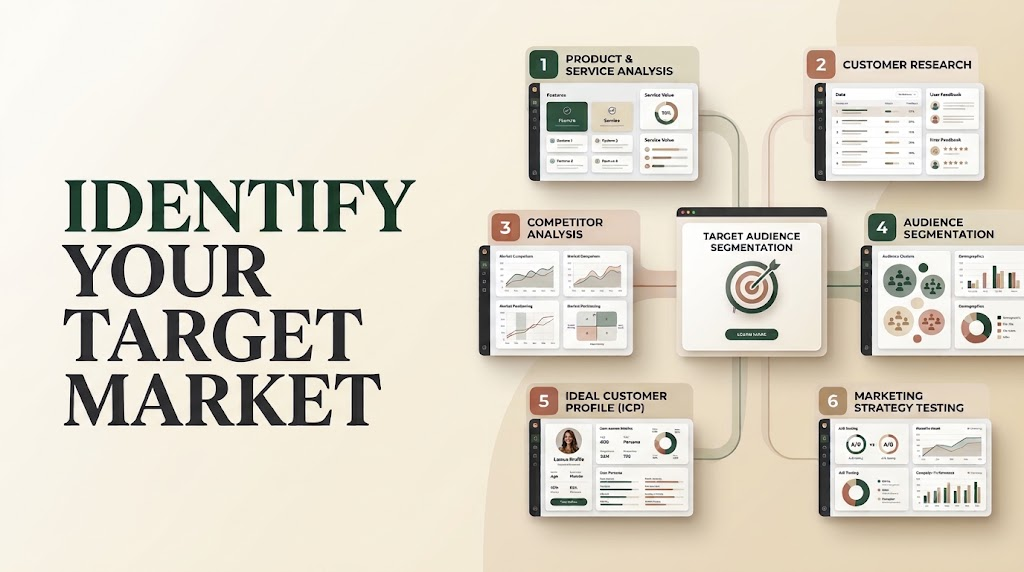
To identify your target market, define your product or service, research existing and potential customers, analyze competitors, segment your audience, create an ideal customer profile, and test your marketing strategy. Use customer data, buying behaviour, and campaign results to understand who is most likely to buy, what customers need, and where to reach them. These six steps help businesses identify the right audience, create relevant marketing messages, and improve conversions.
Connect With Our Experts
Request a Callback
Every business needs to know who its customers are. However, reaching the right people is not always easy. A product may solve a real problem, but it will not generate enough sales if it reaches people who do not need it.
This is why businesses must identify their target market before investing time and money in marketing. Target market research helps you understand customer needs, buying behaviour, interests, and purchasing decisions. Furthermore, it shows you which audience groups are most likely to value your products or services.
For example, a fitness studio may attract students, working professionals, and older adults. However, each group may have different fitness goals, schedules, and spending habits. Understanding these differences helps the business create better offers and reach the right customers.
In this guide, we will explain six simple steps to identify your target market, understand your ideal customers, and build a marketing strategy that supports business growth.
What Is a Target Market?
A target market is a specific group of people or businesses most likely to purchase a company’s products or services. These customers share common characteristics, such as age, location, income, interests, needs, or buying behaviour.
Rather than promoting products to everyone, businesses focus on the people who are most likely to benefit from their offerings.
For example, a company selling premium skincare products may focus on adults interested in skincare, willing to invest in quality products, and looking for solutions to specific skin concerns.
A clearly defined target market helps businesses:
- Understand customer needs and expectations.
- Develop relevant products and services.
- Create focused marketing campaigns.
- Choose suitable advertising channels.
- Improve customer acquisition and retention.
- Use marketing resources more effectively.
Target Market vs Target Audience vs Buyer Persona
These three terms are related, but they have different meanings.
| Term | Meaning | Example |
| Target Market | The broader group of potential customers | Adults interested in skincare |
| Target Audience | The specific group a marketing campaign aims to reach | Women aged 25–40 interested in premium skincare |
| Buyer Persona | A detailed profile representing an ideal customer | A 32-year-old professional looking for quality skincare products |
Understanding these differences makes target market analysis easier. It also helps businesses connect their overall market strategy with individual marketing campaigns.
Why Is It Important to Identify Your Target Market?
Identifying your target market helps you make better business and marketing decisions. Without a clear understanding of your customers, you may spend money promoting products to people who have little interest in buying them.
Furthermore, customer research helps businesses understand what influences purchasing decisions and which messages are more likely to attract attention.
Here are some important benefits:
- Better Marketing Decisions: You can choose marketing channels and messages that match your customers’ interests.
- Improved Customer Experience: Understanding customer expectations helps you offer products, services, and support that meet their needs.
- More Relevant Advertising: Audience targeting helps reduce irrelevant impressions and attract people with stronger buying intent.
- Stronger Product Positioning: Customer insights help you explain why your product is useful and what makes it different.
- Better Use of Resources: You can focus your time and marketing budget on customer groups with genuine business potential.
As a result, defining your target market creates a stronger foundation for customer acquisition, brand positioning, and long-term business growth.
Identify Your Target Market in 6 Simple Steps
Finding the right customers requires more than guessing their age or location. You need to study your offerings, collect customer information, understand market demand, and test your assumptions.
Follow these six steps to identify your target market and develop a more focused marketing strategy.
Step 1: Define Your Product or Service and Its Value
The first step in target market identification is understanding exactly what your business offers and why customers should choose it.
Start by examining your product or service. Identify the main problem it solves, the value it provides, and the people who are most likely to need it.
Ask yourself:
- What problem does my product or service solve?
- What makes my offering different from competitors?
- Who benefits most from this solution?
- What customer needs does it address?
- Why would someone choose my business over another option?
These questions help you connect your business offering with real customer needs.
Example: Imagine you own a company that provides project management software. Your product helps teams organize tasks, manage deadlines, and improve collaboration.
Your potential target market may include small businesses, growing companies, project managers, and remote teams. However, businesses with larger teams and complex workflows may need more advanced features.
Therefore, you should identify which customer group receives the greatest value from your solution.
Practical Tip: Write a one-sentence value proposition that explains what you offer, who benefits from it, and which problem it solves. Use this statement as the starting point for your target market research.
Step 2: Research Your Existing and Potential Customers
Once you understand your product, the next step is to learn more about the people who may purchase it.
Customer research helps you identify common characteristics, purchasing habits, expectations, and problems. Furthermore, it allows you to compare your assumptions with actual customer behaviour.
Start with your existing customer data. Look for patterns in the following areas:
- Age and Gender: Which age groups or customer categories purchase most often?
- Location: Where do your existing customers live or operate?
- Income and Spending Habits: What price range can they comfortably afford?
- Interests: Which topics, products, or services attract their attention?
- Buying Behaviour: How do customers discover, compare, and purchase products?
- Customer Challenges: What problems encourage them to look for your solution?
You can collect these insights through customer surveys, interviews, sales records, website analytics, social media interactions, and customer feedback.
Also, research potential customers who have not purchased from you yet. Their needs may reveal new opportunities for your business.
Example: A skincare company reviews its customer records and discovers that most repeat buyers are between 25 and 40 years old. Customer surveys also show that many buyers prefer products for sensitive skin.
This information gives the company a clearer direction for product positioning and marketing messages.
Practical Tip: Use tools such as Google Analytics 4, Google Search Console, and customer surveys to understand how people discover your business and what interests them.
For more ideas, read Ecsion’s guide on Customer Engagement Strategies.
Step 3: Analyze Your Competitors and Market Demand
Understanding your competitors is another important part of target market analysis. Competitor research helps you discover which customer groups other businesses serve, what they offer, and where opportunities may exist.
However, the goal is not to copy their marketing strategy. Instead, study their approach to identify gaps and understand what customers expect from businesses in your industry.
Focus on these areas:
- Competitor Audience: Who are their main customers?
- Products and Services: Which solutions do they promote?
- Pricing: How do their prices compare with yours?
- Customer Reviews: What do buyers appreciate or complain about?
- Marketing Channels: Where do they attract customer attention?
- Market Demand: Are people actively searching for similar products or services?
You can use competitor websites, customer reviews, social media comments, keyword research tools, and industry reports to gather useful information.
Example: Suppose you operate an online learning platform for professionals. Your competitors mainly offer general courses. However, customer reviews reveal that many learners want short, practical courses designed for specific job skills.
This gap may represent an opportunity to target working professionals who prefer focused learning.
Furthermore, keyword research can help you understand what potential customers search for before making a purchase.
Practical Tip: Create a competitor comparison table and record their audience, pricing, strengths, weaknesses, and customer feedback. Use these findings to identify customer needs that your business can serve better.
Step 4: Segment Your Market Based on Customer Characteristics
After collecting customer and competitor information, divide your broader market into smaller groups. This process is known as market segmentation.
It helps businesses understand that not every customer has the same needs, interests, or purchasing behaviour.
There are four common types of market segmentation:
| Segmentation Type | What It Examines | Example |
| Demographic | Age, gender, income, occupation, education | Working professionals aged 25–40 |
| Geographic | Country, city, region, climate, location | Customers living in metropolitan cities |
| Psychographic | Interests, lifestyle, values, preferences | People interested in healthy living |
| Behavioural | Buying habits, product usage, loyalty, purchase intent | Customers who regularly purchase skincare products |
Each segmentation type provides a different view of your potential customers.
For example, a fitness business may segment its market into college students, working professionals, and older adults.
However, each group may respond to different offers:
- Students may prefer affordable membership plans.
- Working professionals may value flexible schedules.
- Older adults may look for low-impact fitness programmes.
Therefore, market segmentation allows businesses to create more relevant products, offers, and marketing campaigns.
Practical Tip: Start with two or three meaningful customer segments. Compare their needs, purchasing ability, and potential business value before deciding which group to prioritize.
Step 5: Create a Detailed Buyer Persona
Once you have identified promising customer segments, create a buyer persona to understand your ideal customer in greater detail.
A buyer persona is a research-based profile that represents a typical customer. It includes information about their background, goals, challenges, interests, and purchasing decisions.
A useful buyer persona should include:
- Name or profile label.
- Age group and occupation.
- Location and income range.
- Personal or professional goals.
- Common problems and challenges.
- Preferred products or services.
- Purchasing motivations.
- Preferred communication channels.
- Common objections before buying.
Example: Buyer Persona for a Project Management Software Company
| Attribute | Customer Profile |
| Name | Priya |
| Age | 30–40 years |
| Occupation | Business Manager |
| Location | Major cities |
| Main Goal | Improve team productivity |
| Biggest Challenge | Managing multiple projects |
| Buying Motivation | Better task visibility and collaboration |
| Preferred Channels | Google Search, LinkedIn, industry blogs |
| Main Concern | Cost and ease of implementation |
This persona helps the company understand what matters to its potential customers.
For instance, instead of promoting general software features, the business can highlight how its platform helps managers organize projects, monitor deadlines, and improve team coordination.
Practical Tip: Build buyer personas using actual customer interviews, surveys, sales data, and website behaviour. Avoid creating profiles based only on assumptions.
Step 6: Test Your Target Market and Refine Your Marketing Strategy
The final step is to test your target market assumptions. Research can help you identify potential customers, but actual campaign results show whether your chosen audience responds to your offer.
Start with small marketing campaigns and compare different customer segments.
You can test:
- Different age groups and locations.
- Customer interests and buying motivations.
- Advertising messages and offers.
- Search campaigns and social media campaigns.
- Landing pages and calls to action.
- Retargeting campaigns for previous website visitors.
For example, a company selling online accounting software may test two audience groups: small business owners and freelance professionals.
The first campaign may focus on business reporting and team access. The second may highlight invoice management and expense tracking.
After running both campaigns, compare their results to understand which group generates more qualified leads and paying customers.
Use Retargeting to Understand Customer Interest
Not every visitor purchases a product during their first website visit. Some people need more information before making a decision.
Retargeting helps businesses reconnect with eligible previous website visitors or people who have interacted with their brand.
For example, a visitor may explore your pricing page but leave without submitting an enquiry. A relevant follow-up advertisement can remind them about your product and encourage them to return.
However, retargeting should support your audience strategy, not replace it. You still need to understand why people visited, what they were looking for, and what may have prevented them from converting.
Track Conversions to Measure Audience Quality
Website traffic and advertisement clicks do not always indicate business success. You should also measure the actions that matter to your business.
Important conversion metrics include:
- Conversion Rate: The percentage of visitors who complete a desired action.
- Cost per Lead (CPL): The amount spent to generate a lead.
- Customer Acquisition Cost (CAC): The cost of acquiring a paying customer.
- Return on Ad Spend (ROAS): The revenue generated for each unit of advertising spend.
- Lead-to-Customer Rate: The percentage of leads that become paying customers.
Use Google Analytics 4, advertising platform reports, and CRM data to understand campaign performance. Ensure that important actions, such as form submissions, calls, and purchases, are tracked correctly.
Furthermore, compare lead quality instead of judging campaigns only by clicks or impressions.
Practical Tip: Review campaign results regularly. Keep the audience groups that generate valuable enquiries and purchases. Adjust or remove segments that consistently attract irrelevant traffic.
For additional guidance, explore Ecsion’s article on Instagram Ads for Small Businesses.
Connect With Our Experts
Request a Callback
Campaign Diagnostic Framework: Are You Reaching the Right Market
Identifying your target market is only the beginning. You must also check whether your marketing campaigns are attracting the right people and generating meaningful business results.
A campaign diagnostic framework helps you identify where your marketing strategy needs improvement.
Use the following framework to review your campaign performance:
| Campaign Performance | Possible Problem | Recommended Action |
| High impressions but low clicks | Your message may not appeal to the audience | Improve ad copy and audience relevance |
| High clicks but low conversions | Landing page or offer may not match customer expectations | Review landing page content and CTA |
| High leads but low sales | You may be attracting the wrong customer segment | Review lead quality and buyer persona |
| High cost per lead | Audience targeting or campaign costs may be inefficient | Test different segments and advertising messages |
| Low engagement | Your content may not match customer interests | Research customer needs and improve content |
| Good conversions but low profit | Customer acquisition costs may be too high | Review pricing, acquisition costs, and customer value |
A Practical Example
Suppose an online software company runs two advertising campaigns.
- Campaign A generates 150 leads, but only 5 become paying customers.
- Campaign B generates 70 leads, but 18 become paying customers.
Although Campaign A attracts more leads, Campaign B produces more customers.
This shows why businesses should evaluate audience quality instead of focusing only on lead volume.
Furthermore, conversion tracking helps you understand which audience groups contribute to actual sales. Use these insights to refine your target market and allocate your marketing resources more effectively.
For a broader perspective on customer discovery and conversion, explore Bizfire Insights.
Target Market Examples Across Different Industries
Understanding target market examples can help you apply customer research to your own business. Different industries attract customers based on their products, pricing, customer needs, and purchasing behaviour.
Here are four practical examples.
1. Target Market for a Fitness Business
A fitness studio may target:
- Students interested in affordable fitness programmes.
- Working professionals looking for flexible workout schedules.
- Adults interested in strength training and weight management.
- Older adults looking for suitable fitness programmes.
The business can create separate membership options and marketing messages for each group.
2. Target Market for an E-Commerce Business
An online clothing store may target:
- Young adults interested in fashion trends.
- Professionals looking for formal clothing.
- Budget-conscious shoppers.
- Customers who prefer premium clothing brands.
By studying browsing behaviour, purchase history, and customer preferences, the store can recommend more relevant products.
3. Target Market for a B2B Software Company
A software company offering business management solutions may target:
- Small business owners.
- Growing companies with larger teams.
- Operations managers.
- Businesses looking to improve workflow management.
In this case, purchasing decisions may depend on business size, operational challenges, software requirements, and available budgets.
4. Target Market for a Local Service Business
A plumbing company may target homeowners, property managers, landlords, and commercial property owners within its service area.
However, these customers may have different requirements. Homeowners may need urgent repairs, while commercial property managers may require regular maintenance.
Therefore, location, service requirements, and customer intent should guide the business’s marketing strategy.
Common Mistakes to Avoid When Identifying Your Target Market
Even with proper research, businesses can make mistakes when selecting their ideal customers. These mistakes may lead to poor marketing decisions, irrelevant traffic, and missed sales opportunities.
Watch out for these common problems:
- Targeting Everyone: A broad audience may seem attractive, but it can make your marketing message less relevant. Focus on customer groups that genuinely need your product.
- Relying on Assumptions: Do not decide who your customers are based only on personal opinions. Use customer feedback, sales records, and market research.
- Ignoring Existing Customers: Your current customers can provide valuable information about why people choose your business. Study their needs and buying patterns.
- Copying Competitors: Competitor research is useful, but their target market may not match your products, pricing, or business goals.
- Creating Too Many Segments: Dividing your market into too many small groups can make marketing difficult to manage. Prioritize segments with clear needs and business potential.
- Ignoring Changing Customer Behaviour: Customer expectations and purchasing habits can change over time. Review your research and update your audience profiles regularly.
- Measuring Clicks Instead of Business Results: High website traffic does not always mean more sales. Track qualified leads, purchases, and customer acquisition costs to evaluate performance.
Avoiding these mistakes helps businesses build a more accurate target market profile and make better decisions as their customer base grows.
How Often Should You Review Your Target Market?
Your target market should not remain fixed forever. Customer needs, industry conditions, competitors, and purchasing habits can change.
Therefore, review your target market whenever you introduce a new product, enter a new location, change your pricing, or notice significant changes in customer behaviour.
A practical review schedule could include:
- Monthly: Review campaign performance, website traffic, and lead quality.
- Quarterly: Analyze customer feedback, buying patterns, and audience segments.
- When Your Business Changes: Reassess your ideal customer profile when launching new products or entering new markets.
Regular target market analysis helps you recognize new opportunities and adjust your marketing strategy based on current customer needs.
Frequently Asked Questions
1. How do you identify your target market?
Start by understanding your product, researching existing customers, analyzing competitors, segmenting your market, creating buyer personas, and testing your marketing campaigns. These steps help you identify the customers most likely to purchase your products or services.
2. What are the four types of market segmentation?
The four main types are demographic, geographic, psychographic, and behavioural segmentation. Businesses use these methods to group customers based on personal characteristics, location, interests, and purchasing habits.
3. What is the difference between a target market and a target audience?
A target market is the broader group of potential customers for a product or service. A target audience is the specific group a business wants to reach through a particular marketing campaign.
4. Why is target market research important?
Target market research helps businesses understand customer needs, identify buying patterns, evaluate market demand, and develop relevant marketing strategies. It also helps reduce wasted marketing spend.
5. What tools can help identify your target market?
Useful tools include Google Analytics 4, Google Search Console, Google Trends, customer surveys, CRM systems, social media analytics, and keyword research tools. These resources provide insights into customer interests, website behaviour, search demand, and purchasing patterns.
6. Can a business have more than one target market?
Yes. A business can serve multiple customer segments with different needs and purchasing preferences. However, each segment should have a clear purpose and a suitable marketing approach.
The Importance of Knowing Your Target Customers
Identifying your target market is an important part of building a successful business. It helps you understand who your customers are, what they need, and why they may choose your products or services.
Start by defining your offering and researching existing customers. Next, study competitors, divide your market into meaningful segments, and create detailed buyer personas. Finally, test your marketing campaigns and use conversion data to refine your audience.
Furthermore, keep reviewing customer behaviour as your business grows. A well-defined target market helps you make informed decisions, improve marketing performance, and build stronger customer relationships.
The goal is not to reach everyone. It is to reach the people who are most likely to value what your business offers.
Connect With Our Experts
Request a Callback