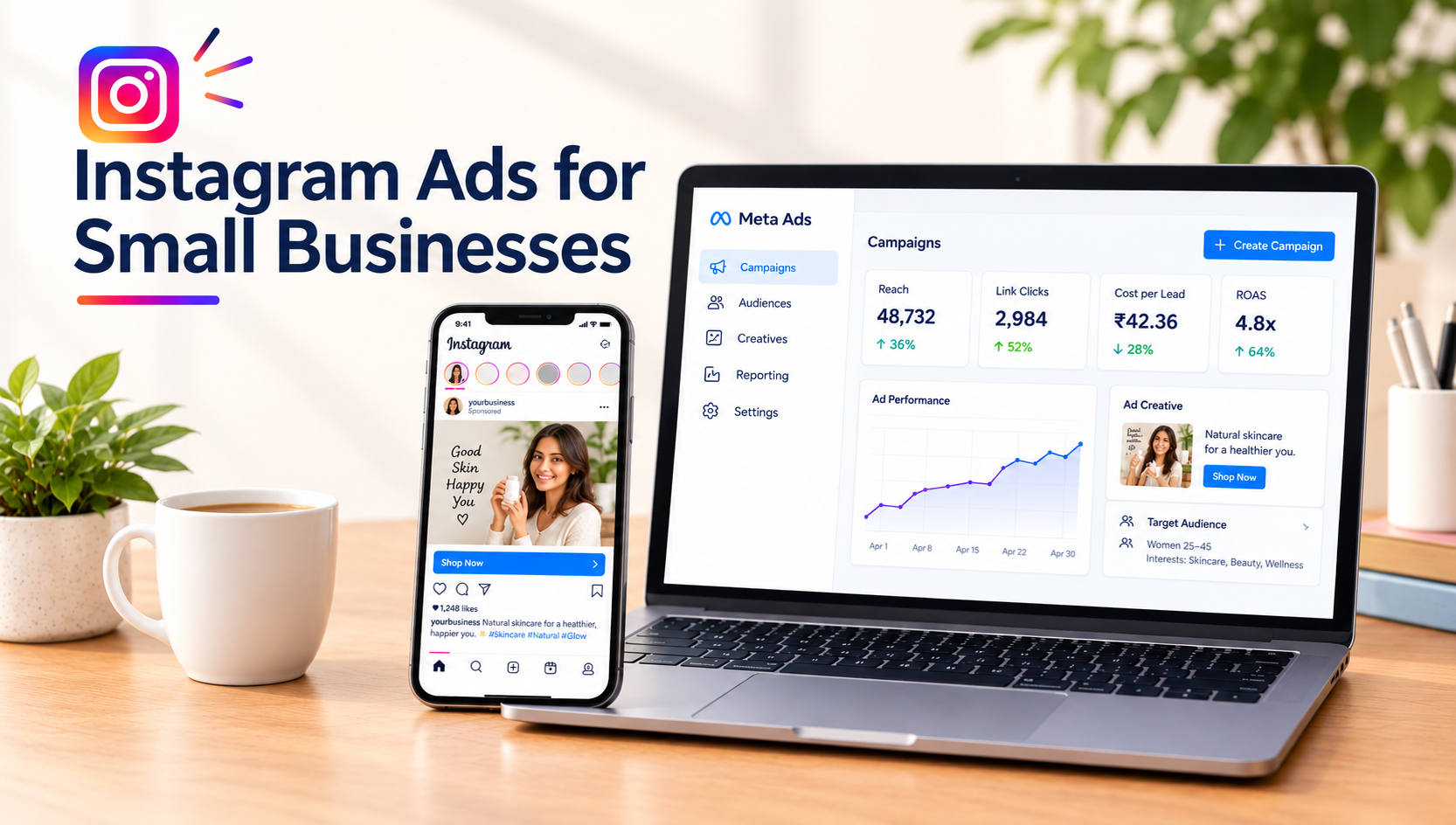
Small businesses can get more sales from Instagram Ads by targeting the right audience, creating engaging Reels and Stories, writing compelling ad copy, using clear calls to action, testing different creatives, and retargeting interested users. They should also track conversions, monitor Return on Ad Spend (ROAS), and optimize campaigns based on actual sales rather than likes or impressions.
Instagram has become an important advertising platform for small businesses that want to reach potential customers, promote products, and increase sales. However, simply running ads does not guarantee business growth. You need the right audience, compelling creatives, clear offers, and a strategy that turns clicks into customers.
Instagram Ads for Small Businesses can help brands reach people who are more likely to purchase, generate qualified leads, and build customer relationships. With the right Instagram advertising strategy, even businesses with limited marketing budgets can compete for attention in their target markets.
For example, a local clothing store can promote its latest collection through Instagram Reels Ads, while a beauty salon can use Instagram Stories Ads to encourage appointment bookings. The key is to match the ad format, audience, and message with the action you want customers to take.
For a broader understanding of paid advertising, explore Ecsion’s Instagram Ad Strategies to Grow Your Business and Bizfire’s growth insights.
In this guide, we will explore nine practical ways to improve Instagram ad campaigns, increase conversions, manage advertising costs, and generate more sales.
Why Are Instagram Ads Important for Small Businesses?
Instagram Ads give small businesses an opportunity to reach potential customers beyond their existing followers. Unlike organic posts, paid advertisements can be targeted using available audience, location, and interest settings.
Furthermore, businesses can select campaign objectives based on their marketing goals, such as awareness, engagement, leads, or sales.
Here are some important benefits:
- Reach potential customers: Introduce your products and services to people who may not know your business.
- Generate qualified leads: Encourage interested users to submit enquiries or contact your team.
- Increase website traffic: Direct potential buyers to product pages, service pages, and landing pages.
- Improve brand recognition: Show your business to relevant audiences through different ad placements.
- Measure campaign performance: Review clicks, conversions, purchases, and advertising costs.
- Retarget interested users: Reconnect with eligible audiences who previously interacted with your business.
However, advertising works best when it supports a well-designed customer journey. Your website, landing pages, and follow-up process should make it easy for interested users to take the next step.
Read Ecsion’s 10 Proven Facebook Ads Strategies to Boost Sales for additional paid social advertising ideas. You can also explore Bizfire’s website growth approach to understand why converting visitors matters as much as attracting them.
9 Ways to Use Instagram Ads for Small Businesses to Get More Sales
1. Target the Right Audience for Better Ad Results
Audience targeting is one of the most important parts of Instagram advertising. Even an attractive advertisement may generate poor results when it reaches people who have little interest in your products or services.
Therefore, define your ideal customer before launching a campaign.
Consider these factors:
- Location: Target customers within the cities, regions, or service areas where your business operates.
- Age group: Select age ranges that match your typical customers.
- Interests: Use relevant interests and audience signals where available.
- Customer behaviour: Consider shopping intent and previous interactions where eligible targeting options are available.
- Existing customers: Use eligible customer data to build relevant custom audiences.
For example, a local fitness studio in Pune may target people within its service area who are interested in fitness, exercise, and healthy lifestyles. This approach can make the advertising message more relevant than targeting an entire country.
You should also avoid narrowing your audience too much without a clear reason. Test different audience groups and compare their results before increasing your budget.
Related reading: Instagram Ad Strategies | Bizfire SEO and AI Plugin
2. Create Engaging Instagram Reels Ads
Instagram Reels Ads can help small businesses present products and services through short-form video content. They provide an opportunity to demonstrate how something works, highlight product features, and communicate an offer.
Instead of creating a video that looks like a traditional advertisement, focus on content that feels relevant to your target audience.
Try these creative ideas:
- Show how your product works in everyday situations.
- Demonstrate a product before and after use, where appropriate.
- Highlight three important product benefits.
- Share a short customer testimonial with permission.
- Introduce a limited-time offer with clear terms.
- Show how your service solves a common customer problem.
For example, a bakery can create a short video showing how a custom cake is prepared and decorated. The advertisement can end with a clear message encouraging viewers to place an order.
Best practice: Use vertical video designed for Reels, capture attention early, and make the main benefit easy to understand.
Additionally, test different opening scenes and video lengths. A creative that attracts attention is useful, but one that also encourages enquiries or purchases is more valuable.
Related reading: Ecsion’s Instagram advertising strategies | Bizfire’s growth platform
3. Use Instagram Stories Ads to Promote Special Offers
Instagram Stories Ads appear between organic Stories and offer businesses a full-screen advertising format.
They can be useful for promoting seasonal offers, new products, service packages, and upcoming sales.
To make your Instagram Stories Ads more effective:
- Start with a clear offer or customer benefit.
- Use attractive images or short videos.
- Keep the message short and easy to read.
- Include a relevant call to action.
- Direct users to the correct product page, website, or messaging destination.
For example, an online skincare store can advertise a new product range with the message: “Discover Your Daily Skincare Essentials.” The advertisement can direct interested users to the product collection.
However, avoid adding too much text or multiple unrelated offers to one Story. A focused advertisement gives customers a clearer reason to take action.
Related reading: Ecsion’s social media marketing resources | Bizfire’s insights
4. Write Compelling Instagram Ad Copy with Clear CTAs
Your Instagram ad copy should explain what you offer, why it matters, and what customers should do next.
Strong visuals may attract attention, but clear messaging helps users understand the value of your product or service.
Use this simple structure:
| Ad copy element | What to include |
| Opening hook | A question, problem, or interesting benefit |
| Main message | Explain the product or service |
| Value proposition | Highlight what makes your offer useful |
| Call to action | Tell customers what to do next |
Example of Instagram ad copy:
Looking for stylish everyday outfits? Explore our latest clothing collection, discover new designs, and find styles that match your preferences. Shop the collection today!
Choose a CTA that matches the campaign objective:
- Shop Now for product purchases.
- Learn More for product or service information.
- Sign Up for registrations.
- Book Now for appointment-based services.
- Contact Us for enquiries.
Furthermore, make sure your advertisement and landing page communicate the same offer. When customers click an ad promising a discount, they should be able to find that discount easily on the destination page.
For more ideas, read Ecsion’s Facebook Ads strategies and explore Bizfire’s website growth solutions.
5. Use Instagram Carousel Ads to Showcase Multiple Products
Instagram Carousel Ads allow businesses to display multiple images or videos within one advertisement. Users can swipe through the cards to explore different products, features, or benefits.
This format is especially useful for businesses that want to present several options without creating separate advertisements for every item.
Consider these examples:
- A clothing brand can showcase different outfits from one collection.
- A furniture store can display different designs and product features.
- A restaurant can highlight several popular menu items.
- A digital service company can explain different service offerings.
- An online store can present product variations and benefits.
For better results, arrange your carousel cards in a logical order. Start with the most attractive product or strongest benefit, then use the remaining cards to provide more information.
Also, include a clear CTA that directs users to the relevant destination.
Related reading: Instagram Ad Strategies by Ecsion | Bizfire SEO and AI Plugin
6. Set a Realistic Instagram Advertising Budget
A small business does not need to spend a large amount immediately to begin advertising. Instead, start with a budget that your business can afford and use the initial campaign to understand audience response.
Your Instagram Ads budget should depend on your business goals, audience size, product price, competition, and expected customer acquisition cost.
Follow these steps:
- Set a clear campaign objective.
- Decide how much you can spend during the testing period.
- Test a small number of relevant audiences and creatives.
- Monitor spending and conversion results.
- Increase the budget only when the campaign produces satisfactory results.
For example, suppose an online store starts with a daily advertising budget of ₹500. It can test two different creatives and compare their cost per purchase, conversion rate, and revenue.
However, do not increase spending just because an advertisement receives more likes or clicks. Look at the actions that contribute to business revenue.
Related reading: Ecsion’s paid advertising resources | Bizfire’s Intelligence and growth products
7. Use Instagram Retargeting Ads to Reach Interested Customers
Not every customer makes a purchase during their first interaction with a business. Some users may visit your website, view a product, interact with your Instagram account, or add an item to their cart without completing the purchase.
Instagram retargeting ads help businesses reconnect with eligible audiences who have previously interacted with their brand.
Depending on available audience and tracking options, you can create custom audiences based on:
- Website visitors.
- Product page visitors.
- People who added products to their carts.
- Instagram account engagers.
- Video viewers.
- Previous customers.
For example, imagine a customer visits an online shoe store and views a particular pair of sneakers but does not purchase them. The business can use an eligible retargeting audience to show that customer a relevant advertisement later.
To improve your retargeting strategy:
- Show products or services related to previous interactions.
- Highlight useful product benefits.
- Address common purchase concerns.
- Use clear and relevant offers.
- Exclude recent purchasers when the campaign is not intended for them.
Remember that retargeting depends on audience eligibility, consent, platform settings, and available tracking data. It should also respect applicable privacy requirements.
Related reading: Ecsion’s Instagram advertising guide | Bizfire’s attribution and growth insights
8. Track Instagram Ad Conversions and Improve ROAS
Running Instagram Ads without measuring conversions makes it difficult to understand whether your advertising is generating business results.
Two important metrics to monitor are conversion rate and Return on Ad Spend (ROAS).
What is ROAS?
ROAS measures how much revenue your advertising generates for every unit of advertising spend.
ROAS=RevenuefromAdsAdvertisingSpend
For example, suppose your Instagram campaign generates ₹30,000 in attributed revenue from an advertising spend of ₹5,000.
ROAS=30,0005,000=6
This means the campaign generated ₹6 in attributed revenue for every ₹1 spent on advertising.
However, ROAS is not the same as profit. Product costs, shipping, salaries, taxes, and other expenses must also be considered.
Important metrics to track:
| Metric | What it tells you |
| CTR | How often people click after seeing your ad |
| CPC | Average cost per click |
| CPM | Cost per 1,000 impressions |
| Conversion rate | Percentage of visitors who complete the desired action |
| CPA | Cost of acquiring a conversion |
| ROAS | Revenue generated per unit of ad spend |
| Frequency | Average number of times an ad is shown to a person |
To measure website activity, configure the Meta Pixel and consider the Conversions API where appropriate. Check that important events, such as product views, leads, and purchases, are recorded correctly.
You can also use UTM parameters and analytics tools to understand how visitors behave after clicking an advertisement.
Furthermore, compare platform-reported results with your actual orders and enquiries. Attribution differences can occur because of reporting windows, privacy restrictions, and differences in measurement methods.
Related reading: Ecsion’s digital marketing resources | Bizfire’s attribution insights
9. Test and Optimize Instagram Ad Campaigns Regularly
A successful Instagram Ads strategy requires regular testing. An advertisement that performs well initially may lose effectiveness over time. Similarly, a new audience or creative may produce better results than your existing campaign.
Therefore, monitor campaign performance and make changes based on reliable data.
Focus on testing:
- Ad creatives: Compare different images, videos, and Reels.
- Headlines: Test different opening messages and benefits.
- Audience groups: Compare relevant audience segments.
- CTAs: Check which action encourages more valuable conversions.
- Landing pages: Test different layouts, offers, and page experiences.
- Placements: Review performance across eligible Instagram placements.
For example, a furniture store may test two advertisements. The first highlights product design, while the second focuses on durability and comfort. By comparing purchases and cost per purchase, the business can identify which message works better.
Avoid changing too many campaign elements at once. Otherwise, it becomes difficult to identify what caused the improvement or decline.
Related reading: Ecsion’s Instagram Ad Strategies | Bizfire’s SEO and AI Plugin
Instagram Ads Campaign Diagnostic Framework: Find Out Why Your Ads Are Not Generating Sales
Getting impressions and clicks does not always mean your Instagram Ads campaign is successful. To improve results, identify where potential customers are leaving the buying journey.
Use this diagnostic framework to identify common advertising problems and the actions you can take.
| Campaign problem | Possible reason | Recommended action |
| Low impressions | Limited audience, budget, or delivery issues | Review targeting, budget, and campaign delivery |
| Low CTR | Weak creative or unclear messaging | Test new visuals and stronger hooks |
| High CPC | Low engagement or expensive audience competition | Test creatives and relevant audience groups |
| Clicks but no sales | Landing page, pricing, or offer issues | Improve the purchase experience |
| High add-to-cart, low purchases | Checkout friction or unexpected costs | Review checkout steps and shipping information |
| High CPA | Poor conversion performance or expensive acquisition | Review audience quality and conversion rate |
| Low ROAS | Revenue is low compared with ad spend | Improve conversion value and campaign efficiency |
| Repeated ad exposure | High frequency and possible creative fatigue | Test fresh creatives and review audience reach |
Follow the Customer Journey Before Changing Your Budget
Instagram Ads Conversion Funnel
- Ad Impression
Are the right people seeing your advertisement?
- Ad Click
Does the creative encourage relevant users to click?
- Landing Page Visit
Does the page match the advertisement and offer?
- Enquiry or Add to Cart
Can visitors easily take the next step?
- Purchase or Qualified Lead
Are advertising interactions generating business results?
Use the funnel to find where performance drops. For example, when an advertisement receives clicks but produces few purchases, increasing the ad budget may not solve the problem. First, review the landing page, product information, pricing, checkout process, and conversion tracking.
Similarly, when users submit enquiries but do not become customers, examine lead quality and follow-up processes.
This approach helps businesses focus on the actual problem instead of making random campaign changes.
For more information, explore Ecsion’s digital marketing blog and Bizfire’s approach to conversion and business intelligence.
Best Practices for Instagram Ads for Small Businesses
The nine strategies can improve campaign performance, but businesses should also follow a few important practices to get better results over time.
- Start with one clear objective: Decide whether you want purchases, leads, website visits, or messages.
- Use mobile-friendly creatives: Make sure images, videos, and text look good on mobile screens.
- Keep your offer relevant: Promote products and services that match your audience’s needs.
- Create dedicated landing pages: Send users to pages that directly relate to the advertisement.
- Test before scaling: Compare different creatives, audiences, and messages before increasing spending.
- Monitor conversion quality: Measure actual purchases and qualified enquiries instead of focusing only on engagement.
- Follow advertising policies: Review Meta’s advertising standards before publishing campaigns.
You can learn more about ad placements and creative selection through Meta Blueprint’s advertising training. For additional website optimization ideas, explore Bizfire’s SEO and AI Plugin.
Frequently Asked Questions About Instagram Ads for Small Businesses
1. Are Instagram Ads effective for small businesses?
Yes. Instagram Ads can help small businesses reach relevant audiences, promote products, generate leads, and increase sales. Results depend on audience targeting, creative quality, campaign objectives, offers, and conversion optimization.
2. How much should a small business spend on Instagram Ads?
There is no fixed advertising budget for every business. Start with an affordable testing budget, monitor cost per conversion, and increase spending when the campaign generates satisfactory results.
3. Which Instagram ad format is best for increasing sales?
Reels, Stories, Feed, and Carousel Ads can all support sales campaigns. The best format depends on your product, audience, creative, and campaign objective. Test different formats to identify what generates the most valuable conversions.
4. How can I get more customers from Instagram Ads?
To attract more customers, target relevant audiences, create engaging advertisements, communicate clear product benefits, use strong CTAs, and direct users to relevant landing pages. Additionally, use retargeting and conversion tracking to improve campaign performance.
5. What is a good ROAS for Instagram Ads?
There is no universal good ROAS. It depends on product margins, operating costs, customer acquisition costs, and business goals. A campaign with a high ROAS may still be unprofitable when its other costs are high.
6. What is Instagram retargeting?
Instagram retargeting involves showing advertisements to eligible people who have previously interacted with your business. These audiences may include website visitors, Instagram engagers, and previous customers, depending on available targeting options.
7. How can I track sales from Instagram Ads?
You can track sales using Meta Ads Manager, the Meta Pixel, and the Conversions API where appropriate. UTM parameters and website analytics can also help you understand traffic sources and customer activity.
For more advertising and website growth resources, visit Ecsion’s blog library and Bizfire’s business growth insights.
Turn Instagram Advertising into More Sales
Instagram Ads can help small businesses connect with potential customers, promote their offerings, and increase revenue. However, successful advertising requires more than attractive images and regular spending.
Start by understanding your target audience, choosing the right ad formats, and creating messages that communicate clear benefits. Furthermore, use retargeting to reconnect with interested users and monitor conversion metrics to understand campaign performance.
Most importantly, evaluate your advertising based on purchases, qualified leads, and revenue rather than likes and impressions alone.
With consistent testing, accurate conversion tracking, and a well-optimized customer journey, Instagram Ads for Small Businesses can become a valuable part of your digital marketing strategy.
Explore Ecsion’s digital marketing resources and Bizfire’s growth solutions to learn more about improving online visibility, customer acquisition, and business performance.