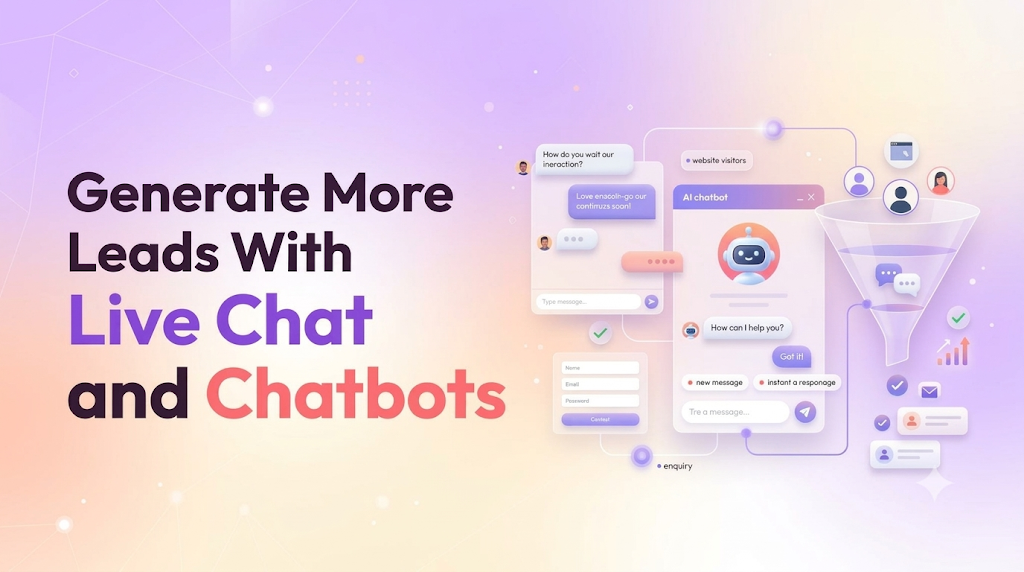
You can generate leads with live chat and chatbots by engaging website visitors, answering their questions, understanding their requirements, and collecting contact information with their permission.
Live chat allows sales representatives to provide personalized assistance and build relationships with potential customers. Chatbots engage visitors automatically, answer frequently asked questions, qualify prospects, and collect enquiry details. When combined with relevant website conversion strategies, these tools can help businesses turn more website visitors into qualified leads.
Getting visitors to your website is only the first step toward growing your business. The real challenge is turning those visitors into potential customers. Many people visit business websites to explore products, compare services, or find answers to their questions. However, not everyone is ready to complete a contact form or make a purchase immediately. Without timely assistance, businesses may lose valuable opportunities to connect with these visitors.
This is where live chat and chatbots can make a difference. Both tools help businesses communicate with website visitors, understand their needs, and encourage them to take the next step. While live chat connects visitors with human representatives, chatbots use automated conversations to answer common questions and collect useful information. Businesses can combine these tools with effective sales lead generation strategies to attract and convert more prospects.
So, how can you generate leads with live chat and chatbots? The answer lies in using both tools strategically. In this guide, you will discover two proven approaches, practical examples, lead qualification techniques, and ways to measure your results.
What Is Lead Generation?
Lead generation is the process of attracting potential customers and encouraging them to express interest in a business’s products or services. It involves identifying people who may need your offerings and collecting relevant information so your sales or marketing team can follow up.
For example, imagine someone visits a software company’s website to learn about its business solutions. The visitor starts a conversation through live chat and asks about pricing. After understanding the requirements, the representative collects the visitor’s name, business email, and project details with their permission. This interaction creates a potential sales lead.
Businesses use several methods to generate leads, including content marketing, search engine optimization, social media campaigns, email marketing, and website enquiry forms. You can explore more ways to generate sales leads for small businesses to understand how these methods support business growth.
Why Are Live Chat and Chatbots Important for Lead Generation?
Website visitors often have questions before they decide to contact a business. They may want to understand pricing, compare features, check service availability, or learn how a product works. However, waiting for an email response or searching through several website pages can make the process difficult.
Live chat and chatbots make communication easier by giving visitors a direct way to ask questions. They also help businesses identify visitor interests and guide potential customers toward relevant information. When supported by a well-designed website landing page, these conversations can encourage visitors to complete an enquiry.
Here are some important benefits:
- Faster customer assistance: Visitors can get answers without searching through multiple pages.
- Better visitor engagement: Interactive conversations encourage people to explore relevant products and services.
- Improved lead qualification: Businesses can ask questions to understand customer needs and buying intentions.
- More opportunities to capture leads: Visitors can share their contact details during relevant conversations.
- Personalized communication: Sales representatives can provide answers based on individual requirements.
- Better customer experience: Visitors have a convenient way to connect with the business.
Furthermore, businesses can use conversation insights to identify common questions and improve their marketing messages. These insights can also support target audience research and help companies understand what potential customers expect.
2 Powerful Techniques to Generate Leads With Live Chat and Chatbots
Live chat and chatbots serve different purposes, but both can support the same lead-generation goal. The following two strategies explain how businesses can use them to attract prospects, collect enquiries, and improve customer engagement.
1. Use Live Chat to Engage Visitors and Generate Qualified Leads
Live chat is a communication feature that allows website visitors to connect with a real person through a chat window. It gives potential customers an opportunity to ask questions and receive personalized answers while exploring your website.
For businesses, live chat creates an additional channel for customer communication. Instead of waiting for visitors to submit a contact form, sales representatives can respond to questions and understand what customers are looking for. This approach can support your wider sales lead generation process.
How Does Live Chat Help Generate Leads?
Live chat can support lead generation in several ways:
- Engage Visitors at the Right Time
Visitors may need additional information before contacting a business. A live chat invitation can help them start a conversation when they are exploring an important service or product page.
For example, a person visiting a web development company’s service page may want to understand the difference between custom website development and a ready-made solution. A chat representative can explain the available options and guide the visitor toward the most relevant service.
Businesses can also use insights from their website traffic analysis to identify pages where visitors may benefit from additional assistance.
- Provide Personalized Product and Service Recommendations
Not every visitor has the same requirements. Some customers may need a basic service, while others may be looking for a more advanced solution.
Live chat representatives can ask relevant questions about a visitor’s goals, budget range, preferences, or business requirements. Based on the answers, they can recommend suitable products or services.
For instance, a digital marketing agency may ask a visitor whether they need SEO services, paid advertising, or a complete digital marketing strategy. The representative can then direct the visitor toward the appropriate service.
This type of interaction helps businesses understand customer expectations and improve their target audience engagement.
- Capture Contact Details From Interested Visitors
Some visitors may need more information than a chat conversation can provide. In such cases, representatives can invite them to share their contact details for a consultation, quotation, or detailed discussion.
For example, a visitor interested in custom software development may ask about project costs and delivery requirements. The representative can collect the visitor’s name, business email, and project summary with permission so the sales team can follow up.
However, avoid requesting unnecessary personal information. Explain why the details are needed and how the business will use them. This makes the lead collection process more transparent.
You can also connect these enquiries with your broader lead generation strategy to organize follow-ups and evaluate lead quality.
- Build Trust Through Real-Time Assistance
Customers are more likely to consider a business when they can get clear answers to their questions. Live chat gives representatives an opportunity to explain services, address concerns, and provide useful information.
For example, someone considering a website development service may have questions about mobile responsiveness, maintenance, and technical support. A knowledgeable representative can explain these aspects and help the visitor understand the offering.
Additionally, clear service information and a useful website landing page experience can reinforce the visitor’s confidence.
Best Practices for Generating Leads Through Live Chat
To make live chat useful for lead generation, businesses should focus on the quality of conversations rather than simply increasing the number of chats.
Consider these practices:
- Make the chat option visible: Place the chat feature where visitors can find it without interrupting their browsing experience.
- Respond promptly: Long waiting times can discourage interested visitors from continuing the conversation.
- Train chat representatives: Ensure that your team understands your products, services, pricing, and common customer concerns.
- Ask relevant questions: Collect information that helps you understand the visitor’s requirements.
- Use clear communication: Keep responses simple, helpful, and focused on the customer’s question.
- Offer a suitable next step: Invite interested visitors to request a quotation, schedule a consultation, or contact your sales team.
- Review chat conversations: Identify recurring questions and areas where your team can improve its responses.
Furthermore, businesses should review their landing page conversion performance to understand whether live chat is helping visitors move toward meaningful actions.
Example: How a Web Development Company Can Generate Leads Through Live Chat
Imagine a web development company receives 2,000 website visitors every month. Many visitors explore its service pages, but only a small number submit enquiry forms.
The company introduces live chat to help visitors understand its services. When someone opens the website development page, a representative can offer assistance and ask what type of website the visitor needs.
A potential customer may explain that they need an eCommerce website with product management and online payment features. The representative can answer basic questions, explain the available services, and invite the visitor to request a project consultation.
The sales team can then follow up with interested prospects and discuss their requirements in greater detail. By combining live chat with relevant website development information, the company creates another opportunity to turn website visitors into potential customers.
2. Use Chatbots to Automate Conversations and Capture More Leads
Chatbots are software applications that communicate with website visitors through automated conversations. They can answer predefined questions, guide users through different options, collect enquiry details, and direct visitors to relevant information.
Unlike live chat, chatbots do not always require a human representative to respond to every interaction. They can handle common questions and initial conversations automatically, based on their configuration.
This makes chatbots useful for businesses that want to engage website visitors even when their sales or support teams are unavailable. When combined with effective digital marketing strategies, chatbots can support a more organized lead-generation process.
How Do Chatbots Help Generate Leads?
Chatbots can contribute to lead generation through several useful activities.
- Welcome Visitors With Automated Messages
A chatbot can display a welcome message when someone visits your website or opens the chat window. This gives visitors a convenient starting point for asking questions.
For example, an online software company could display:
“Welcome! Are you looking for business software, website development, or technical support?”
The visitor can select an option and continue the conversation. Based on the response, the chatbot can provide relevant information or guide the visitor toward a suitable service page.
However, welcome messages should be helpful rather than intrusive. A simple invitation can be more effective than repeated pop-ups that interrupt browsing.
Businesses can also connect these conversations with their website traffic generation efforts to understand how different traffic sources interact with the website.
- Collect Contact Information Through Automated Conversations
One of the useful applications of chatbot lead generation is collecting contact information during a conversation.
For example, a chatbot on a consulting company’s website could ask:
- What type of service are you interested in?
- Is this for an individual or a business?
- What is your primary requirement?
- Would you like someone from our team to contact you?
After understanding the visitor’s needs, the chatbot can request a name and email address with an explanation of the intended follow-up.
This creates an opportunity for the sales team to contact interested prospects. However, businesses should avoid asking for excessive information or making contact details a requirement for accessing basic answers.
For better results, use a clear lead generation approach that connects chatbot enquiries with the next stage of the sales process.
- Qualify Leads With Relevant Questions
Not every website visitor is ready to become a customer. Some people are simply researching, while others are comparing service providers or preparing to make a purchase.
Chatbots can ask a few relevant questions to understand the visitor’s needs and level of interest.
For example, a software development company may ask:
- What type of software are you looking to develop?
- Do you already have a project plan?
- When would you like to begin?
- Would you like to discuss your requirements with our team?
The responses can help the business identify enquiries that need immediate attention and those that may require further information.
Additionally, businesses can use these insights to improve target audience identification and create more relevant follow-up communication.
- Answer Frequently Asked Questions
Visitors often ask similar questions about pricing, services, delivery timelines, product features, and support.
A chatbot can provide predefined answers to common questions, reducing the need for representatives to handle every basic enquiry manually.
For instance, an eCommerce business could configure its chatbot to answer questions about shipping, payment methods, product availability, and return policies.
When a question requires a detailed explanation, the chatbot should provide an option to connect with a human representative or submit an enquiry.
This creates a more useful customer experience and allows businesses to focus their human support resources on conversations that need additional attention. It also supports a stronger website conversion experience.
- Guide Visitors Toward Relevant Services
A chatbot can help visitors find the information they need by presenting suitable options based on their responses.
For example, a digital marketing agency could offer these chatbot options:
- SEO services
- Website development
- Google Ads management
- Social media marketing
- Custom software development
When a visitor selects a service, the chatbot can share the relevant page and ask whether they need further assistance.
This makes it easier for visitors to explore the business’s offerings without searching through the entire website. Moreover, linking chatbot conversations with relevant service information can help visitors make informed decisions.
Best Practices for Generating Leads Through Chatbots
A chatbot should make communication easier, not create additional work for website visitors. Therefore, businesses should focus on simple conversations and useful responses.
Here are some practices to follow:
- Create clear conversation paths: Organize questions around common visitor requirements.
- Use simple language: Make chatbot messages easy to understand.
- Ask only relevant questions: Avoid collecting information that does not support lead qualification or follow-up.
- Provide useful answers: Keep the chatbot’s information accurate and updated.
- Offer human assistance: Allow visitors to connect with a representative when automated responses are insufficient.
- Make contact collection transparent: Explain why information is requested and how it will be used.
- Test conversations regularly: Check for incorrect answers, broken links, and confusing question sequences.
- Review chatbot performance: Measure completed enquiries, qualified leads, and visitor interactions.
Furthermore, businesses should make sure their chatbot works properly on mobile devices and does not cover important website content. A well-structured landing page can help visitors move naturally from a conversation to an enquiry.
Example: How an eCommerce Business Can Generate Leads Through Chatbots
Imagine an online store sells office furniture. Visitors often browse desks, chairs, and storage products but leave without contacting the business.
The company introduces a chatbot to help visitors find suitable products. When someone opens the chat window, the chatbot asks whether they are looking for office chairs, desks, or complete office furniture solutions.
A visitor selects office chairs and receives information about available options. The chatbot then asks whether the visitor needs a single chair or furniture for an entire office.
Based on the response, it can guide the visitor toward relevant products and offer an enquiry option for bulk requirements.
The business can use these interactions to understand customer interests and identify potential sales opportunities. Combined with relevant website traffic strategies, chatbot conversations can help businesses make better use of their existing website visitors.
Live Chat vs. Chatbots: Which Is Better for Lead Generation?
Both live chat and chatbots can support lead generation, but their functions are different. The right choice depends on your business requirements, customer expectations, and available resources.
| Comparison | Live Chat | Chatbots |
| Communication | Human-to-human conversations | Automated conversations |
| Response availability | Depends on representative availability | Can operate automatically according to configuration |
| Personalization | Representatives can adapt responses to individual needs | Responses depend on the chatbot’s design and capabilities |
| Lead qualification | Representatives ask questions and assess requirements | Automated questions collect initial qualification details |
| Common questions | Handled by representatives | Can answer predefined questions |
| Complex enquiries | Suitable for detailed discussions | May require transfer to a human representative |
| Lead collection | Representatives can request relevant contact details | Can collect details through automated questions |
| Best suited for | Personalized assistance and sales discussions | Initial engagement and routine enquiries |
Should You Use Live Chat or Chatbots?
Choose live chat when your customers need personalized recommendations, detailed explanations, or direct communication with your sales team.
Choose chatbots when your business wants to automate common questions, guide website visitors, and collect initial enquiry information.
However, you do not always need to choose one over the other. A combined approach can be useful. Chatbots can handle initial interactions and direct visitors to a human representative when their questions require additional support.
This approach can also work alongside your sales lead generation strategy, helping your team manage enquiries more effectively.
How to Measure Live Chat and Chatbot Lead Generation Performance
Introducing live chat or a chatbot is only the beginning. You also need to measure whether these tools generate useful enquiries and contribute to business growth.
Instead of focusing only on the number of conversations, monitor the actions visitors complete and the quality of leads generated.
Here are some important metrics to track:
| Metric | What It Measures | Why It Matters |
| Chat engagement rate | Percentage of visitors who start a chat | Shows how many visitors interact with the feature |
| Lead capture rate | Percentage of chat interactions that produce a lead | Measures contact collection performance |
| Lead qualification rate | Percentage of captured leads that meet your business criteria | Helps assess lead quality |
| Response time | Time taken to respond to visitor messages | Helps evaluate customer assistance |
| Chat-to-conversion rate | Percentage of chat interactions that result in a defined conversion | Shows how conversations contribute to business goals |
| Follow-up rate | Percentage of collected leads receiving the intended follow-up | Helps evaluate the sales process |
| Cost per qualified lead | Marketing and tool costs divided by qualified leads, using a consistent cost definition | Helps evaluate lead generation efficiency |
Use Conversion Tracking to Measure Results
Conversion tracking helps businesses understand which website interactions lead to valuable actions. For live chat and chatbots, these actions may include completed enquiry forms, consultation requests, qualified leads, or purchases.
For example, a company can track how many visitors start a chatbot conversation, how many share their contact details, and how many eventually become qualified leads.
Google Analytics 4 and Google Tag Manager can help measure these interactions when events are configured correctly. You can also refer to Google’s official guide on measuring conversions and key events.
Additionally, connect the available lead information with your sales process so your team can evaluate which conversations produce genuine business opportunities. This provides a clearer picture of how your website traffic and marketing activities contribute to results.
Use Retargeting to Reconnect With Interested Visitors
Not every visitor who interacts with a chatbot or live chat feature will become a customer immediately. Some may need more time to compare services, discuss their requirements, or make a purchasing decision.
Retargeting can help businesses reconnect with eligible previous website visitors through advertising platforms, subject to platform rules, audience eligibility, and applicable privacy requirements.
For example, someone may visit a software company’s pricing page, interact with its chatbot, and leave without requesting a consultation. The business may use an eligible remarketing audience to show that visitor a relevant advertisement later.
However, retargeting should complement helpful follow-up communication rather than replace it. Businesses should use appropriate consent and privacy controls and avoid sending personal chat information to advertising platforms without a valid basis.
You can also improve the visitor journey by connecting relevant campaigns with focused landing page conversion strategies.
Live Chat and Chatbot Lead Generation: A Practical Diagnostic Framework
When live chat or chatbot interactions do not generate enough leads, increasing the number of messages is not always the right solution. First, identify where visitors stop engaging or completing the intended action.
Use the following diagnostic framework to find possible problems and decide what to improve.
| What You Notice | Possible Problem | What to Check | Recommended Action |
| Many visitors but few chat interactions | Chat option is difficult to find or poorly positioned | Chat placement and visibility | Improve chat accessibility |
| Visitors start chats but leave quickly | Welcome message or questions are unclear | Opening messages and conversation flow | Simplify the initial interaction |
| Many conversations but few leads | Visitors are not receiving useful next steps | Enquiry prompts and contact collection | Improve the lead capture process |
| Many leads but poor quality | Questions do not identify visitor requirements | Qualification questions and lead sources | Ask more relevant questions |
| Chatbot cannot answer common questions | Responses are incomplete or outdated | Chatbot content and configuration | Update answers and provide human support |
| Live chat response times are high | Insufficient representative availability | Team schedules and conversation volume | Improve chat support coverage |
| Many leads but few sales | Follow-up or sales qualification is weak | Lead response and sales outcomes | Improve the follow-up process |
| Chat interactions increase but conversions do not | Conversations are not connected to business goals | Conversion events and lead quality | Review tracking and the customer journey |
A Step-by-Step Improvement Process
Step 1: Identify the main problem. Review chat engagement, conversation drop-offs, collected enquiries, and qualified leads. Determine whether the issue is low engagement, poor lead capture, or weak follow-up.
Step 2: Review conversation quality. Read live chat transcripts and chatbot conversations where appropriate. Look for repeated questions, confusing messages, and points where visitors stop responding.
Step 3: Improve the conversation flow. Rewrite unclear messages, remove unnecessary questions, and provide useful options. Make sure visitors can reach a human representative when needed.
Step 4: Check lead qualification. Review whether the information collected helps your sales team understand customer requirements. Avoid collecting unnecessary details that do not support the next step.
Step 5: Verify conversion tracking. Test whether important actions, such as completed enquiry submissions and qualified lead events, are recorded correctly.
Step 6: Review business outcomes. Compare lead quality, follow-up rates, and customer conversions over a suitable period. Use the findings to decide which improvements deserve priority.
This process helps businesses improve their live chat and chatbot lead generation efforts through measurable changes rather than guesswork.
Common Mistakes to Avoid When Using Live Chat and Chatbots
Although these tools can support lead generation, poor implementation may create a frustrating experience. Businesses should avoid the following mistakes:
- Using intrusive chat pop-ups: Repeated messages can interrupt visitors and discourage them from exploring your website.
- Asking too many questions: Long conversations may cause visitors to abandon the interaction.
- Providing irrelevant responses: Incorrect or unrelated answers can reduce customer confidence.
- Ignoring complex enquiries: Visitors should have an option to connect with a real person when necessary.
- Collecting unnecessary personal information: Request only the details needed for the intended purpose.
- Failing to follow up: Capturing a lead has little value when the business does not respond appropriately.
- Ignoring mobile users: Chat features should be easy to use on different screen sizes.
- Not measuring results: Without performance data, businesses cannot identify which conversations generate meaningful enquiries.
Furthermore, businesses should review their website conversion performance regularly to identify other issues that may prevent visitors from becoming customers.
Frequently Asked Questions About Generating Leads With Live Chat and Chatbots
1. How can live chat help generate more leads?
Live chat helps generate leads by allowing businesses to communicate directly with website visitors. Representatives can answer questions, understand customer requirements, recommend suitable services, and collect contact information with permission. This creates opportunities to connect interested visitors with the sales team.
2. How do chatbots generate leads?
Chatbots generate leads by engaging website visitors through automated conversations. They can answer common questions, guide users toward relevant services, ask qualification questions, and collect contact details when appropriate. Businesses can then use the information to follow up with interested prospects.
3. Are chatbots better than live chat for lead generation?
Neither option is universally better. Chatbots are useful for automated conversations and initial lead qualification, while live chat is suitable for personalized assistance and complex enquiries. Businesses can combine both tools to support different stages of the customer journey.
4. What information should a chatbot collect from potential customers?
A chatbot may collect a visitor’s name, business email, service requirements, and preferred contact method. The information should be relevant to the enquiry and collected transparently. Businesses should avoid requesting unnecessary personal details.
5. Can live chat improve website conversion rates?
Live chat can support website conversions by answering visitor questions, addressing concerns, and guiding interested prospects toward relevant actions. However, results depend on response quality, visitor intent, website experience, and the relevance of the offer. Businesses should measure completed enquiries and qualified leads to evaluate its impact.
6. How can I measure chatbot lead generation success?
Track chatbot engagement, completed conversations, contact submissions, qualified leads, and eventual customer conversions. You can use analytics tools and your sales records to understand which interactions produce meaningful business results.
7. Can small businesses use chatbots for lead generation?
Yes. Small businesses can use chatbots to answer common questions, provide service information, collect relevant enquiries, and direct visitors toward the right contact channel. They should start with a simple conversation flow and improve it based on actual customer interactions.
8. Should businesses use live chat and chatbots together?
Yes. A combined approach can help businesses automate routine conversations while keeping human assistance available for complex questions. Chatbots can handle initial interactions, while live chat representatives can provide personalized support and discuss detailed requirements.
Turn More Website Visitors Into Qualified Leads
Generating leads requires more than attracting visitors to your website. Businesses also need to engage potential customers, understand their requirements, and make it easy for them to take the next step.
Live chat and chatbots offer two practical ways to support this process. Live chat helps businesses build personal connections, answer detailed questions, and guide interested prospects. Meanwhile, chatbots automate initial conversations, answer common questions, and collect relevant enquiry information.
However, successful lead generation depends on more than installing a chat feature. You need clear conversation flows, useful responses, relevant qualification questions, timely follow-ups, and accurate conversion tracking.
Start by identifying where visitors need assistance. Then choose live chat, chatbots, or a combination of both based on your business goals. By reviewing performance and improving the customer experience, you can create more opportunities to turn website visitors into qualified leads and potential customers.
Ready to attract more visitors and generate valuable business enquiries? Explore Ecsion’s digital solutions to discover how a well-developed website and effective digital strategy can support your business growth.