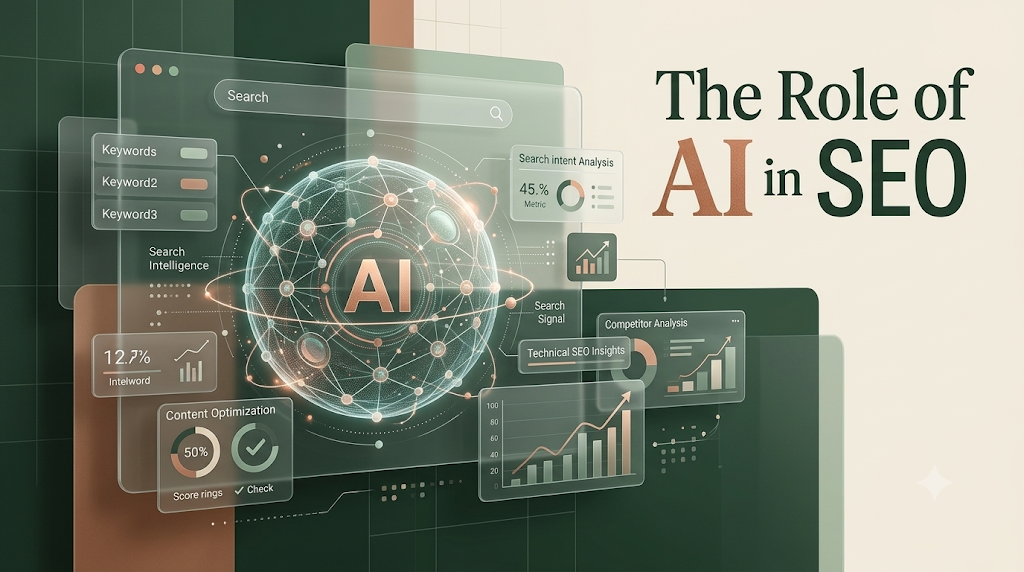
AI in SEO uses artificial intelligence and machine learning to improve keyword research, search intent analysis, content optimization, technical SEO, competitor research, and performance tracking. It helps marketers process large amounts of data, identify opportunities, and make informed decisions. When combined with human expertise and effective SEO practices, AI can support better search visibility, relevant organic traffic, and stronger digital marketing performance. Businesses should also understand the importance of technical SEO, keyword research, and content optimization when applying AI-powered search strategies.
Artificial intelligence is changing how businesses approach search engine optimization. AI in SEO helps marketers understand search intent, discover valuable keywords, optimize website content, analyze competitors, and identify technical issues. These capabilities make SEO research faster and help businesses make better decisions. Businesses can also explore practical SEO strategies for improving website rankings to understand how these activities contribute to search visibility.
However, AI is not a replacement for SEO expertise. Businesses still need useful content, strong technical foundations, relevant keywords, and a clear understanding of their audience. This guide explores how AI is transforming SEO and how businesses can use practical AI-powered strategies to improve search visibility, attract relevant traffic, and generate more leads through an effective SEO and AI search visibility strategy.
What Is AI in SEO?
AI in SEO refers to the use of artificial intelligence technologies to improve how websites are researched, optimized, analyzed, and monitored for search engines. These activities build on traditional search engine optimization practices, including on-page optimization, keyword research, and technical website improvements.
These technologies can process large datasets, recognize patterns, understand language, and identify opportunities that may take longer to discover through manual research. They can also support the analysis of website search performance and keyword opportunities.
For example, an AI-powered SEO tool can analyze search queries to identify related keywords, group them by search intent, and suggest topics for a content strategy. Similarly, AI-assisted website audits can help identify missing metadata, broken links, duplicate content, and other technical issues. Businesses can learn more about meta tags for SEO and website sitemap optimization to understand how these technical elements support search engine discovery.
AI in SEO commonly supports the following activities:
- AI keyword research: Finding relevant keywords, related search terms, and content opportunities.
- Search intent analysis: Understanding what users expect when they enter a search query.
- AI content optimization: Improving content structure, relevance, clarity, and keyword coverage.
- Competitor analysis: Identifying content gaps and comparing competing webpages.
- Technical SEO: Assisting with website audits, crawling issues, and metadata checks.
- Predictive SEO analytics: Analyzing historical data to identify possible performance trends.
- AI search optimization: Supporting content strategies for AI-powered search experiences.
However, AI-generated recommendations need human review. Search trends, business goals, audience needs, and search engine guidelines must guide the final decisions. A clear understanding of technical SEO and search optimization requirements also helps businesses validate AI-generated recommendations.
Why Is AI Important in SEO?
Traditional SEO often involves collecting data from multiple sources, reviewing competing pages, analyzing keywords, and identifying technical problems. These tasks can take considerable time, especially for websites with hundreds or thousands of pages. Reviewing common website ranking problems can help businesses understand why these activities are necessary.
AI makes several parts of this process more efficient. It can analyze large amounts of information, organize findings, and help marketers focus on important opportunities. For example, AI can support keyword research, content optimization, and website performance analysis.
Here are some reasons why AI has become valuable in modern SEO.
1. Faster Keyword Research and Analysis
Keyword research is a major part of SEO. AI tools can analyze search terms, related queries, and keyword patterns to identify relevant opportunities. Businesses can also explore SEO keyword research and search intent strategies to develop more focused keyword plans.
For example, a company offering website development services may target the keyword “website development company.” AI-assisted research can help discover related searches such as:
- Custom website development services.
- Business website design.
- Responsive website development.
- Website development cost.
- Ecommerce website development.
These keywords can be grouped according to search intent and business relevance.
As a result, marketers can build a more organized keyword strategy instead of targeting unrelated search terms. This approach also supports better website rankings through relevant keyword targeting.
2. Better Understanding of Search Intent
Search intent explains what users want to achieve when they search online. Understanding it helps marketers select appropriate page formats, improve content relevance, and build an effective SEO content strategy.
AI can help classify queries into informational, navigational, commercial, and transactional categories. This makes it easier to connect search queries with the right content and landing pages.
For example, consider these searches:
| Search query | Search intent | Suitable content |
| What is SEO? | Informational | Educational blog |
| Best SEO tools | Commercial | Comparison article |
| Ecsion SEO services | Navigational | Brand or service page |
| Hire an SEO agency | Transactional | SEO service landing page |
Understanding search intent helps marketers select the right page format and provide information that matches user expectations. For additional guidance, explore how search intent influences website rankings.
3. Improved Content Optimization
AI-powered content analysis can identify missing topics, related keywords, unclear explanations, and content gaps. These insights can support on-page SEO optimization and help businesses improve existing website pages.
For example, an article about digital marketing may discuss SEO but overlook related subjects such as search intent, technical optimization, conversion tracking, and AI-powered search.
AI can highlight these gaps and suggest areas for improvement.
However, the goal should not be to include every suggested keyword. Instead, use recommendations that make the content more useful and complete. Reviewing important on-page SEO elements, including title tags and meta descriptions, can also improve content presentation in search results.
4. More Efficient Technical SEO Analysis
Technical SEO includes website crawling, indexing, page performance, mobile usability, and website architecture. Businesses can strengthen these areas by following technical SEO practices for better Google rankings.
AI-assisted tools can help analyze technical reports and identify patterns across multiple pages.
For instance, a website with hundreds of service pages may contain duplicate title tags or missing meta descriptions. Automated analysis can help locate these issues faster. Understanding how to optimize meta tags for SEO and how to optimize a website sitemap can help SEO teams address related technical problems.
Consequently, SEO teams can spend more time prioritizing and fixing important problems.
5. Smarter Competitor Analysis
AI can help compare competing webpages, identify content gaps, and analyze keyword patterns. These insights can help businesses understand why competitors may perform better for relevant search queries.
For example, a business may notice that its competitors receive organic traffic from questions that its own website does not answer. AI-assisted competitor research can organize these opportunities into relevant topics.
Furthermore, marketers can use this information to create original content that addresses customer questions more effectively. Businesses can also explore SEO, AEO, and GEO search visibility strategies to understand how competitor research fits into a broader digital visibility strategy.
6. Better SEO Reporting and Decision-Making
SEO involves monitoring several performance indicators, including organic clicks, impressions, keyword rankings, and conversions. AI can help organize reports, identify unusual changes, and summarize performance trends.
For example, an SEO team may notice that organic impressions are increasing while clicks remain unchanged. AI-assisted analysis can help identify pages and queries that need further investigation. Businesses can use Google ranking improvement strategies to determine which pages require further optimization.
However, recommendations should always be checked against actual analytics and Search Console data. It is also important to distinguish between search visibility problems and website issues that affect conversions, such as those explained in 7 website problems that cost you sales.
12 Practical Ways to Use AI in SEO for Better Search Visibility
AI becomes valuable when it supports specific SEO tasks. Instead of using it only to generate content, businesses should apply it across research, optimization, technical analysis, and performance measurement. These activities should complement established SEO practices for improving website rankings.
The following strategies explain how to use AI in SEO effectively.
1. Use AI for Advanced Keyword Research
Keyword research helps identify the terms potential customers use when searching for products, services, and information. AI-powered keyword research can help marketers discover related search terms, identify long-tail keywords, and organize large keyword lists.
For example, a company offering custom software development may begin with the primary keyword:
Custom Software Development
AI-assisted research can help expand this into supporting keyword groups:
| Keyword group | Example keywords | Content opportunity |
| Service keywords | Custom software development company, custom software services | Service pages |
| Informational keywords | What is custom software development, benefits of custom software | Educational blogs |
| Commercial keywords | Custom software development cost, best software development company | Comparison and decision guides |
| Industry keywords | Healthcare software development, retail software solutions | Industry-specific pages |
| Long-tail keywords | How to choose a custom software development company | Detailed guides |
This approach helps businesses create content for different stages of the customer journey. It also supports a more focused keyword strategy for improving website search visibility.
How to use AI effectively:
- Provide your industry, services, and target audience.
- Ask for relevant keyword variations.
- Group keywords by search intent.
- Identify long-tail search opportunities.
- Compare suggestions with actual keyword research data.
- Prioritize keywords based on relevance, competition, and business value.
Remember that AI-generated keyword suggestions are not proof of search demand. Validate them using reliable keyword research tools and search data.
2. Use AI to Analyze Search Intent and Customer Queries
Finding keywords is only one part of SEO. You also need to understand why people use those keywords. Search intent analysis helps marketers identify the appropriate content format and develop a relevant SEO strategy.
AI can help classify search queries and identify the type of information users expect.
For example, consider a business targeting “Google Ads not generating leads.”
A useful content strategy may include:
- Why Google Ads generate clicks but no leads.
- How to identify irrelevant search traffic.
- How to improve landing page relevance.
- How to check conversion tracking.
- How to review bidding and targeting settings.
These topics address the problems behind the search rather than simply repeating the keyword.
Furthermore, query analysis can help marketers identify questions that deserve their own sections or articles. Matching content with search intent is also an important part of improving website rankings on Google.
3. Optimize Website Content With AI
Content optimization is one of the most practical applications of AI in SEO. AI tools can review existing content and suggest improvements to headings, paragraph structure, keyword coverage, readability, and topical relevance.
For example, imagine a blog targeting “How to Improve Website SEO.”
An AI-assisted content audit may identify missing information about:
- Internal linking.
- Page titles and meta descriptions.
- Mobile optimization.
- Website loading speed.
- Search intent.
- Structured data.
- Content updates.
These suggestions can help make the article more comprehensive. Businesses can also refer to meta tags for SEO and mobile-first indexing and Mobile SEO when reviewing specific optimization elements.
Best practices for AI content optimization:
- Review the current content and identify its main purpose.
- Compare it with relevant search queries and competing pages.
- Find missing information and outdated explanations.
- Use AI to improve clarity and content organization.
- Verify technical facts and recommendations.
- Add original insights, practical examples, and expert input.
- Review the final article before publishing.
The objective is to improve content quality, not produce longer articles filled with repeated keywords.
4. Generate SEO-Friendly Titles and Meta Descriptions
Title tags and meta descriptions help communicate what a webpage offers. They are important parts of on-page SEO and can influence how users understand your pages in search results.
AI can generate title ideas and description variations based on a primary keyword and search intent.
For example:
Primary keyword: AI in SEO
Suggested SEO title:
AI in SEO: 12 Strategies to Improve Search Visibility
Suggested meta description:
Discover how AI in SEO improves keyword research, content optimization, technical audits, and search visibility with practical strategies.
However, AI-generated metadata should always be reviewed before publishing. For detailed guidance, refer to Ecsion’s Meta Tags for SEO: Ultimate Guide to Boost Rankings.
Check that:
- The title accurately describes the page.
- The primary keyword appears naturally.
- The description reflects the actual content.
- Titles are unique across important pages.
- No unnecessary keyword repetition is present.
Google may rewrite title links and search snippets, so avoid treating AI-generated metadata as a guarantee of how a search result will appear.
5. Use AI for Competitor SEO Analysis
Competitor analysis helps businesses understand why other websites may perform better for relevant search queries. AI can assist with organizing competitor information, comparing content topics, and identifying potential keyword gaps.
For example, an ecommerce company may discover that competitors publish detailed articles about product comparisons, buying guides, and product features.
However, its own blog may focus only on general product information.
AI can highlight these differences and suggest topics worth researching. Businesses can also learn how to evaluate SEO and AI search visibility strategies when comparing competing websites.
A practical competitor analysis process:
| Step | AI-assisted activity | Expected outcome |
| 1 | Review competitor page topics | Understand their content focus |
| 2 | Compare keyword coverage | Identify missing search terms |
| 3 | Analyze search intent | Find content format gaps |
| 4 | Review content structure | Discover missing explanations |
| 5 | Prioritize opportunities | Build a focused content plan |
Do not copy competitor content. Use the findings to identify what your audience still needs and create a more useful resource.
6. Improve Technical SEO With AI
Technical SEO ensures that search engines can access, crawl, understand, and index important website pages. A website’s technical foundation is also essential when following SEO strategies to improve Google rankings.
AI-assisted SEO tools can help identify common technical issues and organize audit findings.
These may include:
- Broken internal links.
- Missing title tags.
- Duplicate meta descriptions.
- Incorrect canonical URLs.
- Indexing problems.
- Redirect chains.
- Missing image alt text.
- Slow-loading pages.
- Mobile usability issues.
For example, an AI-assisted audit may identify multiple service pages with missing meta descriptions. Instead of reviewing each page manually, the SEO team can organize the findings and prioritize pages based on their importance.
Businesses can also refer to website sitemap optimization for SEO to understand how website structure supports crawling and discovery.
However, AI cannot independently confirm every technical issue. Verify recommendations through crawling tools, browser inspection, and Google Search Console.
7. Use AI to Improve Internal Linking
Internal links connect related pages on your website. They help visitors explore relevant information and allow search engines to discover important content. A well-organized internal link structure is also an important part of improving website rankings.
AI can analyze website topics and suggest possible connections between existing articles and service pages.
For example, a blog about AI in SEO may link naturally to articles about:
- Building an effective SEO strategy.
- Improving website rankings.
- Technical SEO optimization.
- AI-powered search visibility.
- AEO and GEO strategies.
A useful internal linking strategy should follow these practices:
- Link only to relevant pages.
- Use descriptive anchor text.
- Connect supporting articles with related pillar content.
- Avoid excessive links in one paragraph.
- Check that linked pages are live and useful.
- Review internal links when updating older content.
For example, relevant articles about website ranking improvements, SEO meta tags, and website sitemap optimization can support different sections of an SEO content cluster.
AI can suggest possible connections, but the SEO team should verify each URL and anchor text before publishing.
8. Apply AI to Local SEO Optimization
Local SEO helps businesses appear when people search for services in a specific area. AI can support local keyword research, customer review analysis, location-based content planning, and business profile optimization.
For example, a web development company serving Nagpur may target searches such as:
- Website development company in Nagpur.
- Web design services in Nagpur.
- Ecommerce website development in Nagpur.
AI can help group these keywords and identify relevant local content opportunities. It can also summarize recurring themes in customer reviews, such as communication, service quality, and delivery experience.
However, local business information must remain accurate. Do not generate fake reviews, incorrect addresses, or unsupported claims about services and locations. Businesses should also consider how AEO and GEO strategies influence local search visibility.
9. Use AI for Image SEO and Visual Content Optimization
Images contribute to website usability and can support organic discovery through image search. AI tools can assist with image classification, alt text suggestions, file organization, and visual content analysis.
For example, an image showing a website analytics dashboard may need descriptive alt text such as:
“Website analytics dashboard displaying organic traffic and search performance.”
Good image SEO practices include:
- Use descriptive image filenames.
- Write meaningful alt text.
- Compress images without unnecessary quality loss.
- Use suitable image formats.
- Maintain responsive image dimensions.
- Place images near relevant content.
Image optimization should also be considered alongside mobile website optimization, because oversized images can affect loading performance on smartphones.
Alt text should describe the image accurately. Avoid adding unrelated keywords simply to increase keyword coverage.
10. Use AI for Predictive SEO and Trend Analysis
Predictive SEO uses historical data and analytical methods to identify possible future opportunities. AI can help analyze seasonal search patterns, changing keyword demand, content performance, and historical website traffic.
For example, a travel website may notice that searches for holiday destinations increase before major vacation periods.
AI-assisted analysis can help identify suitable topics and suggest when to prepare relevant content.
However, predictions are not guarantees. Search demand can change due to competition, market conditions, user behaviour, and external events.
Therefore, combine AI-generated forecasts with actual search trends and business data. Regularly reviewing website search performance and ranking trends can help validate these opportunities.
11. Use AI to Support AEO and GEO Strategies
Search experiences are becoming more conversational. People now ask detailed questions through AI-powered platforms and expect direct, relevant answers.
This creates opportunities for businesses to improve their visibility through Answer Engine Optimization (AEO) and Generative Engine Optimization (GEO). To understand these changing search approaches, explore Ecsion’s guide to AI, SEO, AEO, and GEO search visibility.
AI can help identify customer questions, organize content around related topics, and improve the clarity of explanations.
For example, a business offering accounting software may create content addressing:
- What features should accounting software include?
- How does accounting software help small businesses?
- What is the difference between cloud and desktop accounting software?
- How do you choose accounting software for a growing company?
Each article should provide accurate answers supported by useful examples.
To support AEO and GEO:
- Use descriptive question-based headings.
- Provide direct answers before detailed explanations.
- Include original insights and practical examples.
- Keep business information consistent.
- Use relevant structured data where appropriate.
- Support important claims with reliable references.
- Make sure important content is accessible to search engines.
Importantly, there is no special AI meta tag or guaranteed GEO technique that ensures inclusion in AI-generated answers. Strong SEO fundamentals remain essential, including technical SEO, useful content, and website structure.
12. Use AI for SEO Performance Analysis and Reporting
SEO reporting helps businesses understand whether optimization activities are producing useful results. AI can assist with analyzing data from Google Search Console, Google Analytics, and other marketing platforms.
For example, consider a service page with the following performance:
| Metric | Previous month | Current month |
| Impressions | 12,000 | 16,000 |
| Organic clicks | 720 | 800 |
| Click-through rate | 6% | 5% |
| Average position | 8 | 7 |
In this example, impressions and clicks have increased, while CTR has declined.
AI-assisted analysis can help identify which queries and pages contributed to this change. Businesses can also use website ranking improvement techniques to identify potential optimization opportunities.
However, the SEO team should also investigate search position, query mix, seasonality, and changes in search result layouts before deciding what to update.
The goal is to turn performance data into useful decisions rather than simply generate automated reports.
AI in SEO for Content Creation: How to Balance Automation and Human Expertise
AI content generation has changed how marketers research, outline, draft, and improve website content. It can support content optimization and website search visibility by helping marketers organize information and identify content opportunities.
However, publishing AI-generated articles without meaningful review can lead to repetitive explanations, inaccurate information, and generic content.
Google’s guidance focuses on helpful, reliable, people-first content rather than whether AI was used to create it. Using generative AI to produce large numbers of unoriginal pages without adding value can violate Google’s scaled content abuse policy.
Therefore, businesses should use AI as a supporting tool within a human-led content process.
Where AI Can Help in Content Creation
AI can support several stages of content development:
| Content activity | How AI can help | Human responsibility |
| Topic research | Identify related topics and questions | Select relevant subjects |
| Keyword research | Suggest keyword variations | Validate search demand |
| Content outlines | Organize headings and subtopics | Check topic coverage |
| First drafts | Help prepare initial explanations | Add expertise and original insights |
| Content editing | Improve grammar and readability | Verify accuracy and tone |
| Content audits | Identify possible content gaps | Decide what needs updating |
| SEO optimization | Suggest titles and descriptions | Review search intent and relevance |
For example, marketers can use AI to identify missing SEO meta tags and content optimization opportunities while retaining responsibility for the final content.
Why Human Review Still Matters
AI can produce information that sounds convincing but contains errors or outdated details.
Human review helps ensure that published content reflects real expertise, accurate facts, and the needs of the target audience.
For example, an AI tool may suggest adding a technical SEO recommendation that no longer matches current Google documentation.
An experienced SEO professional can identify the issue, verify the correct information, and update the content before publication. This is particularly important when reviewing technical SEO recommendations and website ranking issues.
Therefore, the strongest approach combines AI efficiency with human judgment, original research, and subject knowledge.
AI in SEO vs Traditional SEO: What Is the Difference?
Traditional SEO and AI-powered SEO share the same broader objective: improving website visibility in search engines.
However, AI changes how marketers perform research, analyze information, and make optimization decisions. These approaches work together within a broader SEO strategy for better Google rankings.
| Comparison | Traditional SEO | AI-powered SEO |
| Keyword research | Manual research and keyword tools | AI-assisted keyword discovery and clustering |
| Search intent | Manual query and SERP analysis | AI-assisted intent classification |
| Content optimization | Manual content reviews | Automated suggestions and content gap analysis |
| Competitor research | Manual comparison | AI-assisted pattern and topic analysis |
| Technical audits | Crawling and manual issue review | AI-assisted issue detection and prioritization |
| Reporting | Manual data interpretation | Automated summaries and trend analysis |
| Content planning | Manual topic selection | AI-assisted topic research and planning |
| Decision-making | SEO expertise and available data | Human expertise supported by AI analysis |
Traditional SEO remains important. AI does not replace crawling, indexing, quality content, relevant links, or a technically sound website.
Instead, it helps SEO professionals perform many research and analysis tasks more efficiently. Businesses can continue strengthening these fundamentals through website ranking optimization and effective sitemap management.
How AI in SEO Supports Conversion Tracking and Retargeting
Search visibility is important, but attracting visitors is only one part of digital marketing.
Businesses also need to understand what visitors do after reaching their websites. AI can help analyze user behaviour, identify conversion patterns, and support advertising optimization. However, SEO metadata, analytics tracking, and advertising pixels perform different functions.
Businesses should also consider how website usability and conversion barriers affect results. Ecsion’s guide to website problems that cost you sales explains why attracting visitors does not automatically result in enquiries or purchases.
1. AI-Assisted Conversion Tracking
Conversion tracking measures valuable actions taken by website visitors.
These actions may include:
- Contact form submissions.
- Product purchases.
- Phone enquiries.
- Demo requests.
- Newsletter registrations.
- Service enquiries.
For example, a software company may receive 1,000 organic visits to its service page but only 10 enquiries.
AI-assisted analytics can help identify patterns in traffic sources, landing pages, user journeys, and conversion data. Understanding website conversion problems and ways to improve sales can help businesses interpret these patterns more effectively.
However, accurate tracking must first be configured through tools such as Google Analytics 4, Google Tag Manager, and relevant advertising conversion tags.
2. AI and Retargeting Campaigns
Retargeting allows businesses to reach people who have previously interacted with their website or brand, subject to platform policies and applicable consent requirements.
AI-powered advertising systems can help analyze audience behaviour and optimize campaign delivery.
For example, an ecommerce business may use retargeting to reach visitors who viewed products but did not complete a purchase.
Similarly, a B2B company may develop campaigns for visitors who explored its service pages but did not submit an enquiry.
AI can support audience analysis, ad performance evaluation, and campaign optimization. However, audience eligibility and tracking depend on the advertising platform, implementation, and privacy settings. Businesses should also review their website’s conversion experience and common barriers to customer enquiries.
3. Connect SEO Traffic With Business Outcomes
A successful SEO strategy should measure more than keyword rankings.
Consider the following example:
| Performance metric | Result |
| Organic website visits | 5,000 |
| Contact form submissions | 100 |
| Qualified leads | 40 |
| Converted customers | 8 |
This data helps a business understand how organic traffic contributes to enquiries and sales.
AI can assist with identifying patterns across landing pages and conversion sources. However, businesses should verify attribution, tracking configuration, and data quality before making campaign decisions.
It is equally important to investigate website issues that may prevent visitors from becoming customers, including unclear messaging, weak calls to action, and complicated contact forms.
Best AI SEO Tools to Improve Search Performance
Choosing the right AI SEO tools depends on your website size, objectives, and optimization requirements.
Some tools focus on keyword research, while others support technical audits, content analysis, competitor research, and analytics. These tools should complement established SEO optimization methods rather than replace professional evaluation.
The following tools can support different parts of an SEO workflow.
| Tool | Primary use | How it supports SEO |
| Google Search Console | Search performance | Monitors impressions, clicks, queries, and indexing |
| Google Analytics 4 | Website analytics | Measures traffic, user activity, and conversions |
| Semrush | SEO research | Supports keyword research, competitor analysis, and site audits |
| Ahrefs | SEO analysis | Helps examine backlinks, keywords, and competing pages |
| Screaming Frog SEO Spider | Technical SEO | Crawls websites and identifies technical issues |
| Google Gemini | AI-assisted research | Helps organize research, analyze information, and develop ideas |
| ChatGPT | SEO research and content assistance | Supports keyword brainstorming, outlines, content review, and analysis |
How to Choose the Right AI SEO Tool
Before selecting a tool, identify the task you want to improve.
For example:
- Use keyword research platforms to validate search demand.
- Use website crawlers to identify technical issues.
- Use analytics tools to measure organic performance.
- Use AI assistants to organize research and improve content.
- Use search performance data to evaluate optimization results.
No single AI tool can manage every aspect of SEO accurately. Combining reliable data sources with human expertise produces more useful results. For example, website crawlers can help identify issues that affect website indexing and Google rankings, while metadata reviews can be supported by Ecsion’s guide to meta tags for SEO.
Common AI SEO Mistakes Businesses Should Avoid
AI can improve SEO workflows, but incorrect implementation can waste time and weaken content quality. Businesses should understand common reasons why websites fail to rank on Google before relying entirely on automated recommendations.
Here are some common mistakes to avoid.
1. Publishing Unreviewed AI-Generated Content
AI-generated content may contain incorrect information, repeated explanations, or unsupported claims.
Always review facts, examples, sources, and recommendations before publishing. Focus on creating useful information rather than producing pages simply to increase content volume.
2. Overusing Keywords
Adding the same primary keyword to every heading and paragraph makes content unnatural.
Use supporting keywords where they fit the topic. Focus on relevance rather than keyword density. A better approach is to follow effective keyword targeting and on-page SEO practices.
3. Depending Entirely on AI Recommendations
AI tools can misunderstand search intent or suggest changes that do not match business goals.
Validate important recommendations with actual search data and professional judgment. Reviewing website ranking problems and their possible causes can help identify whether suggested improvements address the real issue.
4. Ignoring Technical SEO
Good content cannot solve every crawling, indexing, or website performance issue.
Review technical SEO alongside content optimization. Pay attention to website sitemap optimization, metadata, indexing, and mobile-first indexing requirements.
5. Treating AI Search as a Replacement for Google SEO
AI-powered search experiences are expanding, but traditional search optimization remains important.
Continue investing in crawlability, useful content, relevant internal links, and website performance. Businesses should understand how SEO, AEO, and GEO work together rather than abandoning established SEO practices.
6. Measuring Only Rankings and AI Mentions
Rankings and AI visibility indicators do not explain the full business impact of SEO.
Also monitor qualified traffic, leads, enquiries, and conversions. Businesses can use website conversion optimization practices to understand how visitors move from search results to meaningful business actions.
7. Using AI Without a Clear Strategy
Using AI simply because it is available does not guarantee better results.
Define your SEO objectives first. Then select tools and workflows that help achieve them. A structured approach to SEO and AI search visibility can help connect individual activities with business goals.
AI SEO Diagnostic Framework: Identify and Fix Search Performance Problems
AI becomes most useful when it helps marketers understand why a website is not achieving its expected search performance.
Instead of applying the same optimization method to every page, use a diagnostic approach to connect problems with possible causes and appropriate actions. This is similar to the process used when diagnosing common website ranking problems.
The following framework can help businesses review their SEO campaigns.
| What you notice | Possible problem | What to analyze with AI | Recommended action |
| Website receives few impressions | Weak keyword targeting or indexing issues | Keyword gaps, page coverage, and technical reports | Review indexing and keyword relevance |
| Impressions increase but clicks remain low | Weak titles, descriptions, or search intent match | Search queries, CTR, and competing results | Improve titles and page relevance |
| Organic traffic drops suddenly | Technical changes or search demand changes | Historical traffic and affected URLs | Investigate technical and content changes |
| Competitors rank for more keywords | Content gaps or stronger topical coverage | Competitor pages and keyword overlap | Build useful, original supporting content |
| Blog traffic increases but leads remain low | Weak conversion journey | Landing pages, user paths, and conversion data | Improve calls to action and enquiry experience |
| Pages are not being indexed | Crawl or indexing problems | Robots directives, canonical tags, and crawl reports | Fix technical barriers |
| Website receives irrelevant traffic | Poor keyword and search intent alignment | Search query patterns and landing page relevance | Refine keyword targeting |
| Organic pages have high exit rates | Content or user experience mismatch | Page engagement and navigation patterns | Improve content usefulness and page experience |
| Brand is missing from relevant AI answers | Limited discoverability or content relevance | AI platform tests and brand information | Improve original content and technical accessibility |
For additional troubleshooting guidance, businesses can explore how to identify and fix website ranking problems.
A Practical AI SEO Campaign Diagnostic Process
Step 1: Establish a Performance Baseline
Start by collecting existing SEO data.
Review organic clicks, impressions, keyword rankings, website traffic, landing page performance, and conversions.
Use Google Search Console and Google Analytics 4 to establish a reliable starting point. You can also refer to website ranking strategies and performance measurement when deciding which metrics to monitor.
Step 2: Identify the Main Problem
Next, determine where performance is falling short.
For example, low impressions may indicate limited search demand, poor indexing, or weak keyword targeting. Meanwhile, high impressions with low CTR may require a review of search result relevance.
AI can help organize these findings, but the actual cause must be verified. Refer to common reasons why a website is not ranking on Google when investigating these issues.
Step 3: Analyze Keywords and Competitors
Compare your target keywords with relevant competitor pages.
Identify missing topics, search intent gaps, and opportunities to create more useful content.
Prioritize keywords that match your services and audience rather than targeting every available suggestion. For further guidance, explore keyword research and SEO improvement techniques.
Step 4: Review Content and Technical SEO
Use AI-assisted analysis to identify outdated content, missing information, metadata problems, broken links, and possible technical issues.
Then verify the findings using appropriate SEO audit tools.
You can also review Ecsion’s resources on SEO meta tag optimization and website sitemap optimization to investigate specific technical elements.
Step 5: Implement Focused Improvements
Make changes based on the problems identified.
For example, improve content relevance when search intent is mismatched. Fix indexing settings when important pages are blocked. Update landing pages when organic traffic does not lead to enquiries.
For mobile usability and website performance issues, refer to Mobile SEO and mobile-first indexing and website problems that cost you sales.
Avoid changing everything at once because it becomes difficult to measure the impact of individual improvements.
Step 6: Measure Results and Conversion Performance
After implementation, compare new performance with the original baseline.
Monitor organic clicks, impressions, CTR, rankings, leads, and conversions.
Furthermore, evaluate relevant AI search visibility through consistent query testing and available platform reporting. Businesses can also measure how website changes influence enquiries using website conversion improvement strategies.
Step 7: Refine the Strategy
SEO requires continuous improvement.
Review performance regularly, identify new opportunities, and update your approach based on actual results.
This creates a practical cycle of research, optimization, measurement, and improvement. Businesses can use a structured SEO improvement process to keep their optimization activities focused on measurable results.
The Future of AI in SEO: What Businesses Should Prepare For
AI is changing how search engines process information and how people discover businesses online.
As AI-powered search experiences evolve, businesses need to focus on more than traditional keyword rankings. Understanding the relationship between SEO, AEO, and GEO can help businesses prepare for these changes.
Here are some important developments shaping the future of SEO.
1. Growth of AI-Powered Search Experiences
Google AI Overviews, AI Mode, and conversational search platforms are changing how people explore information.
Users can ask detailed questions, compare options, and discover supporting sources within AI-generated responses.
Therefore, businesses should create useful content that answers real questions and provides relevant information. Explore AI, SEO, AEO, and GEO search visibility strategies to understand how businesses can approach these emerging search experiences.
2. Greater Focus on Search Intent and Context
Search engines increasingly use language understanding and contextual signals to interpret queries.
Consequently, keyword optimization should focus on meaning, relevance, and user needs rather than exact-match repetition. Businesses can strengthen this approach through search intent analysis and keyword optimization.
3. More Advanced SEO Automation
AI-powered systems can assist with website audits, keyword grouping, content analysis, reporting, and routine optimization tasks.
This can help SEO teams manage larger websites and identify issues more efficiently. For example, automated analysis can support website sitemap optimization and the identification of technical SEO problems affecting website rankings.
However, human review remains important when prioritizing changes and evaluating recommendations.
4. Stronger Demand for Original and Helpful Content
As AI makes content generation easier, generic articles become less useful as a competitive advantage.
Businesses need to publish original research, practical insights, real examples, and expert explanations.
This helps create content that offers value beyond information already available across multiple websites. Strong on-page SEO and content optimization practices can help businesses organize and present this information effectively.
5. Greater Importance of Measurement Across Search Channels
Businesses will need to evaluate visibility across traditional search results, AI-powered search experiences, and answer engines.
Therefore, reporting should combine established SEO metrics with relevant AI visibility indicators and business outcomes. Businesses can explore SEO, AEO, and GEO agency strategies to understand how these different search channels can be evaluated.
The goal is not simply to appear in more places. It is to reach the right audience and support meaningful business results.
Frequently Asked Questions About AI in SEO
1. What is AI in SEO?
AI in SEO refers to using artificial intelligence and machine learning to support keyword research, search intent analysis, content optimization, technical audits, competitor research, and performance tracking. It helps marketers analyze information and make more informed optimization decisions. These activities complement traditional SEO practices for improving website rankings.
2. How does AI improve SEO?
AI can improve SEO workflows by analyzing large datasets, identifying keyword opportunities, suggesting content improvements, detecting technical issues, and summarizing performance trends. However, results depend on data quality, implementation, and human review. Businesses should also address technical and content-related website ranking problems.
3. Can AI replace traditional SEO?
No. AI can support many SEO activities, but it cannot replace the need for technical SEO, useful content, search intent analysis, relevant links, and human expertise. Traditional SEO fundamentals remain essential, including website optimization and search engine indexing.
4. Which AI tools are best for SEO?
Useful tools include ChatGPT, Google Gemini, Semrush, Ahrefs, Google Search Console, Google Analytics 4, and Screaming Frog SEO Spider. The best choice depends on whether you need keyword research, content assistance, competitor analysis, technical audits, or performance measurement. For example, businesses can combine these tools with meta tag optimization and website sitemap management.
5. Can AI-generated content rank on Google?
Yes. AI-generated content can appear in Google Search when it provides helpful, reliable, original value and follows Google’s policies. However, producing large amounts of unoriginal content primarily to manipulate rankings can violate Google’s scaled content abuse policy. Businesses should prioritize useful content and follow effective website SEO and content optimization practices.
6. How does AI help with keyword research?
AI can suggest related keywords, identify long-tail search terms, group queries by intent, and organize keyword opportunities. Validate these suggestions with actual keyword research data before including them in your SEO strategy. You can also explore keyword research strategies for improving website rankings.
7. What is the difference between AI SEO and traditional SEO?
Traditional SEO relies on established research, optimization, and analysis methods. AI-powered SEO uses artificial intelligence to assist with these activities through automation, pattern recognition, and data analysis. Both approaches work together to improve search performance through technical SEO, keyword research, and content optimization.
8. How does AI support AEO and GEO?
AI can help marketers identify common questions, organize answer-focused content, analyze topic relationships, and improve content clarity. These activities can support AEO and GEO, although they do not guarantee inclusion in AI-generated answers. Read more about AI, SEO, AEO, and GEO search visibility.
9. Can AI help improve website traffic?
AI can support keyword research, content optimization, competitor analysis, and technical SEO. These improvements may help a website attract more relevant organic traffic over time. However, traffic growth depends on competition, search demand, website quality, and implementation. Businesses can also explore how to rank a website faster on Google for practical optimization strategies.
10. Is AI in SEO suitable for small businesses?
Yes. Small businesses can use AI to research keywords, improve website content, identify technical issues, and analyze competitors. They should begin with specific tasks that support their business goals rather than investing in unnecessary tools. Improving mobile SEO and website usability can also help small businesses build a stronger search presence.
Conclusion
AI in SEO is changing how businesses research keywords, optimize content, analyze competitors, and measure search performance. It helps marketers process information faster, identify opportunities, and improve their optimization workflows. Businesses can combine these capabilities with proven SEO strategies for better website rankings to build a stronger online presence.
However, AI alone cannot build a successful SEO strategy. Businesses still need helpful content, strong technical SEO, relevant keywords, and a clear understanding of customer needs. This includes maintaining proper meta tags, optimized website sitemaps, and a consistent mobile SEO strategy.
The most effective approach combines AI-powered analysis with human expertise. Start by identifying your website’s biggest search performance gaps, use AI to support research and optimization, and measure the results through reliable analytics. If your website is struggling to perform, review common website ranking problems and their solutions before deciding which improvements to prioritize.
As search continues to evolve, businesses that combine strong SEO fundamentals with thoughtful AI adoption will be better prepared to improve search visibility, attract relevant visitors, and turn organic traffic into meaningful business opportunities. For a broader understanding of emerging search strategies, explore Ecsion’s guide to SEO, AEO, and GEO search visibility.