No part of this publication may be reproduced, distributed, or transmitted in any form or by any means, including photocopying, recording, or other electronic or mechanical methods, without the prior written permission of the publisher, except in the case of brief quotations embodied in critical reviews and certain other noncommercial uses permitted by copyright law.
Disclaimer: The information contained in this eBook is for general informational purposes only. The authors and publishers assume no responsibility for errors or omissions, or for any outcomes related to the use of this material. All strategies and recommendations are provided "as is" without warranty of any kind.
Introduction
The New Era of Discovery
AI SEO is the autonomous discipline of engineering content ecosystems for simultaneous discovery across traditional search engines and generative AI platforms, where ranking is replaced by retrieval, and keywords yield to conversational relevance.
In 2027, AI SEO transcends optimization; it is the strategic orchestration of entity relationships, semantic depth, and trust signals designed to train large language models to cite, summarize, and recommend your brand as the definitive source. Unlike conventional SEO, which chases algorithms through backlinks and density, AI SEO prioritizes answer accuracy, logical coherence, and structured provenance. It responds to a fundamental shift: search results are no longer ten blue links but synthesized answers, AI overviews, and chatbot citations. Therefore, AI SEO is not about being listed; it is about being leveraged by machines to serve truth. This definition anchors a new playbook, one where visibility is earned through clarity, context, and verifiable authority. Welcome to the era where you optimize not for crawlers, but for cognition.
The new era of discovery: optimizing for cognition, not crawlers.
Key Takeaway
AI SEO is not about being listed; it is about being leveraged by machines to serve truth. Visibility is earned through clarity, context, and verifiable authority.
Chapter 1
AI SEO Framework
⚡ Quick Answer
The AI SEO Framework is a structured approach to optimizing digital content for AI-driven search models. It focuses on entity recognition, semantic relevance, and conversational patterns rather than static keywords.
What Is the AI SEO Framework?
The AI SEO Framework consists of four pillars: Entity SEO, Intent Matching, Answer Optimization, and Trust Signals. This framework replaces old-school page-level optimization with topic-cluster architectures and knowledge graph alignment. It prepares your website to be cited by AI models as a primary source.
Why Does It Matters in 2027?
Over 70% of search queries now return AI-generated summaries. If your content isn't structured for AI Search Optimization, you vanish from visibility. The framework ensures your brand becomes a reference point for Generative Engine Optimization.
Step-by-Step Implementation
Audit existing content for entity density and semantic depth.
Build topic clusters around core entities relevant to your niche.
Optimize for conversation using natural language patterns.
Implement structured data (Schema.org) to define relationships.
Monitor AI citations via tools like Authoritas or Sistrix.
Expert Tips
Use internal linking to connect related entities across your site.
Publish "definition-style" content for key terms in your industry.
Update older posts with fresh statistics and authoritative outbound links.
Common Mistakes
Ignoring user intent behind long-tail conversational queries.
Over-optimizing for one keyword instead of semantic families.
Failing to verify how your brand appears in AI-generated answers.
Chapter 2
AI Overviews Optimization
⚡ Quick Answer
AI Overviews Optimization is the practice of tailoring content to appear within generative search results featured above organic listings, often called SGE (Search Generative Experience) results.
What Are AI Overviews?
AI Overviews are synthesized answer blocks generated by search engines using large language models. They pull information from multiple authoritative sources to answer complex queries instantly. In 2027, these overviews consume nearly 60% of clicks that previously went to first-position results.
How to Optimize for AI Overviews
AI Overviews Optimization requires a shift from ranking to being cited. Follow these rules:
Use clear subheadings (H2/H3) that mimic question formats.
Provide direct answers within the first 100 words of a section.
Cite data and studies with proper attribution.
Maintain consistent entity definitions across your domain.
Checklist for AI Overviews Success
Key factors for AI Overviews success
Factor
Action Item
Answer clarity
Write "In short:" summaries
Source authority
Get backlinks from .edu or .gov
Freshness
Update content every 90 days
Multimedia
Add relevant images and video transcripts
Future Trend
By late 2027, AI Overviews will become interactive, allowing users to ask follow-up questions. Optimization will then require FAQ schema and conversational branching logic.
Chapter 3
ChatGPT SEO
⚡ Quick Answer
ChatGPT SEO involves optimizing content so that ChatGPT and similar LLMs recommend your brand, products, or answers when users ask relevant questions within the chatbot interface.
What Is ChatGPT SEO?
ChatGPT SEO is a subset of AI Search Visibility focused exclusively on large language model chatbots. Unlike traditional search, there are no backlinks in the usual sense. Instead, ChatGPT cites training data, real-time browsing (if enabled), and retrieved information.
Why ChatGPT SEO Is Critical
Millions of users now bypass Google entirely, asking ChatGPT for recommendations. If your brand isn't mentioned, you lose a massive traffic channel. Conversational Search is the new frontier.
Strategies for ChatGPT SEO
Earn citations in high-quality training data — Appear in Wikipedia, CRMs, and authoritative news sites.
Optimize for brand + function queries — Ensure "best project management tool" returns your name.
Publish structured Q&A content — Use "People Also Ask" formats.
Enable real-time retrieval — Make your API-accessible content clean and factual.
💡 Expert Insight
"ChatGPT doesn't read your homepage; it reads the web's collective memory of you. Consistency across trusted sources is everything." — AI Search Analyst
Common Mistakes
Assuming ChatGPT will browse your site naturally.
Ignoring structured data that chatbots consume.
Forgetting to monitor brand mentions inside LLM responses.
ChatGPT SEO ensures your brand is recommended by large language models.Chapter 4
GEO Strategy (Generative Engine Optimization)
⚡ Quick Answer
GEO Strategy (Generative Engine Optimization) is the holistic practice of optimizing for all generative AI interfaces, including search engines, chatbots, and vertical AI assistants.
What Is GEO Strategy?
Generative Engine Optimization (GEO) goes beyond traditional SEO and even AEO. It focuses on how generative engines curate, summarize, and present information. GEO Strategy includes technical readiness, brand authority, and conversational content design.
Key Components of GEO Strategy
Entity Authority: Build a strong knowledge graph presence.
Multi-format Content: Text, video transcripts, and infographics.
Trust Signals: Verified authorship and transparent sourcing.
LLM Compatibility: Clean HTML, logical site structure, and JSON-LD.
Step-by-Step GEO Strategy for 2027
Claim your brand's knowledge panel on Google and Bing.
Publish glossary pages for industry terms.
Create "definitive guides" that answer 20+ related questions.
Use citation linking (linking out to trusted sources).
Monitor generative engine retrievals via GEO-specific dashboards.
Why GEO Matters
Without GEO Strategy, your content may exist but remain invisible to AI models. Generative engines decide what to read, summarize, or ignore. GEO ensures you are selected, not skipped.
Chapter 5
AI Search Visibility
⚡ Quick Answer
AI Search Visibility measures how often your brand, content, or answers appear within AI-generated responses across search engines, chatbots, and voice assistants.
What Is AI Search Visibility?
AI Search Visibility is the successor to traditional search impression share. It tracks presence in AI Overviews, ChatGPT answers, Gemini responses, and voice search results. It also measures entity prominence within knowledge graphs.
How to Measure AI Search Visibility
Tools and methods for measuring AI Search Visibility
Metric
Tool / Method
SGE appearance
Google Search Console (AI tab)
ChatGPT mentions
Brand24 LLM monitoring
Voice assistant answers
AnswerThePublic + manual testing
Entity density
InLinks or MarketMuse
Strategies to Improve AI Search Visibility
Optimize for Voice Search Optimization — Use natural, long-tail conversational phrases.
Implement Answer Engine Optimization (AEO) — Direct, concise answers to specific questions.
Build Semantic SEO clusters — Cover entire topic families.
Earn featured snippets — They often feed into AI Overviews.
Future Prediction
By mid-2027, AI Search Visibility will become a standard KPI in dashboards, with benchmarks tracked by industry and query type.
Chapter 6
Evolution of Traditional SEO to AI SEO
Traditional SEO focused on keywords, backlinks, and page speed. AI SEO focuses on entities, answer accuracy, and conversational relevance. The shift happened because search engines evolved from retrieving documents to generating answers.
Traditional SEO vs. AI SEO comparison
Aspect
Traditional SEO
AI SEO
Primary unit
Keyword
Entity
Optimization target
Page rank
Answer citation
User interaction
Click & browse
Read & leave satisfied
Success metric
CTR & position
Citation rate & zero-click completion
Key Takeaway
AI SEO is not an extension of traditional SEO — it is a fundamental rethinking of how visibility is earned. Entities, answers, and conversational relevance now drive success.
Chapter 7
How AI Search Engines Work
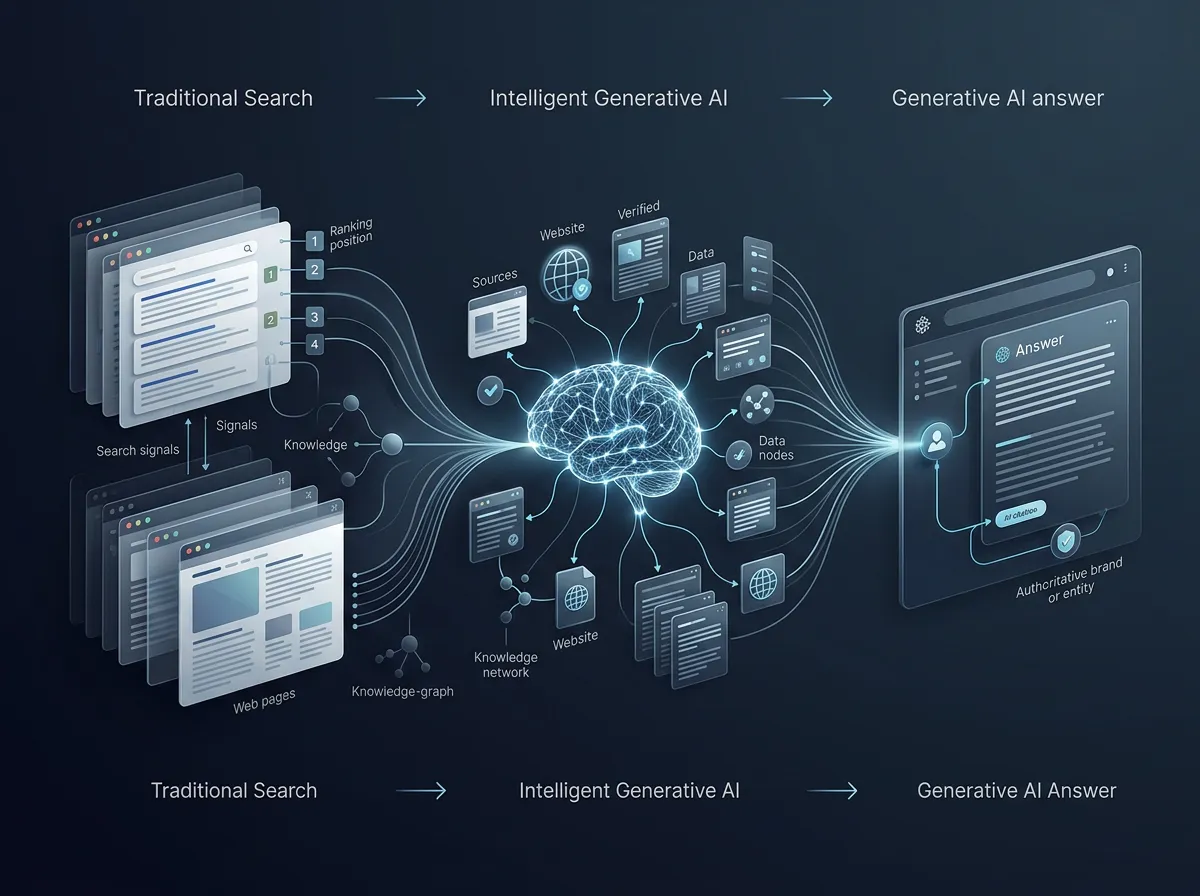
AI Search Engines combine retrieval-augmented generation (RAG) with large language models. When a user asks a question, the engine:
Cites sources (sometimes) and presents the response.
This means AI Ranking Factors include source diversity, factual consistency, and semantic alignment — not just backlinks.
RAG combines retrieval with LLM generation to produce synthesized answers.Chapter 8
Role of Google SGE, ChatGPT, Gemini & AI Assistants
Each AI platform has unique optimization nuances:
Google SGE: Prioritizes E-E-A-T (Experience, Expertise, Authoritativeness, Trustworthiness) and structured data.
ChatGPT: Values training data frequency and recency (if browsing enabled).
Gemini: Integrates deeply with Google's knowledge graph and visual content.
AI Assistants (Siri, Alexa): Favor short, definitive answers and voice-friendly phrasing.
To succeed in AI-driven Search, you must tailor content for each ecosystem while maintaining a core truth layer.
Google SGEE-E-A-T & structured data
ChatGPTTraining data frequency & recency
GeminiKnowledge graph & visual content
AI AssistantsShort, definitive, voice-friendly
Chapter 9
AEO (Answer Engine Optimization)
Answer Engine Optimization (AEO) is the practice of structuring content to provide immediate, accurate answers to specific questions. It overlaps with GEO Strategy but focuses more on voice and featured snippets.
AEO Best Practices
Use question-based headings ("How to...", "What is...").
Keep answers under 50 words for voice.
Provide a "short answer" before detailed explanation.
Use bullet points and numbered lists.
AEO vs. GEO
While AEO answers direct questions, GEO ensures generative engines retrieve you as a source for synthesized answers. Both are essential.
AEO Focus
Direct, concise answers
Voice search optimization
Featured snippets
Question-based headings
GEO Focus
Generative engine retrieval
Source synthesis
Entity authority
Multi-format content
Chapter 10
Semantic Search & Entity SEO
Semantic Search understands user intent and contextual meaning. Entity SEO connects your content to real-world people, places, and things recognized by search engines.
Why It Matters for AI SEO
Generative engines build answers by linking entities. If your content clearly defines and connects entities (e.g., "Apple Inc." → "Tim Cook" → "iPhone 17"), you become part of the AI's reference map.
Actionable Tactics
Use Schema.org's 'sameAs' to connect social profiles.
Create entity relationship tables in your content.
Link to authoritative entity definitions (Wikipedia, Wikidata).
💡 Why Entity SEO Matters
Generative engines build answers by linking entities. Clear entity definitions make your content part of the AI's reference map.
Chapter 11
AI Content Optimization Strategies
AI Content Optimization goes beyond keywords into readability, structure, and fact density.
Top 5 Strategies for 2027
Write for humans and AI: Clear, concise, well-structured.
Add fact-checking statements: "According to [Source]..."
Use predictive phrases: "Commonly asked questions include..."
Embed data visualizations: AI models read alt text and captions.
Refresh content triggers: Every 45-60 days.
Chapter 12
Future AI Search Ranking Factors
AI Ranking Factors in 2027:
AI search ranking factors and their weight in 2027
Factor
Weight
Entity match
High
Answer completeness
High
Source recency
Medium
Backlink authority
Medium (declining)
Page speed
Low (unless extreme)
The future belongs to Entity SEO and Conversational Search patterns.
Automation helps scale AI Search Optimization, but human oversight ensures brand voice remains authentic.
Chapter 14
Common AI SEO Mistakes to Avoid
Keyword stuffing disguised as natural language — AI penalizes low-value repetition.
Ignoring "zero-click" answers — Optimize for visibility without clicks.
Forgetting voice search — It still powers 40% of AI queries.
Using generic stock images — AI reads image filenames and context.
Contradicting your own site — Inconsistent information confuses AI models.
⚠ Critical Mistake
Contradicting your own site with inconsistent information confuses AI models and damages your entity authority.
Chapter 15
Expert Insight: AI's Transformation of Digital Visibility
"AI is not just changing how we search; it is changing how we trust. In 2027, AI Search Visibility depends entirely on a brand's ability to serve as a consistent, verifiable, and helpful entity. We are moving from 'Google-rank thinking' to 'AI-cite thinking.' The brands that win will be those that treat every piece of content as a potential answer tile inside a generative summary. GEO and AEO are not trends. They are the new architecture of discovery. Marketers must adopt Generative Engine Optimization immediately or become invisible to the next billion queries."
— Dr. Elena Marchetti, AI Search Researcher
From 'Google-rank thinking' to 'AI-cite thinking' — the new paradigm.Chapter 16
Comparison Table: Traditional SEO vs. AI SEO vs. GEO vs. AEO
Comparison of Traditional SEO, AI SEO, GEO, and AEO
Feature
Traditional SEO
AI SEO
GEO
AEO
Search behavior
Type & click
Ask & receive
Conversational query
Voice & quick ask
Ranking methods
Backlinks, on-page
Entity authority, source trust
Retrieval relevance
Answer accuracy
Optimization techniques
Keywords, meta tags
Schema, topic clusters
Multi-format content
Short direct answers
User intent
Navigational/informational
Transactional + generative
Exploratory
Question-specific
AI visibility
Not applicable
High (citations in LLMs)
Highest (source for synthesis)
Medium (voice/featured)
Content structure
Pages & posts
Entity-linked clusters
Definitive guides
Q&A blocks
Future scope
Declining baseline
Growing essential
Dominant by 2028
Niche but necessary
Benefits
Predictable traffic
Generative referrals
Brand authority
Voice search share
Chapter 17
Future of AI Search in 2027
By the end of 2027, AI Search Engines will feature:
Multimodal answers (text, video, audio combined).
Personalized generative results based on user history.
Real-time fact-checking with source scores.
AI agents that book, buy, and compare products without visiting websites.
Businesses must adopt ChatGPT SEO, AI Overviews Optimization, and GEO Strategy now to lead in 2028.
Future-Ready Action
Adopt ChatGPT SEO, AI Overviews Optimization, and GEO Strategy now to lead in 2028. The future belongs to brands that serve answers, not just pages.
Chapter 18
Frequently Asked Questions (FAQs)
What is AI SEO in simple terms?
AI SEO is the practice of optimizing content so artificial intelligence systems (like search engines and chatbots) find, trust, and recommend your information.
How is GEO different from traditional SEO?
GEO (Generative Engine Optimization) focuses on being cited as a source inside AI-generated answers, while traditional SEO focused on ranking #1 in blue links.
Can ChatGPT SEO be done without a website?
Yes, through consistent brand mentions on high-authority platforms like Wikipedia, news sites, and industry forums that ChatGPT uses for training.
What is the most important factor for AI Search Visibility in 2027?
Entity consistency across your website and third-party citations. AI models validate facts across multiple sources.
No, but they are less important. Backlinks now serve as trust signals rather than direct ranking fuel.
How often should I update content for AI Overviews?
Every 60–90 days. AI models prefer fresh, dated information for time-sensitive queries.
Can small businesses compete in AI SEO?
Yes, by focusing on niche entity expertise and becoming the definitive answer source for specific topics.
What is the role of schema markup in GEO?
Schema helps AI models understand relationships between entities, improving your chances of being cited.
Will AI search kill organic traffic?
No, but it will reshape it. Traffic becomes referral-based from AI citations rather than direct clicks from ranking positions.
Chapter 19
Conclusion: Your 2027 AI SEO Action Plan
The Complete AI SEO Playbook for 2027 provides everything you need to thrive in an AI-first search world. Start by auditing your current AI Search Visibility. Then, implement GEO Strategy and AEO Optimization chapter by chapter. Remember: AI SEO is not a one-time fix but a continuous process of alignment with generative models. Stay curious, test often, and always prioritize genuine helpfulness over manipulation. The future belongs to brands that serve answers, not just pages.
Final Takeaway
AI SEO is not a one-time fix but a continuous process of alignment with generative models. Stay curious, test often, and always prioritize genuine helpfulness over manipulation.
Thank you for reading. Now go build your AI-powered visibility.
About the Publisher
Ecsion Inc is a forward-thinking research and publishing organization dedicated to equipping digital professionals with actionable strategies for the AI-driven era. With a focus on search innovation, generative technologies, and future-ready marketing, Ecsion Inc delivers authoritative guides that bridge the gap between today's tactics and tomorrow's opportunities.
This playbook is part of the 2027 AI Search Mastery Series.