No part of this publication may be reproduced, distributed, or transmitted in any form or by any means, including photocopying, recording, or other electronic or mechanical methods, without the prior written permission of the publisher, except in the case of brief quotations embodied in critical reviews and certain other noncommercial uses permitted by copyright law.
Disclaimer: The information contained in this eBook is for general informational purposes only. The authors and publishers assume no responsibility for errors or omissions, or for any outcomes related to the use of this material. All strategies and recommendations are provided "as is" without warranty of any kind.
Introduction
SEO, AEO, and GEO: The New Search Trinity
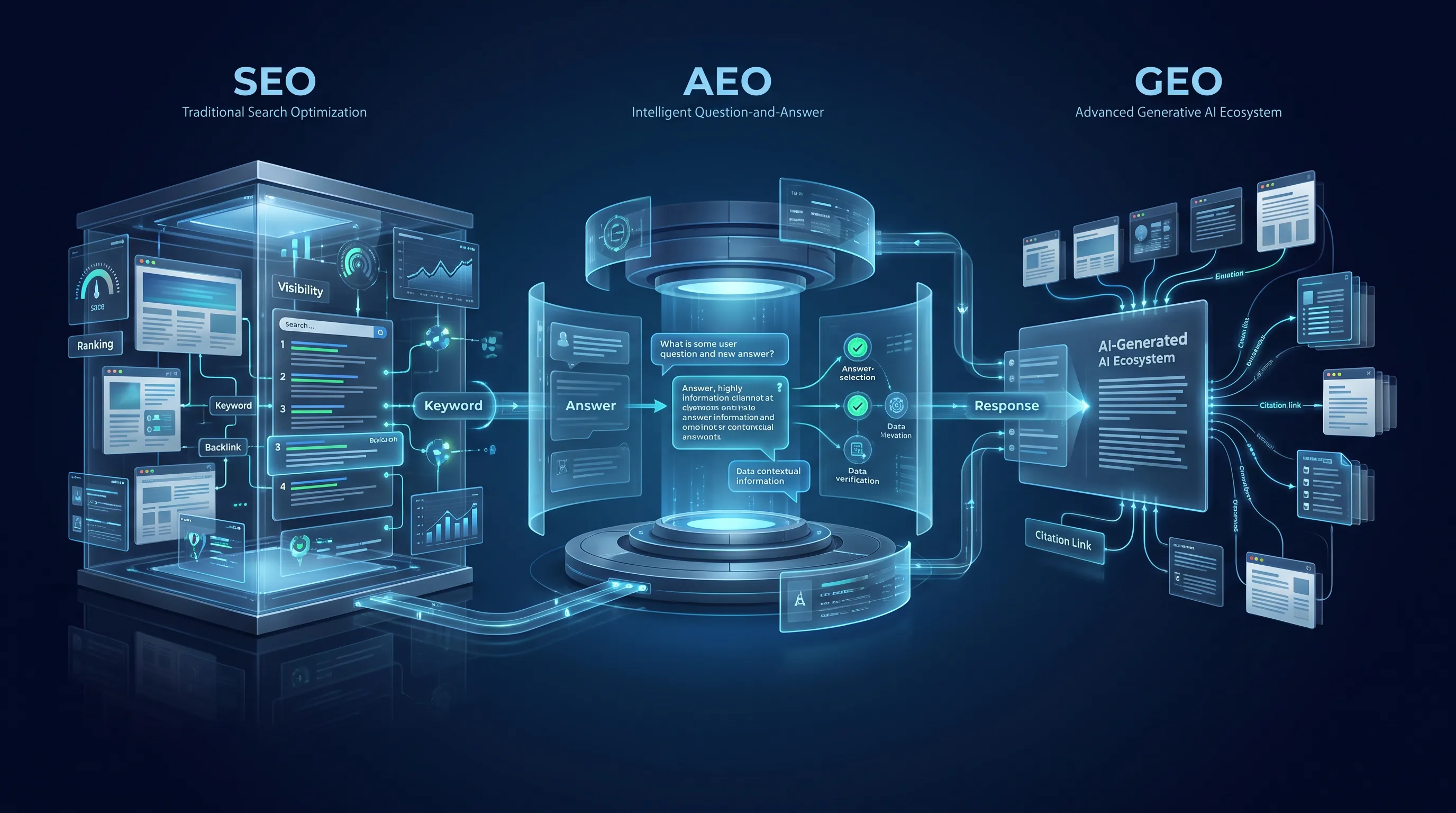
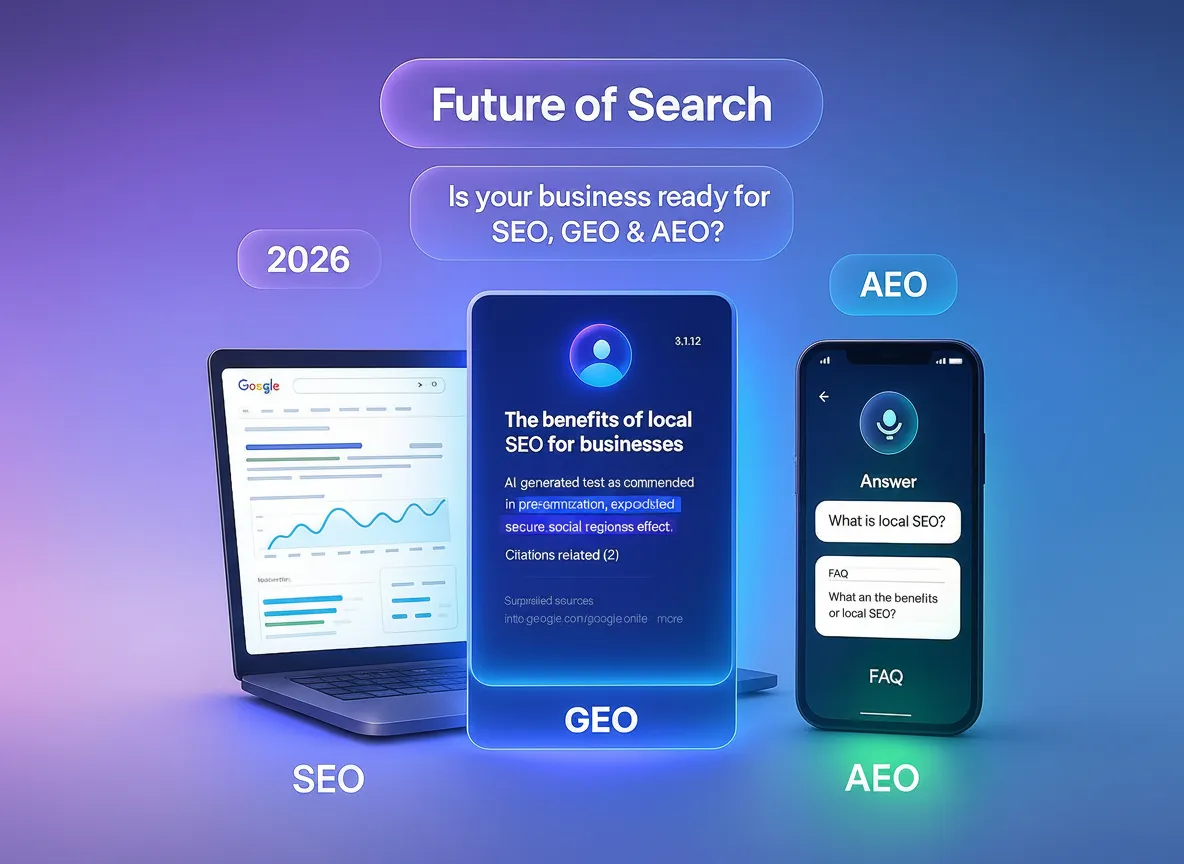
SEO, AEO, and GEO represent three distinct but connected ways to gain visibility in modern search. SEO helps websites rank on traditional search engines through keywords and backlinks. AEO, or Answer Engine Optimization, focuses on winning direct answers for voice assistants and featured snippets. GEO, or Generative Engine Optimization, prepares content for AI chatbots such as ChatGPT, Gemini, and Perplexity. In today's AI-driven search landscape, mastering all three is no longer optional. This guide explains the differences, strategies, and future trends so any reader can stay visible across every search platform.
The three pillars of modern search visibility: SEO, AEO, and GEO.
Key Takeaway
SEO, AEO, and GEO are not competitors. These three disciplines function as three legs of the same stool. Mastering all three ensures visibility everywhere search happens.
Chapter 1
What Is Traditional SEO
Traditional SEO is the practice of optimizing websites to rank higher on search engine results pages. This practice began in the late 1990s and remains the foundation of digital visibility.
Why Traditional SEO Matters
Even in 2027, billions of searches will happen on traditional engines. Strong technical SEO helps AI bots and crawlers find content easily.
Key Elements of Traditional SEO
Keyword research and natural placement
Backlinks from trusted and relevant websites
Meta titles and descriptions for each page
Fast page speed and mobile friendly design
XML sitemaps and robots.txt files for crawler guidance
💡 Insight
Traditional SEO focuses on crawlers first. Writers create content for search engines before humans. However, modern search now includes answer engines and generative AI, which require a different approach.
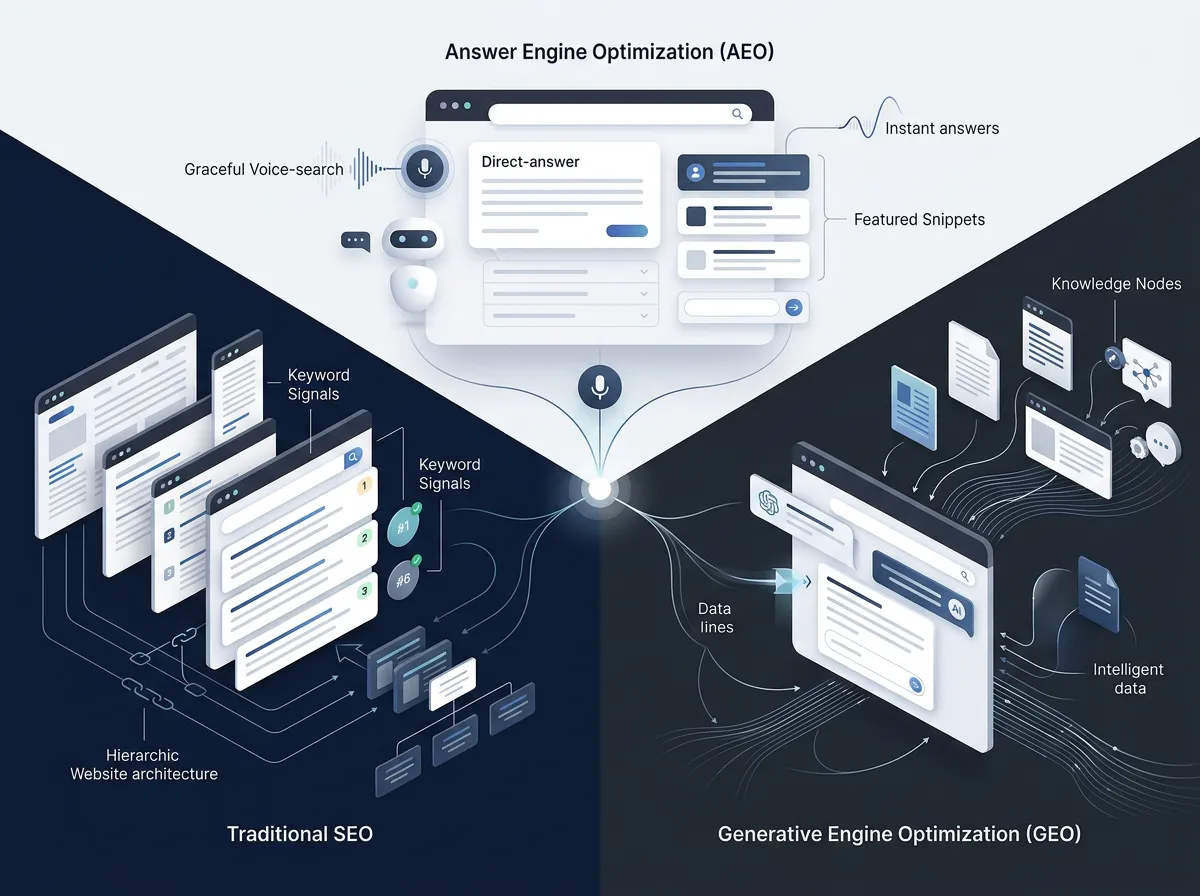
The foundational elements of traditional SEO remain critical in 2027.Chapter 2
What Is AEO (Answer Engine Optimization)
AEO means optimizing content so voice assistants and answer engines select a specific response as the single correct answer. Devices like Siri, Alexa, and Google Assistant use AEO principles for every voice search.
Why AEO Matters
More than half of all searches now end with zero clicks. Users receive their answer directly on the search page or through voice output. Without AEO optimization, these opportunities disappear completely.
How Answer Engines Extract and Display Direct Answers
Answer engines scan web pages for clear and concise responses. They search for snippets, voice ready answers, and knowledge graph data. When a user asks for a capital city, the engine finds the short name and speaks it aloud. No clicks appear. Only one answer exists.
Optimizing Content for Position Zero and Featured Snippets
Position zero is the featured box at the top of Google results. To win this spot, the answer must appear directly within the first 60 words of a page. Short sentences work best. Starting with the exact wording of the target question also helps.
Structured Data and Schema Markup for Answers
Schema markup is small code that helps engines understand page content. For AEO success, FAQ, HowTo, and Speakable schema types are most useful. A speakable schema tells voice assistants exactly which part of a page to read aloud.
Question Based Keyword Research
Every audience asks common questions. Tools like AnswerThePublic or Google's People Also Ask feature reveal these questions. A dedicated FAQ page works best. Each question appears as a heading, followed by a 40 to 55 word answer.
Measuring AEO Success
Snippet ownership tracking is possible with SEMrush or Ahrefs. Voice search CTR data appears in Google Search Console under the Questions filter.
Chapter 3
What Is GEO (Generative Engine Optimization)
GEO is the newest search optimization discipline. It focuses on making content easy for AI chatbots to find, read, and cite. When a user asks ChatGPT or Perplexity a question, GEO determines whether a specific brand appears in the generated answer.
Why GEO Matters
Generative engines now handle nearly one third of all informational searches. Without GEO optimization, a website becomes invisible to millions of potential users.
How Generative Engines Retrieve and Cite Sources
Tools like ChatGPT, Gemini, SGE, and Perplexity use retrieval augmented generation or RAG. These tools search the web, pull relevant content, and generate a fresh answer. Recent content performs best. Structured content performs best.
Entity Optimization and Semantic Density for LLM Parsing
Entities are people, places, things, or concepts. Large language models understand relationships between entities. Linking content to Wikidata, Wikipedia, and industry knowledge graphs improves entity recognition. Using synonyms and related terms naturally creates semantic density.
Formatting Content for Citation
Generative engines prefer tables, numbered lists, and clear headers. A well formatted table receives citations far more often than a long paragraph. Balanced perspectives also matter. Presenting only one side makes AI view content as biased.
Avoiding Hallucination Triggers
Hallucinations occur when AI generates false information. Content creators reduce this risk through clarity, recency, and non contradictory information. Two pages saying different things about one topic confuses AI.
Tracking GEO Performance
Citation rate tracking is available through tools like Ziptie or Frase GEO. Regular checks reveal how often a brand appears in ChatGPT and Perplexity answers.
✔ GEO Best Practice
Use tables, numbered lists, and clear headers. Present balanced perspectives. Keep content recent and non-contradictory to reduce hallucination triggers.
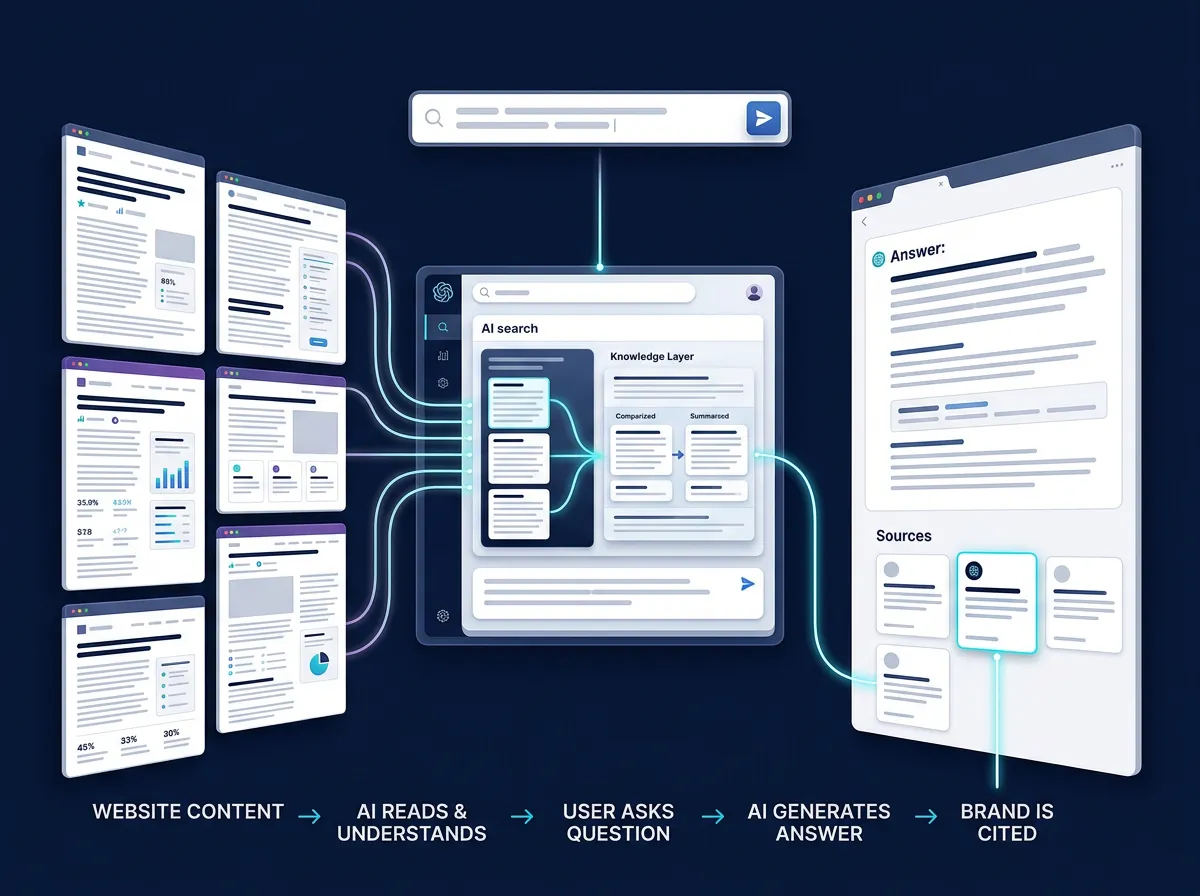
GEO ensures your brand appears in AI-generated answers from ChatGPT, Perplexity, and more.Chapter 4
AI Search Ranking Factors
AI search ranking factors differ significantly from traditional ranking factors. The following list represents the most important factors for 2027.
Entity Authority
Entity authority measures how well Google or ChatGPT recognizes a specific brand as an expert on a given topic. Building entity authority requires mentions on trusted sites like Wikipedia.
Content Freshness
AI prefers content updated within the last 60 days. A simple "Last updated" date at the top of every page satisfies this requirement.
Structured Data Usage
Schema markup helps AI understand content faster. FAQ, HowTo, Speakable, and ClaimReview schemas provide the most value.
Citation Frequency
Citation frequency tracks how often other websites cite a specific domain. Generative engines monitor this metric closely.
User Engagement Signals
Click through rates, dwell time, and bounce rates still influence rankings. AI watches how human users interact with every piece of content.
Semantic Relevance
Semantic relevance measures how completely a page covers a given topic. AI checks for related subtopics, synonyms, and natural language flow.
Chapter 5
How AI Search Engines Work
AI search engines do not simply match keywords. These tools attempt to understand meaning and intent.
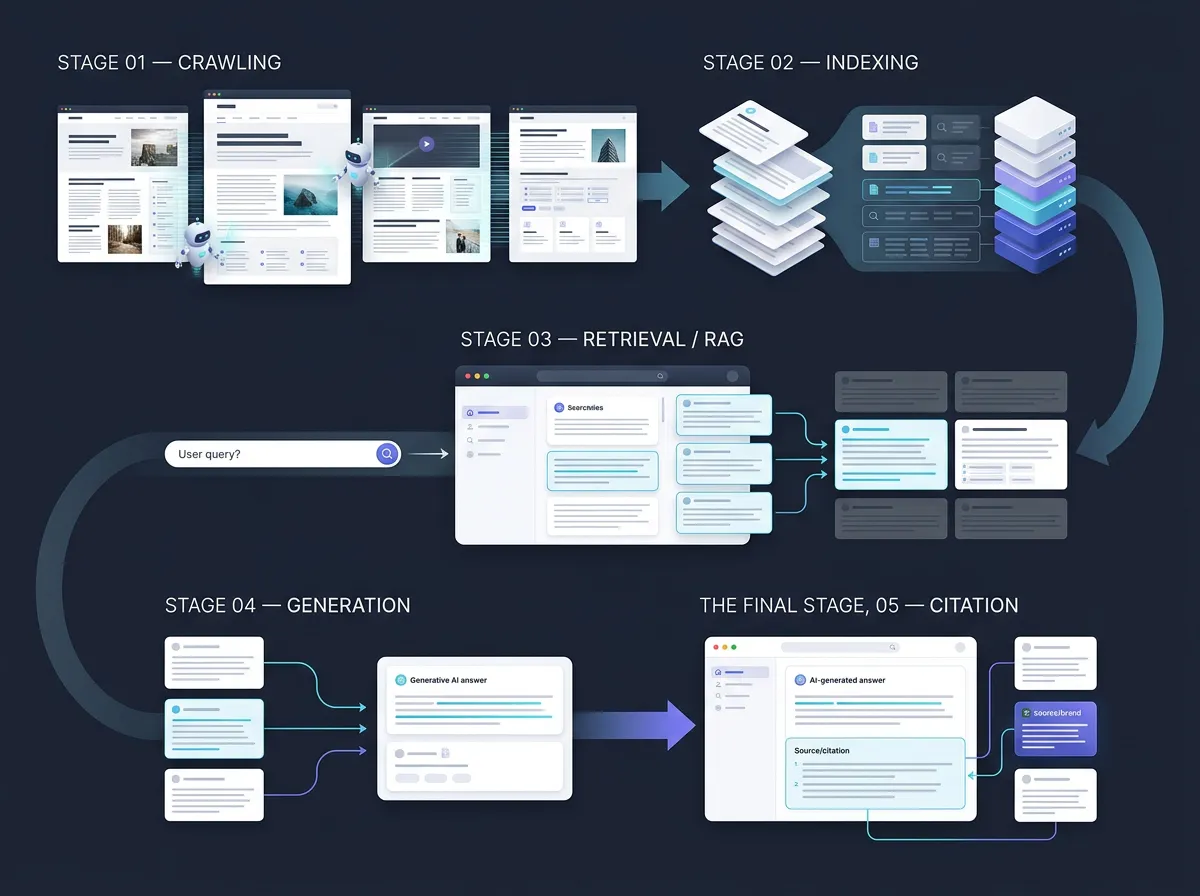
Crawling Stage
AI bots like GPTBot and Google Extended visit websites regularly. Blocking these bots removes a site from AI search results entirely.
Indexing Stage
The search engine stores content in a large database. Structured content receives faster indexing than unstructured content.
Retrieval Stage
When a user submits a query, the engine searches its database for relevant passages. This stage is called retrieval augmented generation or RAG.
Generation Stage
The engine writes a fresh answer using the retrieved passages. Information from multiple sources may combine into a single response.
Citation Stage
When content proves useful, the engine may mention a brand name or link back to the original source.
The five stages of AI search: Crawling, Indexing, Retrieval, Generation, and Citation.Chapter 6
Search Behavior in AI Driven Platforms
User behavior on AI platforms looks very different from behavior on traditional search platforms.
Traditional Search Behavior
Users type two or three keywords. They click a link and read. They may visit multiple websites before finding a satisfactory answer.
AI Chatbot Behavior
Users type full sentences and natural language questions. They expect one complete answer. They rarely click links unless the AI provides them explicitly.
Voice Assistant Behavior
Users speak conversationally without typing. They expect short and accurate answers. They never click anything because voice interfaces have no clickable elements.
Implications for Marketers
Content must optimize for all three behavior types. Conversational writing helps. Direct answers help. Deep content for readers who want to learn more also helps.
Traditional Search
Keywords typed
Click links
Visit multiple sites
Informational intent
AI Chatbot & Voice
Full sentences spoken/typed
Expect one complete answer
Zero clicks
Conversational intent
Chapter 7
ChatGPT SEO and AI Visibility
ChatGPT SEO represents a specialized subset of GEO focused specifically on OpenAI's ecosystem.
How ChatGPT Finds Content
ChatGPT search uses GPTBot to crawl the web. The system also uses custom knowledge from plugins and user interaction patterns.
Optimization Strategies for ChatGPT
Allowing GPTBot access in robots.txt is the first step
Creating an LLMs.txt file helps guide ChatGPT on how to read a site
Building a free ChatGPT plugin related to a specific niche improves visibility
Publishing API documentation provides additional value for SaaS companies
Measuring ChatGPT Visibility
Tools like ChatGPT Analytics and Perplexity Pro API provide visibility metrics. Regular tracking reveals how often a brand appears in ChatGPT responses.
★ Pro Tip
Allow GPTBot in robots.txt and create an LLMs.txt file to guide ChatGPT on how to read and understand your site's content structure.
Chapter 8
Semantic Search and Entity Optimization
Semantic search means understanding user intent instead of simply matching keywords.
What Is Semantic SEO
Semantic SEO organizes content around topics and entities rather than single keywords. For example, instead of optimizing only for "coffee," a semantic approach optimizes for types of coffee, brewing methods, and best coffee beans.
Entity Optimization Checklist
Linking to Wikidata or Wikipedia pages for key entities strengthens semantic signals
Using consistent names and descriptions across a website helps AI recognition
Adding schema markup like sameAs connects a brand to external profiles
Creating a knowledge panel page with business details completes the entity profile
Key Takeaway
Semantic SEO helps AI connect content to related topics, improving citation rates across all search platforms.
Chapter 9
Voice Search and Conversational Search
Voice search represents the clearest example of AEO in action.
Why Voice Search Continues to Grow
Smart speakers now exist in more than 40 percent of homes. People use voice for local searches, shopping tasks, and quick facts. Every voice answer produces zero clicks.
Conversational Search Optimization
Writing the way people speak produces the best results. Natural phrases like "how to fix a leaking tap" work better than formal phrases. Answers must stay under 55 words. Each answer should start with the exact wording of the potential user question.
Technical Requirements for Voice Search
Adding speakable schema to FAQ pages is mandatory
Site loading time must stay under two seconds
HTTPS encryption is required
Mobile optimization matters because most voice searches happen on phones
Chapter 10
AI Content Optimization Strategies
Creating content for AI requires a different playbook than traditional content creation.
Strategy One — Write for Extraction
AI bots scan for easy to extract information. Bullet points work well. Numbered lists work well. Tables work well. Long dense paragraphs should be avoided.
Strategy Two — Add Unique Data
Running original surveys produces unique data. Publishing case studies produces unique data. AI remembers unique data and cites it more often than generic information.
Strategy Three — Use Definitions First
Every important section should start with a clear definition. "X means this" tells the AI exactly what topic the content covers.
Strategy Four — Balance Perspectives
Presenting pros and cons helps. Presenting comparisons helps. AI prefers balanced content because balanced content reduces bias.
Strategy Five — Update Constantly
A sixty day refresh cycle works best for important content. Adding new numbers, examples, and dates keeps content relevant.
Chapter 11
Common SEO, AEO and GEO Mistakes
Avoiding these common errors preserves search visibility across all platforms.
Treating GEO like traditional keyword SEO produces poor results
Having contradictory information on different pages confuses AI
Using old or unsourced claims reduces trust signals
Universal Mistakes
Using no structured data anywhere on a site is a critical error
Having no last updated dates reduces freshness signals
Ignoring negative or comparison queries leaves traffic on the table
⚠ Critical Error
Using no structured data anywhere on a site is a critical error. Blocking AI bots removes content from AI search results entirely.
Chapter 12
Expert Tips and Views
Industry Expert Insight
"AI transforms search from a link delivery system to an answer delivery system. In 2027, winning brands do not have the most backlinks. Winning brands have the clearest and most trustworthy data. Build an entity strategy. Define who the brand is. Define what the brand knows. Define why the brand deserves credibility. Then make it easy for AI to extract that information. Never block AI bots. Being crawled means being considered. Being blocked means being invisible."
— Maria Chen, Head of AI Search at Digital Future Institute
Additional Expert Tips
Local businesses should start with AEO because voice searches for nearby services provide high value
Informational content publishers should invest in GEO because ChatGPT and Perplexity drive qualified traffic
Product pages still need traditional SEO because crawlers rely on technical signals
Chapter 13
Comparison Table — Traditional SEO vs AEO vs GEO
Comparison of Traditional SEO, AEO, and GEO across key dimensions.
Feature
Traditional SEO
AEO
GEO
Primary Goal
Ranking on SERPs
Winning voice and snippet answers
Getting cited by AI chatbots
Ranking Method
Keywords, backlinks, technical health
Direct answer accuracy, schema markup
Retrieval score, recency, structure
Search Behavior
Users click and browse
Users speak or ask for one answer
Users chat conversationally
Optimization Technique
Meta tags, internal linking, page speed
Question research, speakable schema
Tables, lists, definitions, balanced views
User Intent
Informational, navigational
Quick facts, local information
Deep explanations, comparisons
Content Structure
Long form articles over 1000 words
FAQ pages and direct answer pages
Step by step guides, tables, bullet points
AI Visibility
Low to medium
Medium with voice focus
High with chatbot citation focus
Search Experience
List of blue links
Single spoken answer
Full conversational response
Future Scope
Declining but necessary
Steady growth with voice adoption
Explosive growth with AI adoption
Key Benefit
Drives direct website traffic
Wins zero click voice traffic
Builds brand authority in AI answers
Chapter 14
Frequently Asked Questions
What is the main difference between SEO and AEO?
SEO helps a website rank in a list of links. AEO helps content become the single spoken or featured answer.
Does a brand need GEO if it already ranks on Google?
Yes. Google rankings do not guarantee visibility on ChatGPT or Perplexity. GEO specifically targets generative AI platforms.
Is traditional SEO dead in 2027?
No. Traditional SEO serves as a baseline requirement. Strong traditional SEO provides technical health, but AEO and GEO must be added on top.
How can a marketer measure GEO success?
Citation rate tracking through tools like Ziptie provides clear measurement. Regular monitoring reveals how often a brand appears in ChatGPT and Perplexity answers.
What is the most important AI search ranking factor?
Entity authority and content freshness currently rank as the top two factors for 2027.
Can a small business compete with big brands in AEO?
Yes. Voice assistants prefer short and direct answers. A small local business with clear FAQ pages often beats a large brand with generic content.
How often should content be updated for GEO?
Every sixty days is recommended. Generative engines prefer recent information and may ignore content older than six months.
Chapter 15
Conclusion — The Future of AI Powered Search
The future of search includes traditional, answer, and generative engines working together. Traditional SEO shrinks as answer engines dominate quick facts and generative engines handle complex queries. By 2028, over 70% of searches will produce zero clicks. Winning brands become trusted sources behind AI answers. SEO, AEO, and GEO work as one ecosystem. Master all three to stay visible. The future rewards clear, recent, and helpful content.
SEO, AEO, and GEO are not competitors. These three disciplines function as three legs of the same stool. Mastering all three ensures visibility everywhere search happens. The future belongs to clear content, recent content, and helpful content. Becoming all three guarantees long term search success.
The future of search is unified: SEO, AEO, and GEO working as one ecosystem.
Final Takeaway
Master SEO for technical foundations, AEO for voice and zero-click answers, and GEO for AI chatbot visibility. The future rewards clear, recent, and helpful content across all three disciplines.
About the Publisher
Digital Future Institute is a research and education organization dedicated to helping businesses and marketers navigate the evolving digital landscape. With a focus on AI-driven search, content strategy, and emerging technologies, DFI provides actionable insights for professionals worldwide.
This guide is part of the 2027 Search Visibility Series.