No part of this publication may be reproduced, distributed, or transmitted in any form or by any means, including photocopying, recording, or other electronic or mechanical methods, without the prior written permission of the publisher, except in the case of brief quotations embodied in critical reviews and certain other noncommercial uses permitted by copyright law.
Disclaimer: The information contained in this eBook is for general informational purposes only. The authors and publishers assume no responsibility for errors or omissions, or for any outcomes related to the use of this material. All strategies and recommendations are provided "as is" without warranty of any kind.
Introduction
The Age of AI Search
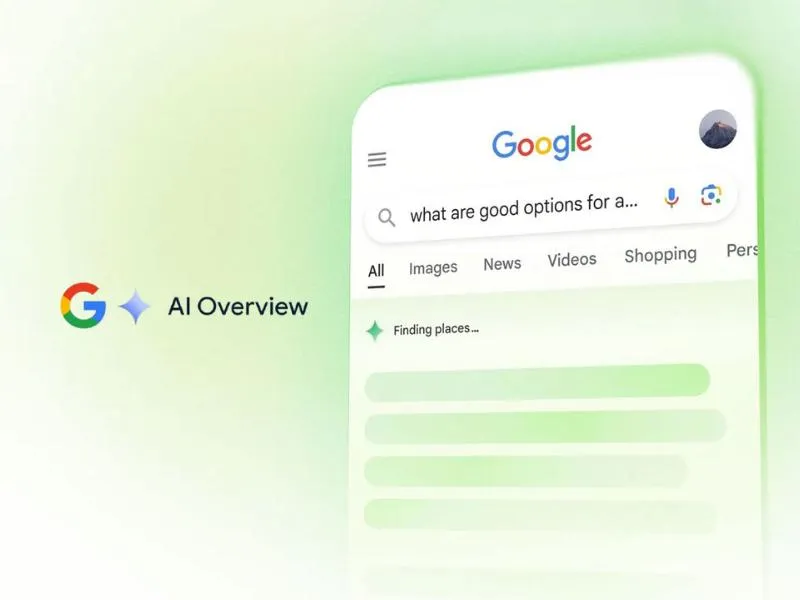
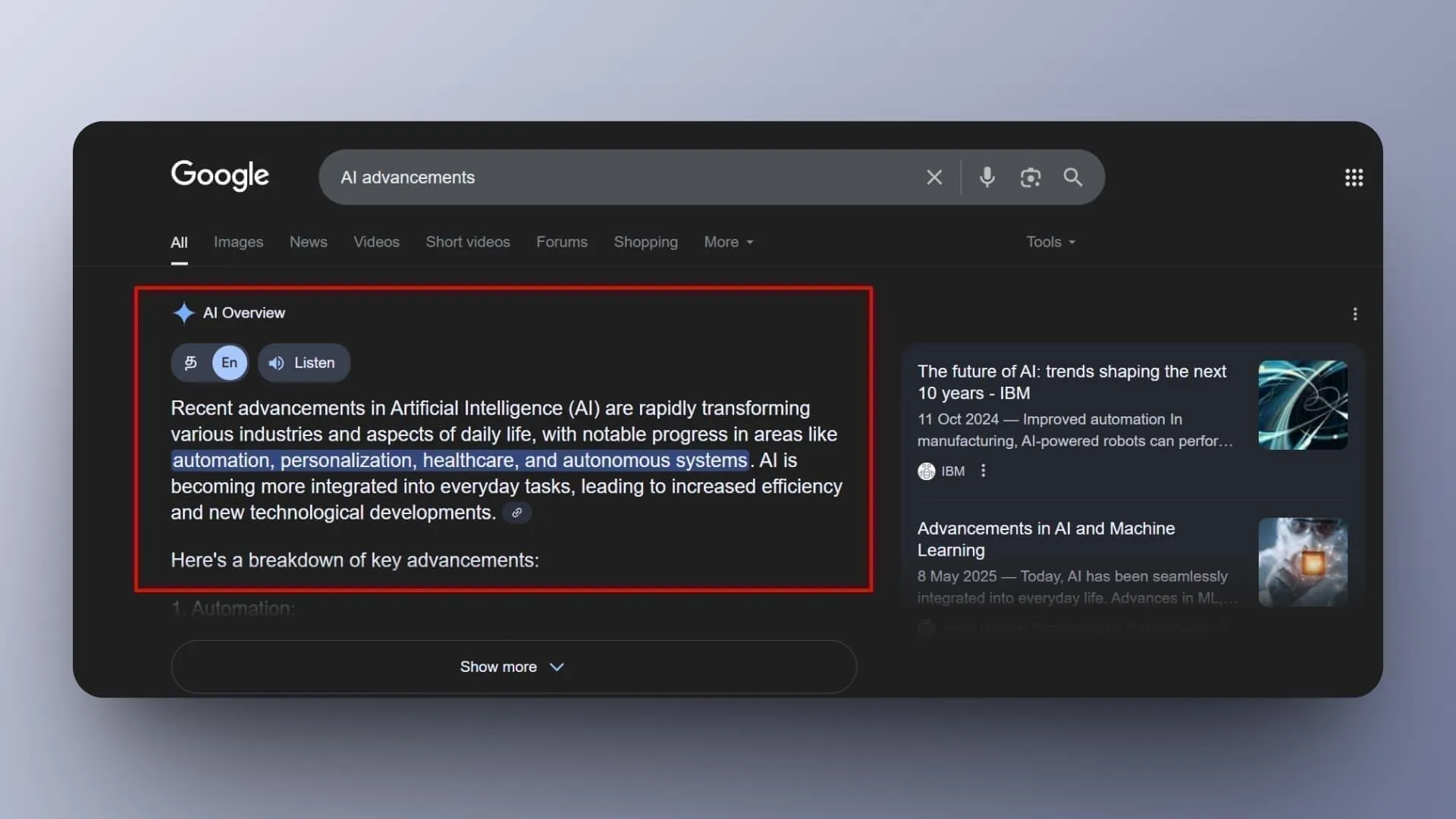
Search has changed forever. When users type queries today, Google's AI reads, interprets, and rewrites information from across the web into a single snapshot called an AI Overview. The old question "How do I rank number one?" is dead. The new question is "How do I become the source the AI trusts?"
This guide distills everything you need to know into clear, actionable insights. No fluff. Just what works.
Google AI Overviews transform search results into synthesized answers.Chapter 1
How AI Overviews Select Winners
Google's Gemini model scans hundreds of documents in seconds, identifying consensus, extracting facts, and verifying claims. The AI organizes information around entities—people, places, concepts—and their relationships. Content with clear entities, logical structure, and verifiable facts gets cited. Ambiguous jargon, meandering introductions, and outdated information get ignored.
Think of the AI as a brilliant but impatient research assistant. Give it clean, structured information and it will reward you with citations. Make it work to understand you and it will move on.
Key Takeaway
Factual density, entity clarity, structural transparency, and freshness signals determine whether your content becomes part of the AI's answer.
Chapter 2
Building Content AI Overviews Crave
Stop creating one massive guide. Start building content clusters—a central pillar page supported by 15-25 specific, question-answering nodes. This Infinite Corpus approach ensures the AI finds perfectly matched content for every angle of your topic.
Internal linking between these nodes signals that you're mapping the entire knowledge space, not just mentioning concepts. Each new article strengthens your domain's entity signature.
Key Takeaway
Create interconnected topic networks rather than sprawling single pages.
Chapter 3
The Citation Ecosystem
Appearing in the AI text is half the battle. The citation links beneath the Overview drive your traffic. The AI selects citations based on corroboration—it wants multiple credible sources confirming the same facts.
Study who's being cited for your target queries. Match their factual core while offering superior format, fresher data, or deeper insights. Position your content within the consensus neighborhood.
Citation factors and your actions
Citation Factor
What AI Evaluates
Your Action
Factual Alignment
Agreement with consensus
Match cited factual core
Format Superiority
Better structure
Use tables and clear headers
Freshness
Current data
Add last-reviewed dates
Depth Bonus
Beyond competitors
Add unique examples
Entity Consistency
Consistent naming
Standardize terminology
Chapter 4
Engineering Clicks Inside AI Answers
Getting cited wins visibility. Getting clicked wins traffic. Users click not when satisfied but when curious. If the AI provides the definition, your snippet must promise the application. If the AI gives summary, offer depth.
Your title and meta description must answer: "What does this link give me that the AI didn't already provide?"
Snippet Tips
Promise a tool or calculator the AI can't reproduce
Offer a counterpoint to the AI's consensus
Signal exclusive data not in the summary
Hint at step-by-step execution guidance
Use specific numbers implying actionable depth
⚡ Click Engineering
Users click not when satisfied but when curious. Your snippet must promise unique value the AI didn't already provide.
Chapter 5
The Psychology of the AI-Informed Click
Before AI Overviews, users clicked to discover answers. Now they already have the answer. The click is driven by value anticipation, not information need.
Visitors arriving from AI Overviews are pre-qualified. They know the basics. Skip introductory fluff and jump directly to intermediate or advanced material. These visitors show higher time on page, lower bounce rates, and stronger conversion rates.
Key Takeaway
The AI has done your qualifying for you. Treat AI-referred visitors as already partway down your funnel.
Chapter 6
Measuring What Matters When Clicks Vanish
Traditional analytics fail in the AI era. A user can receive a complete answer, act on it, and never visit your site—yet your content powered their decision.
Track brand impressions inside AI answers, not just clicks. Monitor branded search lift—when users see your brand cited, many search for you directly later. These are tangible outcomes that click metrics miss entirely.
KPIs for the AI era
KPI
What It Measures
How to Track
Mind Share
Brand presence in AI answers
Weekly manual audits
Branded Search Lift
Increase in direct brand searches
Google Search Console
AI-Assisted Conversions
Conversions with AIO in path
GA4 attribution
📈 Measure Mind Share
Track brand impressions inside AI answers, not just clicks. Branded search lift is a tangible outcome click metrics miss.
Chapter 7
Diagnosing Sudden Traffic Drops
When traffic drops after an AI Overview appears, perform a structured diagnosis before reacting.
Three Layers to Check
Ranking Layer: Has your position dropped or just the SERP layout changed?
Citation Layer: Are competitors being cited while you're excluded? What do they offer?
Intent Layer: Has the AI reclassified your query intent differently?
The most deceptive loss comes from consensus override—when the AI adopts a newer study contradicting your content. No amount of on-page tweaking helps. Only content modernization works.
Key Takeaway
Diagnose before you act. Know what broke before trying to fix it.
Chapter 8
The Tactical Recovery Playbook
Five-Step Recovery Sequence
Identify the exact AI Overview format winning your query
Audit your content against cited sources for factual gaps
Bridge vocabulary mismatches with glossary pages
Reformat content to mirror AI's preferred output modality
Resubmit URL through Search Console for re-crawling
Create glossary pages teaching the AI how your terminology connects to broader concepts. If the AI displays comparison tables and your content is prose, reformat.
Chapter 9
Building Your AI Search Command Center
Integrate multiple data streams into one source of truth: Search Console data, manual audits, brand mention monitoring, and engagement analytics.
Dashboard Essentials
Win Rate tracker for top 20 queries
AI Overview appearance frequency by intent type
Branded search volume trend line
Competitor citation presence comparison
Assisted conversion attribution
Establish a baseline: manually check your top 20 informational queries weekly. Track brand appearance percentage over time.
Key Takeaway
Manual audits remain essential. Automation cannot replace human verification.
Chapter 10
Common Mistakes to Avoid
Ranking Mistakes
Treating AI Overviews as temporary. They're permanent. Waiting cedes citation territory to competitors.
Optimizing exclusively for blue-link rankings ignores AI's unique criteria.
Creating one massive page instead of clusters frustrates AI's need for modular answers.
Writing long introductions before stating facts fails the rapid extraction test.
Using jargon without definition makes content semantically invisible.
Publishing outlier claims without corroboration prevents triangulation.
Assuming Domain Authority guarantees citation—alignment matters more.
Ignoring format alignment with cited competitors creates mismatch.
Letting content go stale signals irrelevance.
Failing to update when consensus shifts ensures exclusion.
CTR Mistakes
Using generic titles like "Complete Guide" adds no value beyond the AI answer.
Repeating information the AI summarized gives no reason to click.
Forgetting to update meta descriptions for post-AI value proposition misses opportunities.
Competing on information when you should compete on application is a losing battle.
Ignoring rich snippets like video and FAQ schema misses visual opportunities.
Serving AI-referred visitors the same page wastes their qualified attention.
Recovery Mistakes
Panic-deleting content without diagnosis risks destroying salvageable work.
Assuming traffic drop means a penalty ignores that it's a SERP layout change.
Ignoring SERP reformatting means fixing wrong problems.
Fighting the new consensus instead of aligning guarantees exclusion.
Neglecting competitor citation analysis means guessing.
Expecting instant re-inclusion—allow weeks for re-crawling.
Recovering one query while creating semantic gaps for others narrows your footprint.
Reporting Mistakes
Relying solely on click data misses brand impressions and assisted conversions.
Treating optimization as one-time ignores model evolution and competitor adaptation.
Strategic Mistakes
Optimizing for AI at expense of human readability produces sterile content.
Ignoring ChatGPT and Perplexity limits reach.
Assuming today's tactics work forever is dangerous.
Measuring volume instead of engagement quality misses the real story.
⚠ Critical Error
Treating AI Overviews as temporary is a critical error. They're permanent. Waiting cedes citation territory to competitors.
Chapter 11
Conclusion: The Path Forward
The journey to AI Overview mastery is not about mastering a single checklist. It is about embracing a fundamental shift in how we think about content, visibility, and value creation in the search ecosystem. The brands that will dominate the coming decade are not those with the most backlinks or the highest domain authority. They are the brands that become indispensable sources of truth for the machines that answer the world's questions.
Embrace Content Respiration
Content must breathe—inhaling new data and exhaling outdated claims. Every piece of content should carry visible freshness signals: last-reviewed dates, version numbers, and explicit sourcing. When an AI model scans your page, it should immediately recognize that your information is current, verified, and transparent about its origins. This reduces what we call epistemic risk—lowering the AI's uncertainty about whether your content can be trusted as a source.
Build Trust Through Consistency
The ultimate goal of long-term search mastery is to build a reputation not just with users, but with the AI systems that serve them. When your domain becomes known to the AI as a consistently reliable, well-structured, and up-to-date source, you transcend individual algorithm updates. You become part of the AI's trusted knowledge foundation. That is the highest form of search visibility in the age of AI.
Stay Adaptable and Vigilant
The AI search landscape will continue to evolve. New models will emerge. User expectations will shift. What works today may need adjustment tomorrow. The most successful practitioners will be those who treat this as an ongoing relationship with the AI ecosystem, not a one-time optimization project.
Your Resilience Checklist
Refresh factual claims across all core content quarterly
Monitor AI model update announcements for shifts in ranking behavior
Diversify content formats to match evolving AI output preferences
Build direct audience relationships that transcend any single search platform
Treat AI systems as ongoing research partners requiring consistent feeding
Audit competitor citation presence monthly to track relative visibility shifts
Maintain a balance between AI optimization and genuine human readability
Measure success through mind share and brand lift, not just clicks
The future belongs to brands that become indispensable sources of truth for AI.FAQ
Frequently Asked Questions
How long before I see results from AI Overview optimization?
Allow four to eight weeks for re-crawling and re-evaluation after implementing changes.
Should I delete pages that lost traffic?
Never delete without diagnosis. Often a format or freshness update is sufficient to recover visibility.
How often should I update AI-optimized content?
Review core content quarterly and refresh facts, dates, and examples as needed.
Is Domain Authority still important?
Yes, but the AI weighs factual alignment and format quality alongside traditional authority signals.
Can smaller sites compete with industry giants?
Yes. The AI favors factual alignment and format quality over domain size, enabling smaller sites to earn citations.
Does appearing in AI Overviews guarantee clicks?
No. Citation earns visibility, but compelling snippets that promise unique value earn the clicks.
How do I know if AI Overviews are hurting my traffic?
Compare impression volume, position changes, and brand search trends before and after AI Overview appearance. A drop in clicks with stable impressions often indicates AI Overview displacement rather than a ranking penalty.
What's the fastest way to get cited in AI Overviews?
Audit currently cited sources, match their factual core, and improve format quality with tables, lists, and clear headers.
Should I write differently for AI and humans?
No. Write clearly for both. AI prefers the same clarity, structure, and value that human readers appreciate.
Will AI Overviews replace search entirely?
They complement rather than replace search. Users still click for depth, tools, templates, and execution guidance that AI summaries cannot provide.
How can I track if my brand appears in AI Overviews?
Perform weekly manual audits of your top 20 informational queries. Search them and note whether your brand appears in the AI text or citation links.
What content formats work best for AI Overview citation?
Comparison tables, step-by-step guides, structured lists, and content with clear heading hierarchies perform best.
The Bottom Line
The Bottom Line
Avoid the mistakes catalogued in this guide. Implement the frameworks consistently. Stay adaptable to change. The future of search belongs to those who earn the AI's trust through accuracy, clarity, freshness, and genuine value. When you become an indispensable source for the machines answering the world's questions, you secure your place in the AI-driven search landscape.
The shift from blue links to AI Overviews is not a disruption to fear. It is an opportunity to rise above the noise and become a recognized authority. Those who adapt today will lead tomorrow. Start now. The AI is watching, and it rewards those who earn its trust.
Final Takeaway
The shift from blue links to AI Overviews is an opportunity to rise above the noise. Adapt today, lead tomorrow. The AI rewards those who earn its trust.
About the Publisher
AI Search Mastery Series is a dedicated publishing initiative focused on equipping digital professionals with the knowledge and strategies needed to thrive in the AI-driven search landscape. Through concise, actionable guides, the series demystifies complex topics like generative engine optimization, entity SEO, and AI Overviews, helping brands earn visibility in the age of AI.
This guide is part of the 2027 AI Search Mastery Series.